This recipe developed fortuitously, evolving from a couple of my recent recipe posts, combined with the season and some recent reading. Here are the inspirations:
– Like many cuisines with a long history, many traditional Italian dishes were born from the need to use up the food that one had on hand. In Italy, this cuisine is referred to as cuisina povera, the ‘cuisine of the poor’. In this simple style of cooking, you work with what you have already; in your pantry, in your yard, what was left over from your last meal.
Leftover pork belly from my last post, a slow braised pork belly in apple cider. A perfect opportunity to apply cuisina povera.
– Articles and blog posts on foraging in Italy. Judy Witt Francini, owner of Davina Cucina cooking school in Tuscany recently blogged about discovering wild asparagus. In a winter 2012 article, “Finding the High Ground in Alto Adige”, La Cucina Italiana shares how local chefs gather wild herbs such as dandelion and pine to flavor their modern versions of traditional foods. We forage ourselves a bit on our Italiaoutdoors Food and Wine culinary bike tours, using bay, basil and rosemary, even wild fennel we stop and harvest while riding. And, of course, we will never turn down fresh figs offered from a friendly farmer!
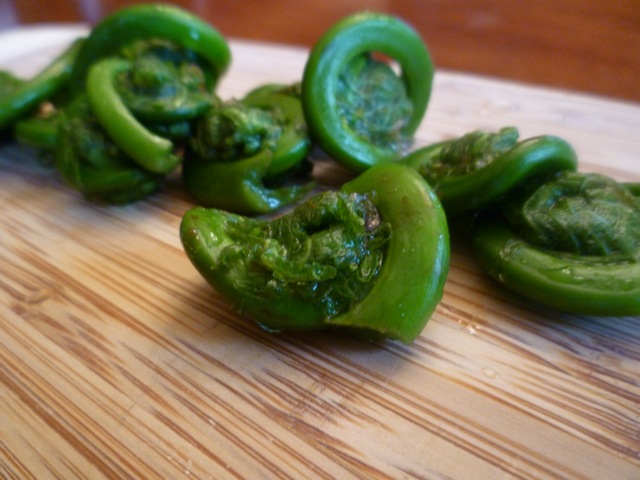
Fiddleheads
– Here in Maine, we are seeing the first of our locally foraged seasonal favorites, fiddleheads. One of the singular delicacies of the spring season here in New England, fiddleheads grow wild in moist, mossy areas. Fiddleheads are the young leaves of the ostrich ferns that have not yet opened. Once they have opened, fern leaves are poisonous, so they can only be used when young and curled up, resembling the scrolled top of a violin. Their taste resembles the flavors of both artichokes and asparagus. And if anyone can educate me as to the proper Italian word for ‘fiddleheads’, please do!
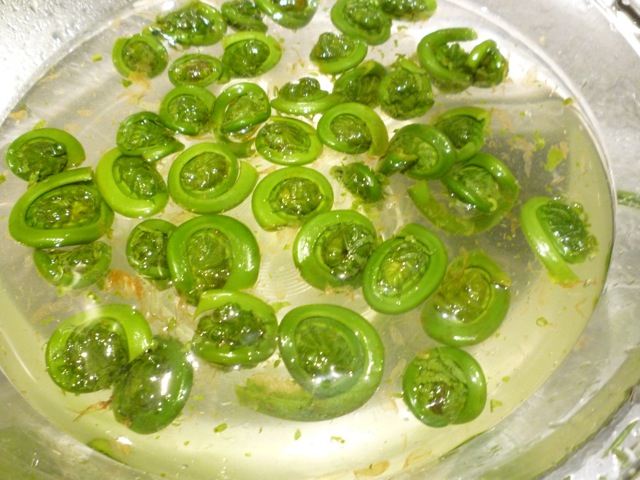
Cleaning fiddleheads
– My recent posting on Pasta alla Carbonara, a prime example of cuisina povera, a simple dish made by woodcutters while cutting wood deep in the forests of Italy. While fiddleheads aren’t indigenous to Italy, one can imagine that if they were, they might well have found their way into a dish such as this.
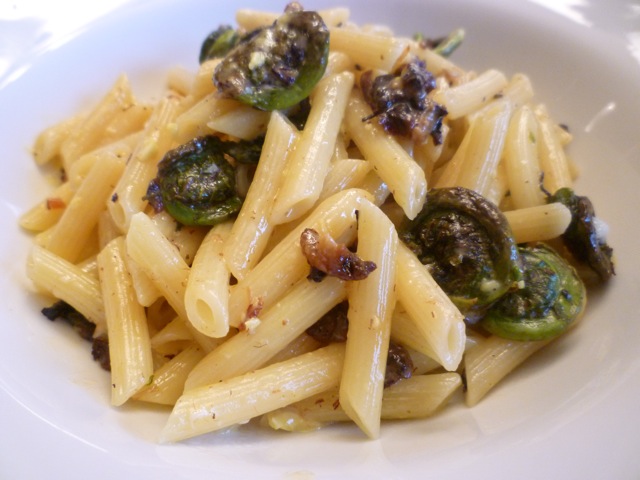
So here is the end result, a very tasty adaptation of Pasta alla Carbonara, designed to use up the foods I had on hand – pork belly and fiddleheads.
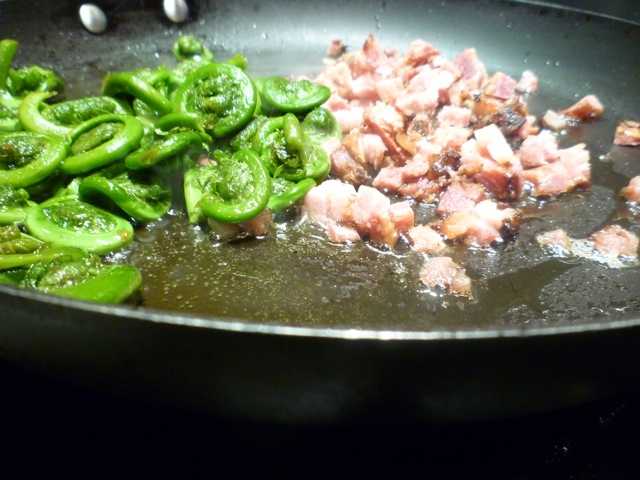
Sauteing pork belly and fiddleheads
Pasta con Pancetta Fresca e Fiddleheads
Serves 4
2 tablespoons extra virgin olive oil
1/4 pound leftover cooked pork belly, chopped into 1/2 inch dice. Substitute pancetta, guanciale, or bacon.
12 ounces fresh fiddleheads, end cut off and soaked in water to remove brown
1 pound of your favorite pasta; spaghetti, fettucini, penne
4 eggs
Freshly ground black pepper
1/2 cup freshly grated pecorino or parmigiano reggiano cheese
Bring a large pot of water to a boil over high heat.
Heat the olive oil in a large skillet over medium-high heat. Add the pork belly and fiddleheads. Cook until fiddleheads are tender and the pork belly has rendered most of its remaining fat. Remove from heat.
When the water is boiling, salt the water. Add the pasta and cook until just al dente.
While the pasta is cooking, place the eggs in a small bowl and whisk until combined.
Drain the pasta, and place the pasta back into the pot. Add the pork belly and fiddlehead mixture. Pour in the eggs and add the grated cheese. Stir until the pasta is thoroughly combined with the rest of the ingredients. Season liberally with freshly ground black pepper, and serve.
I enjoy a lighter bodied red, but with enough acidity to stand up to the fat in the pork belly. A Lagrein from Convento Muri-Gries in Bolzano would fit the bill nicely!
Last June, we welcomed James Beard Award winner Susan Regis as a Master Guest Chef on our Chefs on Bikes tour in Italy. One of the dishes we cooked with her was a braised pork belly. We did have a challenge locating this in the markets in Italy, but it was certainly easier than finding it here in the US! In Italy, fresh pork belly is often sold as pancetta, and not well differentiated from cured pancetta, which is cured and ready to eat. We learned we wanted pancetta fresca – fresh pancetta.
Cured pancetta is fairly easy to find here in the US, but I’ve always seen it sold rolled up into a cylinder and sliced. In Italy, you can find it both rolled and flat, the latter looking more like fresh pork belly than the pancetta I am familiar with. Fresh pork belly, pancetta fresca, is available in grocers and markets in Italy, most frequently in the winter months.
I’ve been itching to play with this recipe since our visit last June, but had real difficulty locating fresh pork belly here in New England. I can order it, but never quite seem to get my act together. Finally, my local farm stand in Massachusetts, Tendercrop Farm in Newbury, MA, was selling a smoked pork belly. Tendercrop Farm raises their own cows, chickens, and pigs, and I purchase their locally raised meats every chance I can get. I use their bacon on a regular basis, and was quite excited to find them selling their own pork belly.
I was cooking this yesterday, when my 16-year old son Liam asked what was for dinner. “Pork belly”, I answered. He expressed skepticism as to whether he would like it, making a face and saying something like “Doesn’t sound too good to me.” His enthusiasm increased when I explained that they made bacon out of pork belly, as bacon is definitely a favorite. When I served this last night, his comment was “Mom, make this meat again. A lot.”
Pork belly needs a long cooking time, allowing the fat to render down. Italian recipes for pancetta fresca slather the belly with herbs and other seasoning, and then slow roast or braise. Susan had her own seasoning mix, which I include below. In my version, I include a seasoning mix more reflective of the cuisine of Northeast Italy, using juniper berries and apple cider as the braising liquid. Trentino-Alto Adige, Friuli-Venezia Giulia and the Veneto are all big producers of apples and apple products such as cider.
During the class itself, Susan created a ‘gastrique’ sauce to accompany the pork. A gastrique is a classic French sauce made from fruit and vinegar; she wanted something acidic to help counter the fat in the belly. Here, I’ve created something similar with the defatted braising liquids (fruity apple cider), by adding balsamic vinegar and a bit of grappa.
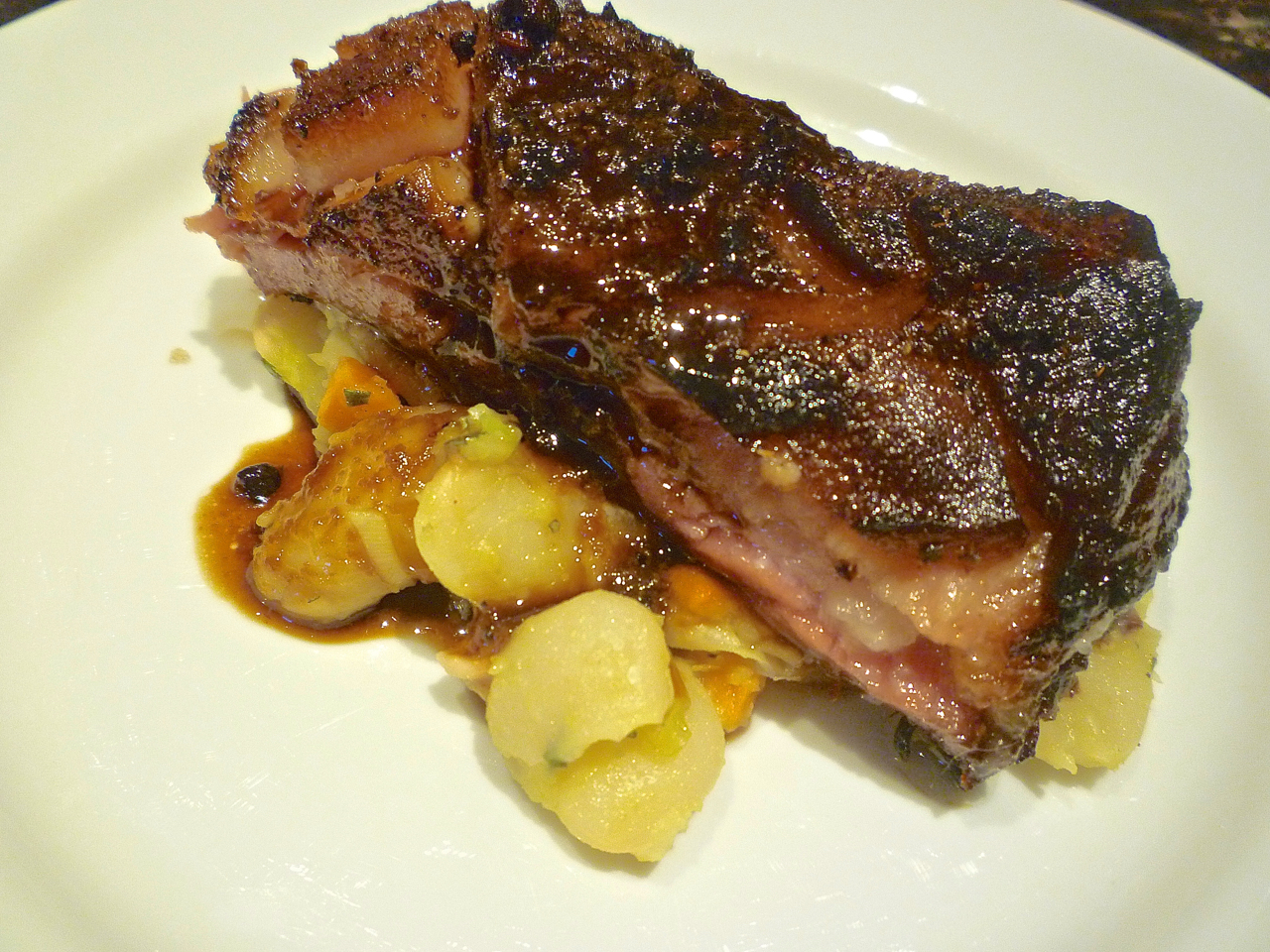
Pancetta di Maiale Fresca con Cidro di Mele e Bacche di Ginepro
Serves 4
2 1/2- 3 pounds fresh or smoked pork belly
4 tablespoons kosher salt
2 tablespoons brown sugar
1 cinnamon stick, gently broken
1 tablespoon juniper berries, coarsely ground
4 cloves garlic, smashed with your knife
2 bay leaves
1/2 sliced onion
2 cups apple cider
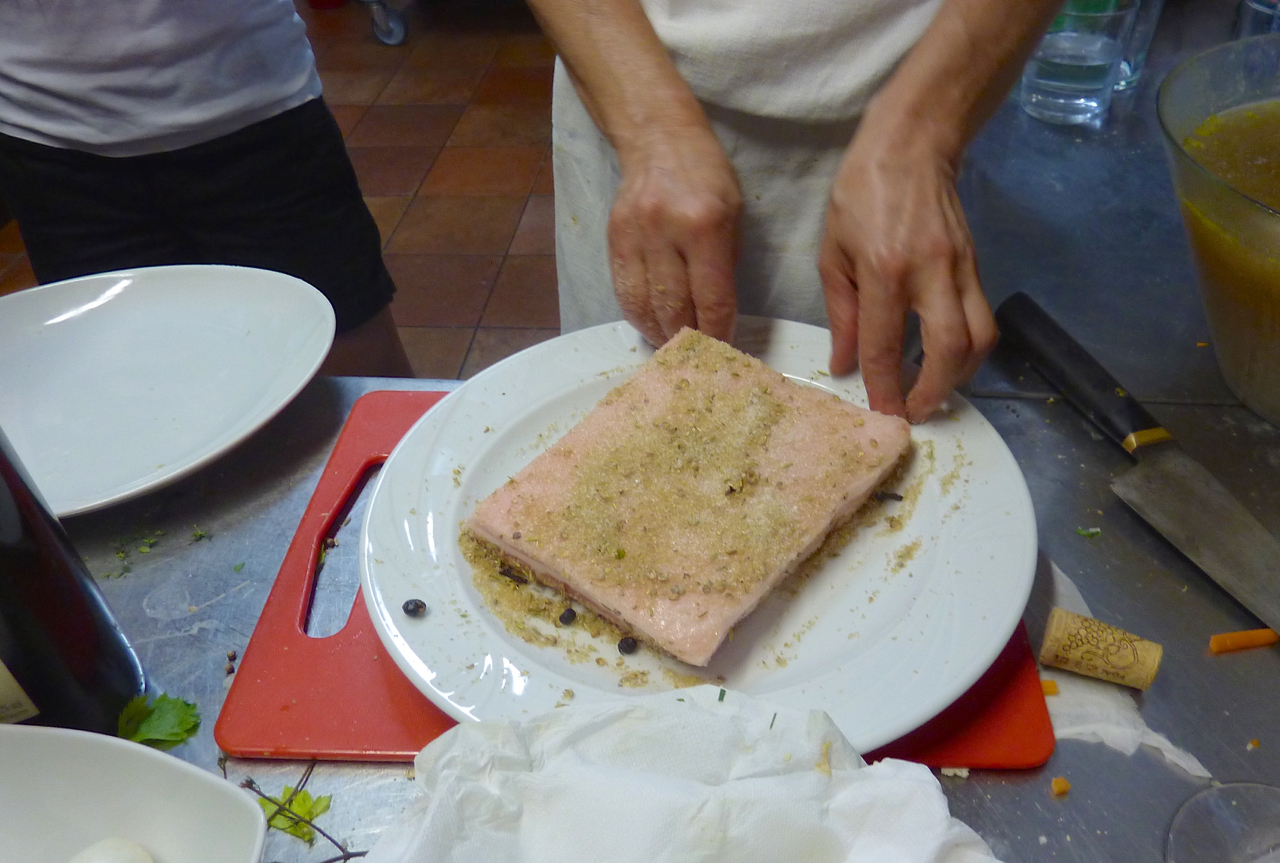
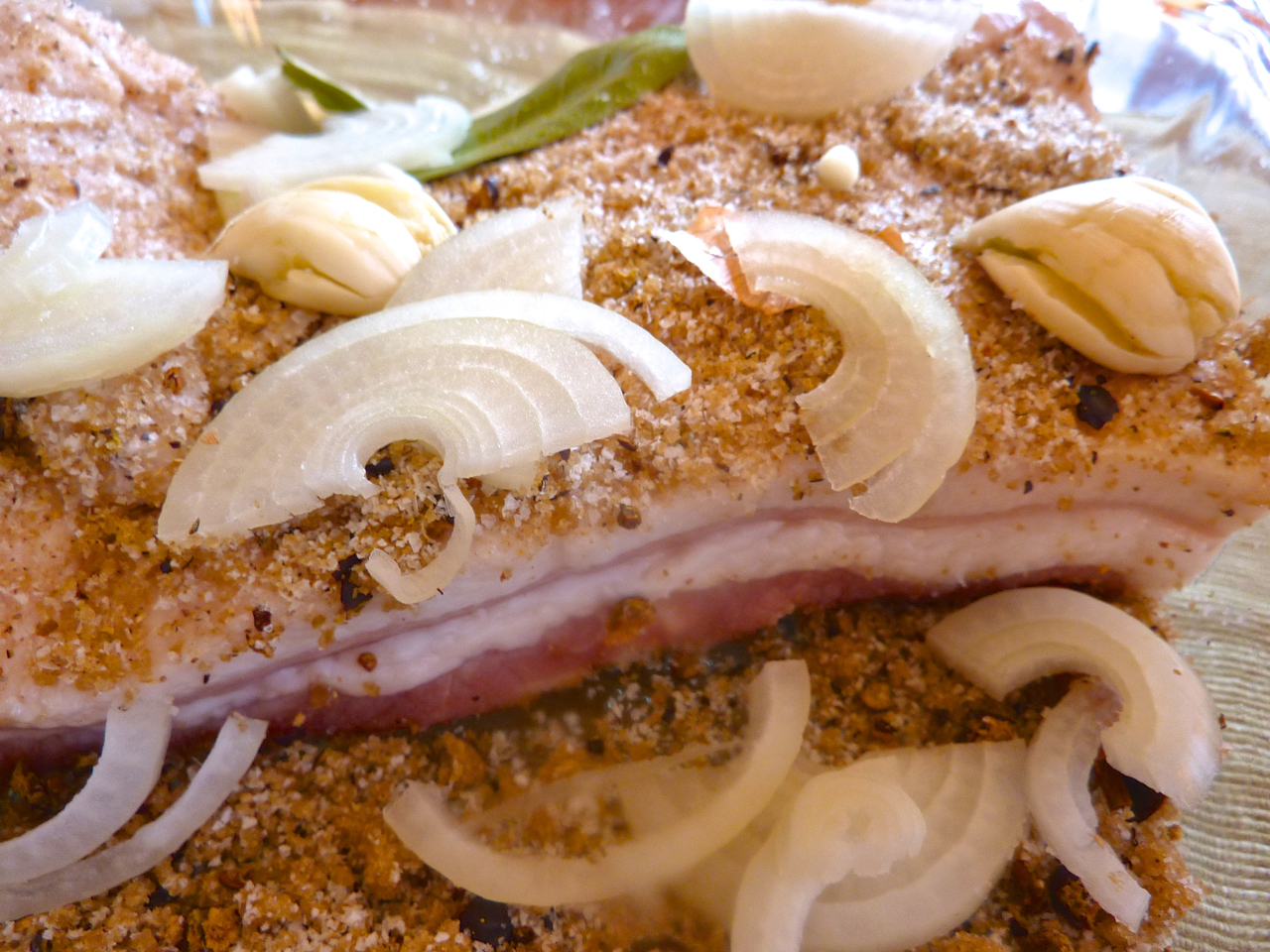
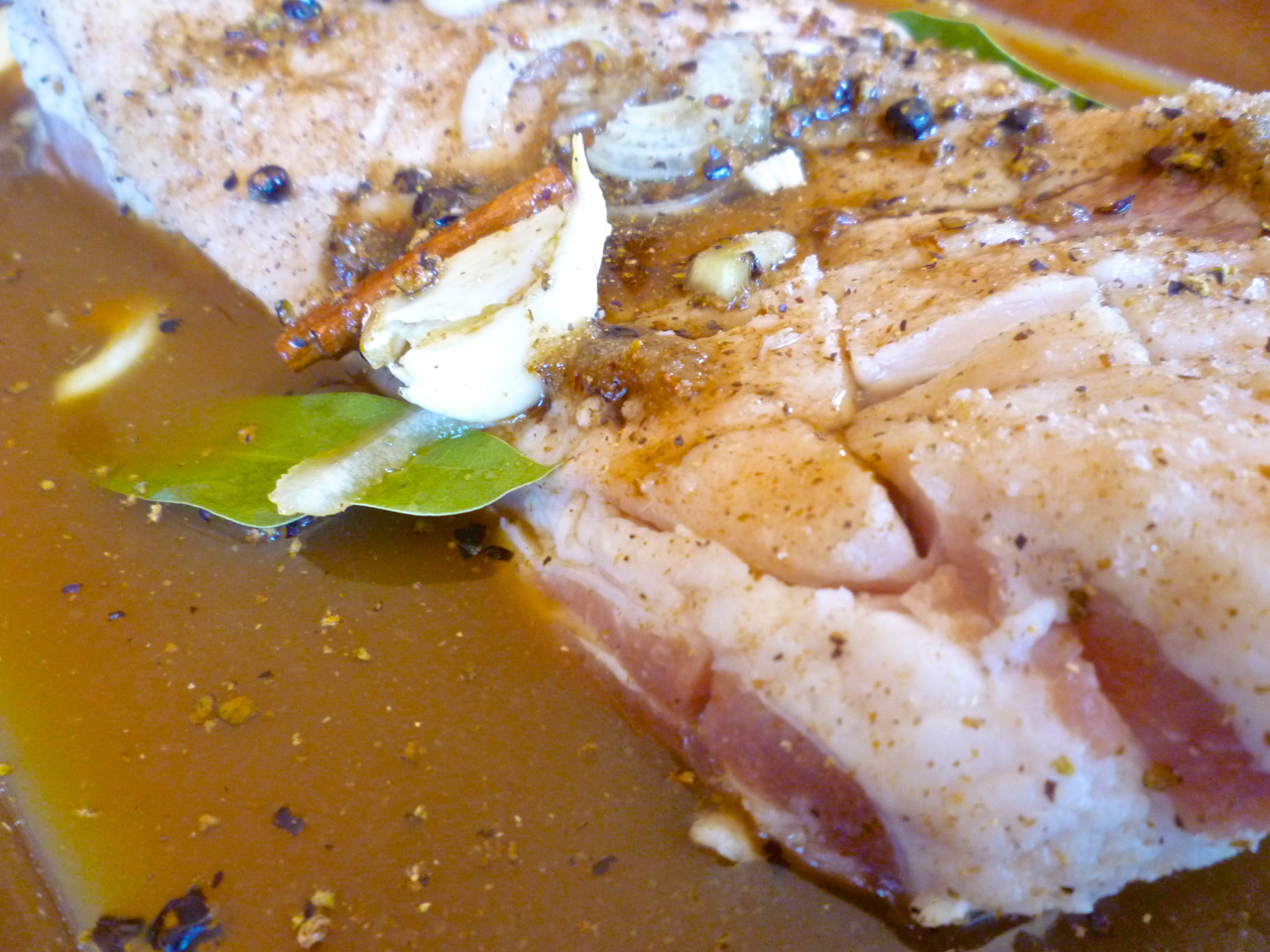
Combine salt, sugar and spices in a small bowl. Score the pork belly by slicing through the fat in a diagonal pattern (see photos above). Place belly in a shallow roasting pan. Add spice mixture and rub all over belly. Turn the belly so the fatty side is facing up. Add garlic, bay leaf, and onion. Cover and refrigerate for 18-24 hours.
Preheat oven to 325°.
Remove the belly from the refrigerator and add enough liquid to cover 3/4 of the belly. Wrap tightly with aluminum foil and place in the preheated oven. Braise until tender, about 4-5 hours. Remove from oven, and transfer belly to a sheet pan. Turn the oven up to 425°.
Pour the liquid from the roasting pan into a heatproof measuring cup. Pour off as much of the fat as you can; this will probably be most of the liquid. The liquids that are not fat are a cloudy brown, and will sink to the bottom. Pour the defatted braising juices into a small saucepan. Add the vinegar and grappa. Heat until warm, and adjust the seasoning. Keep warm while to you finish off the belly.
Place the pork belly back in the roasting pan. Do not cover, and place back in the oven. When warmed through and slightly caramelized on top, remove. If the caramelization is taking a while, you can sit it under the broiler for a minute or so. Cut into 4 pieces, and serve with the warm sauce.
Susan Regis Spice Mix
4 tablespoons kosher salt
2 tablespoons sugar
1 cinnamon stick-gently broken up with your knife
1 piece star anise
1/2 tsp fennel seeds-coarsely ground
1/2 tsp coriander seeds-coarsely ground
This dish needs a strong, acidic red to stand up to the fat – a nice Lagrein from Alto Adige, like those made by Cantina Convento Muri-Gries, would be a great choice.
It’s hard to find someone who doesn’t love a great pizza. With the endless array of possible toppings, you can find something for just about any palate, from the most adventurous of eaters to the pickiest of youngsters. Pizza ‘like’ dishes – a flatbread with some sort of topping – can be found in many cuisines, Greek, Persian, Egyptian. The modern ‘Italian’ style pizza, originated in Naples, where the daring Neopolitans topped flatbread with the latest fruit that had just arrived from the New World – the tomato. Most Europeans were reluctant to try it, fearing it was poisonous. Once the aversion to the tomato passed, this dish became increasingly popular, first with the poorer classes, but eventually reaching the tables of royalty.
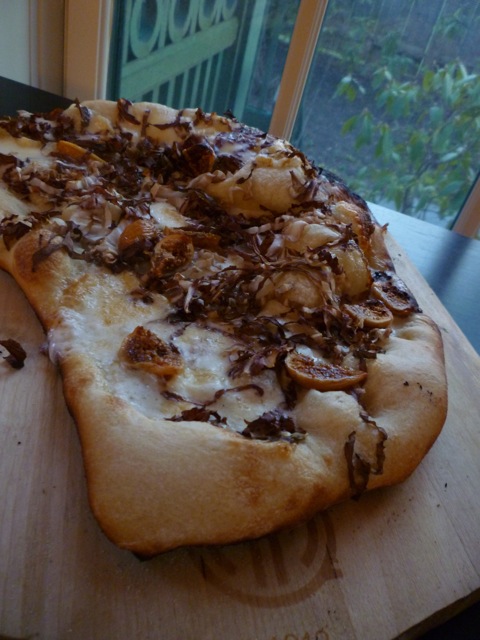
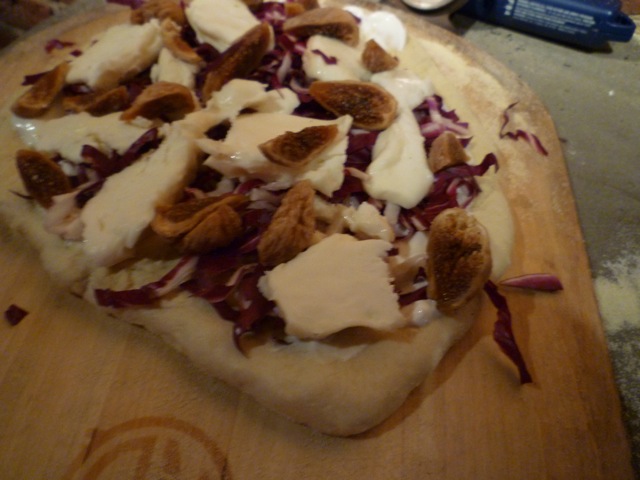
Radicchio and Fig Pizza with Taleggio Cheese and Honey
In 1889, the King and Queen of Italy, Umberto I and Margherita di Savoia, visited Naples and wanted to try the pizzas made by a famous local pizzaiolo (pizza maker), named Raffaele Esposito. He prepared several kinds for them, and the Queen especially liked one with basil, tomatoes and mozzarella; Esposito had created this one to commemorate the Italian flag. This pizza is still known today as Pizza Margherita. Now, pizza is found on tables all over Italy, and we made our own there during our Chefs on Bikes tour with Master Guest Chef Susan Regis.
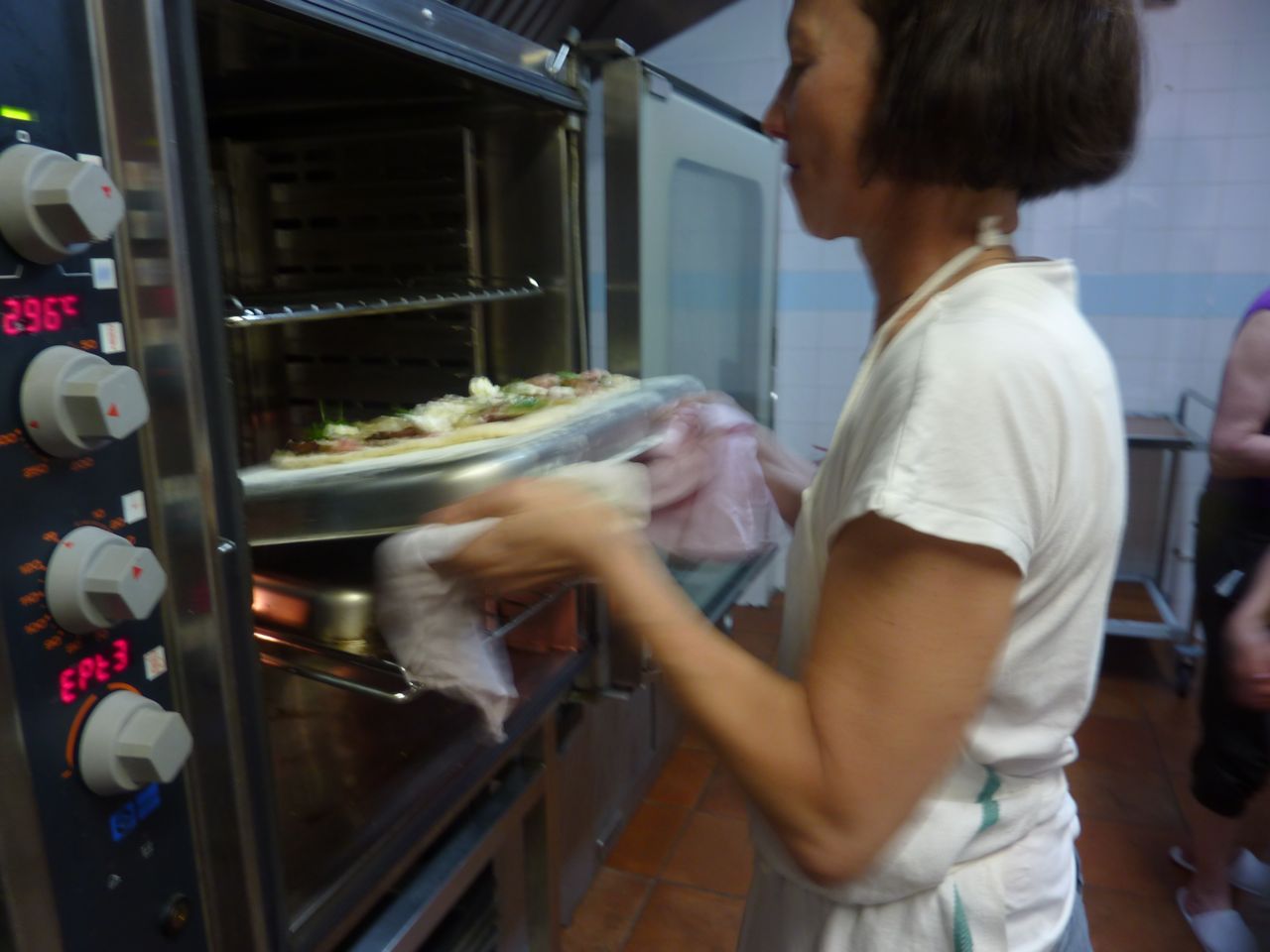
Susan Regis putting pizza in oven
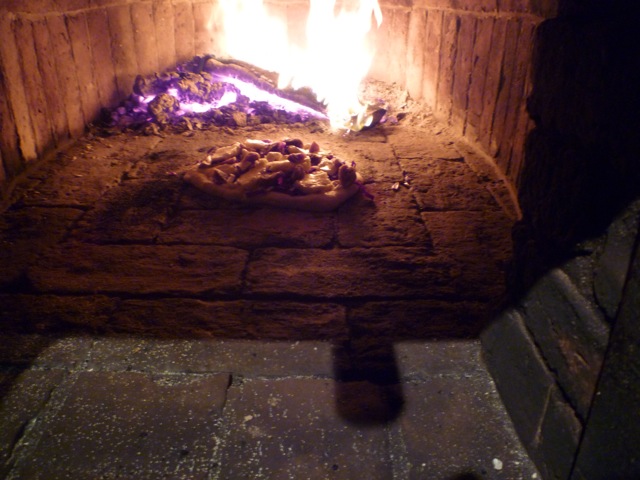
But the toppings are the easy part. What makes or breaks a great pizza is the crust. As I have a cooking class coming up in which we’ll be making pizzas in a wonderful wood fired oven, I’ve been researching – and trying – various pizza doughs, to find one that has great flavor, thin crust, crispy; and one that is pretty straightforward to produce and handles well. I’ve come across many a recipe, and have cooked pizzas with both Jody Adams and Susan Regis, two very well-know Boston area chefs who have wonderful pizzas on their menus. Each has their own dough recipe, with some similarities, and some differences. I’ve included a variation of each below, and offer my findings as to what makes the best ‘home’ pizzas.
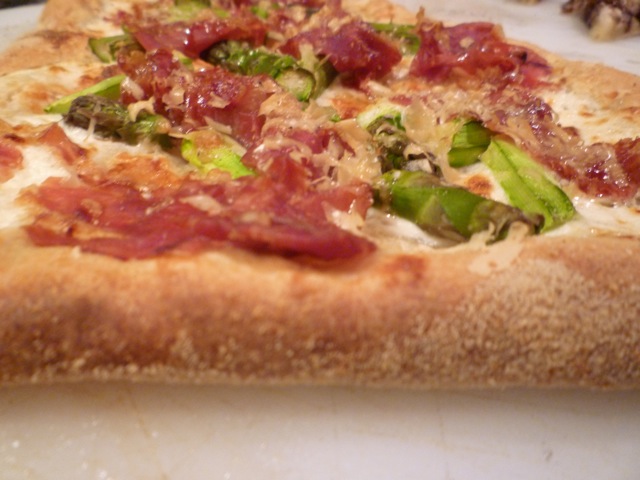
Asparagus and prosciutto - with nice crust!
The Keys to your Best Home Pizza
1. Whatever crust recipe you use, an extended overnight rise is the key to a flavorful crust. Both Jody and Susan recommend this; so does Peter Reinhardt, leader in the artisanal bread movement, instructor at Johnson & Wales, and author of several books, including American Pie: My Search for the Perfect Pizza. In fact, to quote Peter:
“The single biggest flaw in most pizza dough recipes is the failure to instruct the maker to allow the dough to rest overnight in the refrigerator (or at least for a long time). This gives the enzymes time to go to work, pulling out subtle flavor trapped in the starch. The long rest also relaxes the gluten, allowing you to shape the dough easily, “
2. Of course, a wood-fired home oven is best. But lacking this, a pizza stone in your oven is an adequate substitute. Crank up the heat. When I cook in a brick oven, 500° to 550° or so works well, and I set my conventional oven at this temperature. Allow it sufficient time to preheat and come to this high temp, at least 45 minutes.
Preheating the oven
3. Which flour to use? This is something for you to play with, and discover your own preference. But here’s what I’ve learned in my reading and experimenting.
Unbleached flour is a given – this delivers the best flavor. Susan uses high-gluten flour; this dough will have a little more ‘tolerance’, and will hold together better during handling. However, it will be a bit more elastic and can fight you a bit as you shape it. Giving it plenty of rest, and adding a bit of olive oil to the dough can help. Susan also adds semolina flour to her dough, which gives it a nice rustic texture. You could also try adding a bit of whole wheat flour if you wish. The finished crust here will be a little chewy, due to the higher gluten content and the semolina.
Jody uses only all-purpose flour. This flour is less ‘hard’ (contains less protein), and will result in a crust with a little softer chew. The dough will be a bit more prone to tear as you shape it, but also will fight you a bit less. This is a lighter, crisper crust.
4. Shaping the dough – stretch, don’t roll.
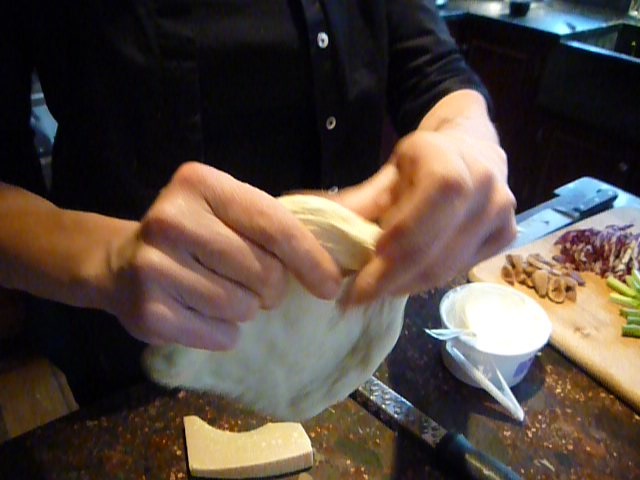
I’m not an expert who can confidently shape a pizza with a few tosses into the air, and I’ll assume most home cooks aren’t either. So how to shape the pizza? Both Susan and Jody recommend stretching, not rolling. Rolling will flatten out any air pockets, eliminating any of those big ‘bubbles’ than can form in the crust – which we like. Jody’s instructions use gravity to assist in the stretching; Reinhardt recommends using your fists (which should be well floured), instead of your fingers, to avoid tearing the dough. Just remember – a pizza with a ‘rustic’, free form shape doesn’t taste any different than a round one!
Shaping the dough - stretching, not rolling
Pizza Dough Recipe
Here’s two versions of ingredients, and instructions that will work for either. The instructions are based on several recipes; Jody’s, Susan’s, and Peter Reinhart’s recipe in The Bread Baker’s Apprentice. I don’t claim my recipe below is better than any of these, but it is as basic as I could make it, without significantly changing the end product.
Jody Adam’s Dough Ingredients:
Makes dough for two 12-inch pizzas
3/4 cup warm water
1/2 package yeast (scant 1 teaspoon)
1 tablespoon kosher salt
2 tablespoons extra virgin olive oil
1 1/2 to 1 3/4 cups unbleached all-purpose flour, plus more as needed
Susan Regis Dough Ingredients:
Makes dough for three 12-inch pizzas
1 cup warm water
1/2 teaspoon fresh yeast
1 1/2 cups high gluten flour (1 1/2 cups unbleached all purpose, with 1 T gluten)
1/2 cup all purpose flour
1/2 cup semolina flour
1 tablespoon salt
2 tablespoons olive oil
Additional 2 tablespoon all purpose flour for dusting
If you haven’t used your yeast in a while, begin by proofing the yeast to make sure it is still active. Combine the yeast and warm water in a large bowl. After a few minutes, bubbles should form. If nothing happens after 10 or 15 minutes, discard and begin again with fresh yeast.
Pizza ready for oven
Add the salt and olive oil and mix well. Stir in the flour(s), 1/2 cup at a time. As you incorporate the last 1/2 cup of flour, the dough should become to stiff to stir. Turn it out onto a floured counter and begin to knead. Continue kneading until smooth and elastic, about 7 minutes or so. Try to use as little flour as possible during the kneading process; the less flour you use, the lighter the dough. The dough should be tacky, even sticky. You can do this in a stand mixer if you prefer.
Divide the dough into 2 or 3 pieces (one for each pizza you plan on making.) Sprinkle flour over the dough, flour your hands and shape each piece into a ball. Place each ball in a medium bowl, drizzle with olive oil and turn the ball to coat it in the oil. Place each in a large plastic bag and put in the refrigerator to rest overnight, or up to 3 days. Note, at this point you can freeze any extra dough just as they are in the plastic bag for up to 3 months.
On the day you are making your pizza, remove the dough balls from the refrigerator 2 hours before you plan to make the pizza. Place the dough balls on a floured counter, sprinkle with flour, dust your hands and press the dough balls into flat discs. Cover with plastic wrap and let rest for 2 hours.
An hour before you plan to cook, place your pizza stone in the oven and preheat to 500° to 550°.
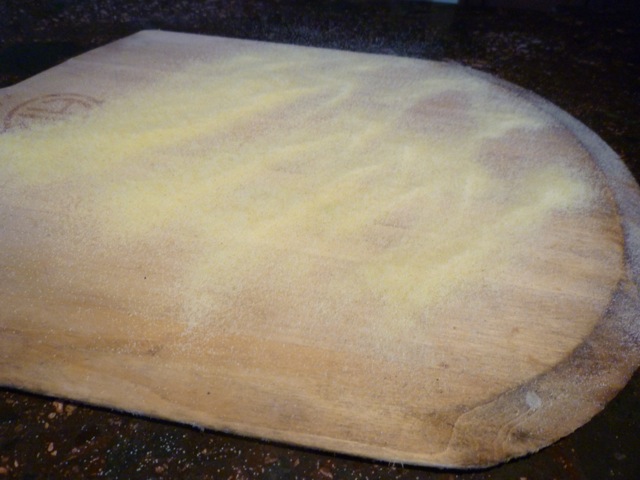
Peel with semolina, ready for pizza
Dust a pizza peel, back of a sheet pan or large wooden cutting board with semolina flour or cornmeal. Dip your hands in flour, including the backs and knuckles, and lift one piece of dough. Here are a couple of ways to shape the dough:
Reinhart: Very gently lay the dough across your fists and carefully stretch it by bouncing the dough in a circular motion on your hands, giving it a little stretch with each bounce. Keep your hands well-floured throughout, if the dough begins to stick, put it back down on the counter and reflour your hands. At this point, you can move to the toss, or just continue to stretch. If you have trouble stretching the dough, or if the dough keeps springing back, let it rest for 5 to 20 minutes so the gluten can relax, and try again.
Adams: Take up one of the flattened dough disks, and grasp with both hands like you were holding a steering wheel, but with your hands a bit closer together; at 11 o’clock and 1, rather than 10 and 2, letting the dough hang down. Gravity will be doing the stretching for you. Rotate the dough disc by moving your hands along the edge in a circle. Don’t try to stretch the ball into a full circle all at once; it will gradually stretch, and you may be find allowing the partially stretched dough to rest while you work on another ball of dough more effective overall.
When the dough is stretched to your liking, place it on your peel or pan, making sure you have enough semolina or cornmeal that the disc will move when you give the peel a shake. Top with your favorite toppings, keeping in mind that the more you use, the more difficulty you will have sliding it into the oven, and the crust will not cook as nicely if it is overloaded. I usually pick at most 4 different items, including sauce and cheese.
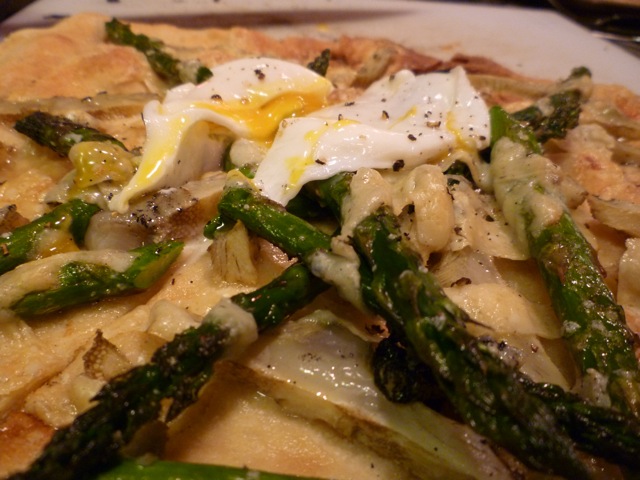
Asparagus, artichoke pizza topped with a poached egg
Slide the pizza onto the hot stone (or bake on the sheet pan, if you don’t have a stone.) The pizza should cook in 5 to 8 minutes; check halfway through and rotate if necessary to cook evenly on both sides. Remove from oven, and let sit for 3-5 minutes before slicing.
I enjoyed a fantastic, lighter-bodied red with pizza recently, a Schiava from San Pietro in Alto Adige.
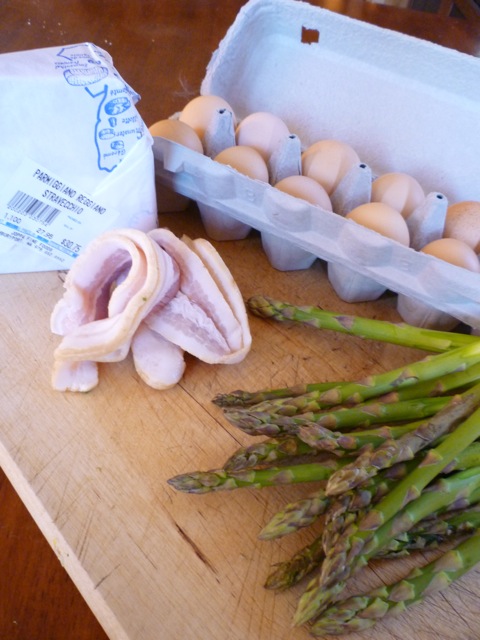
A classic Italian pasta preparation known the world over, pasta alla carbonara is a quintessential example of Italian peasant food. Stories as to its origin are many and varied, and you will find versions of it all over Italy, with spaghetti used in Rome, penne when prepared in the Appenine mountains of Abruzzo, bucatini when in the Northeast – a thick, hollow spaghetti-like noodle native to the regions we explore on our bike tours, but most believe it was popularized in Rome itself. You will find various debates at to the proper ingredients: pancetta versus guanciale (pork cheek), pecorino romano versus parmigiano reggiano. I’ll share a few of the more interesting stories and thoughts on this dish, and then offer a basic recipe that I’ve mucked around with by adding asparagus. You can go totally traditional and leave this out, but I am always trying to include more vegetables in my diet, asparagus is in season as I write this, it is traditionally paired with eggs in Italy, and my kids will eat it if I hide it in something else.
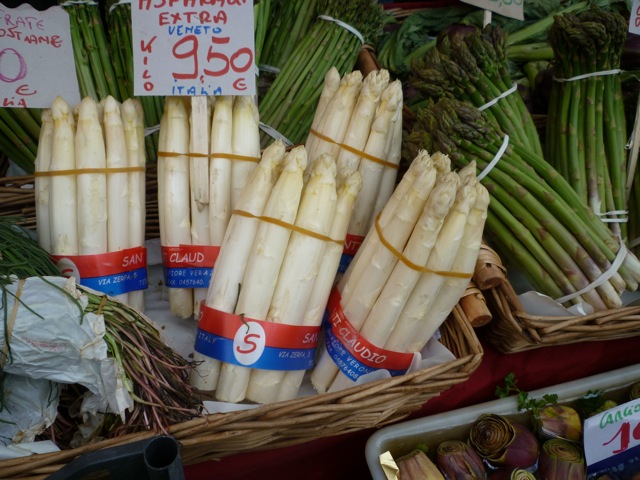
Asparagus at Rialto Market, Venice
Many authorities, including Clifford Wright, mention that the name carbonara derives from the Italian word carbonaro, meaning charcoal burner, and the carbonari, the woodcutters who would cut wood and make charcoal. They would spend months at a time camping outside in the woods, with little ability to store fresh food. This was prepared with foods that would keep without refrigeration – cured pork, cheese, oil, pasta, the only perishable ingredient is the eggs, which they could usually find at a nearby farm. They would prepare this over a charcoal fire.
A second popular anecdote about its origins is attributed to the food shortages that plagued the city after the liberation of Rome in 1944. Allied troops were generously distributing military rations to the locales that included powdered egg and bacon; they added water, and combined these ingredients with pasta, most likely in an effort to recreate a dish they were already familiar with.
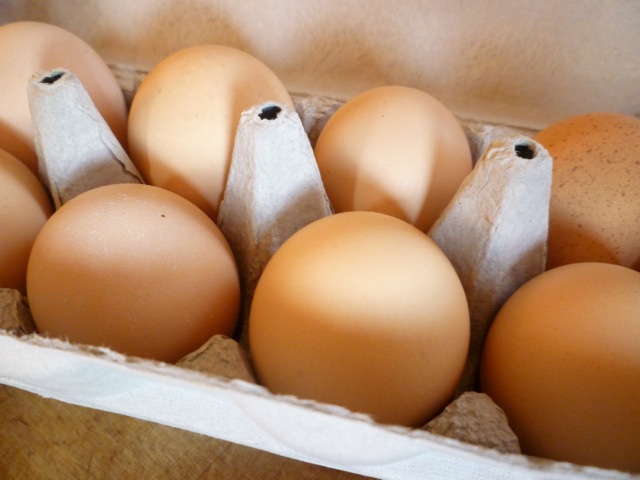
Fresh local eggs
The world-famous actress, Sophia Loren, shares her experiences with this dish in her cookbook, Sophia Loren’s Recipes & Memories. When in Italy in the late 1950s filming the movie Two Women, she tells of a mountainside encounter between the film crew and a group of carbonari, who prepared the dish for them in the traditional way. She shares their recipe in her cookbook, although her particular version does include cream, which most authorities would turn up their nose at!
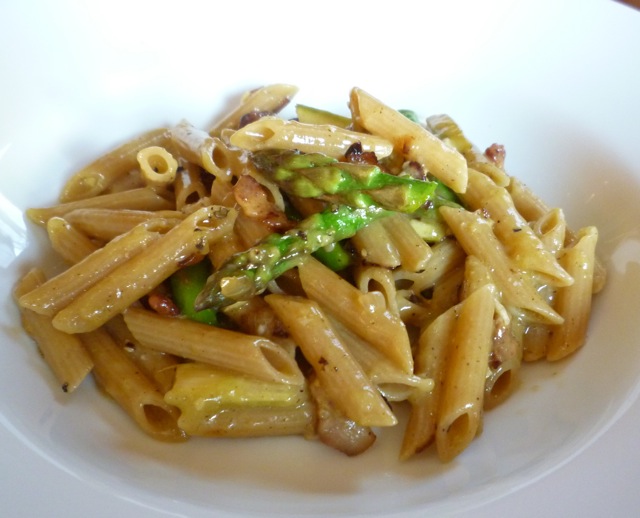
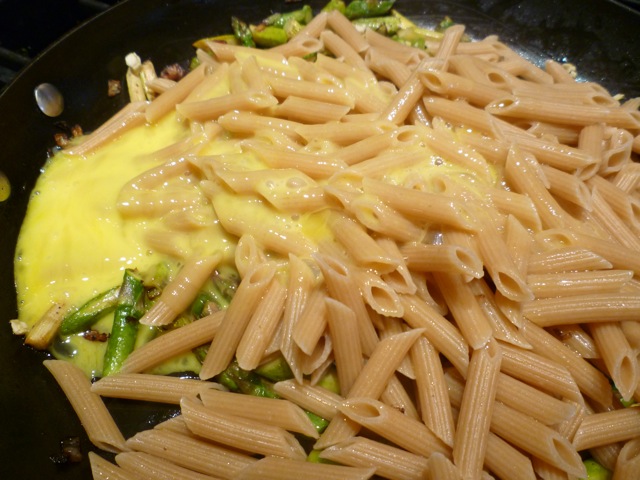
So here’s the version I just prepared; again, not rigorously authentic. But if you are running out to the grocers in order to make this, that is not really in keeping with the spirit of this peasant dish. It was created to make the best use of the ingredients you would have on hand. So I used bacon, rather than pancetta or guanciale, because that is what I always have. Great fresh eggs from a local farm. Fresh asparagus, and a mixture of pecorino and parmigiano cheeses. No cream – gasp! I used a whole wheat penne, as I enjoy the rustic feel of this dish and I think it pairs well with the whole wheat pasta. And penne is so much easier to toss, and eat! The key here is to not overcook the eggs; there should be liquid egg/cheese sauce, not hard cooked eggs, when you are finished. This is achieved by combining the eggs with the cooked pork and cooked pasta AFTER you have removed the pan from the heat; the residual heat in the pasta/pork will cook the eggs just enough.
Combine with eggs off of the heat
Pasta alla Carbonara con Asparagi
Serves 4
1/4 pound pancetta, guanciale, or bacon, chopped in 1/2 inch dice
2 tablespoons olive oil
1/2 medium onion, cut into 1/4 inch dice
12 ounces fresh asparagus, peeled, woody end snapped off, and cut into 1 inch pieces
1 clove garlic, minced
1 pound of your favorite pasta; spaghetti, fettucini, penne
4 eggs
Freshly ground black pepper
1/2 cup freshly grated pecorino or parmigiano reggiano cheese
Bring a large pot of water to a boil over high heat.
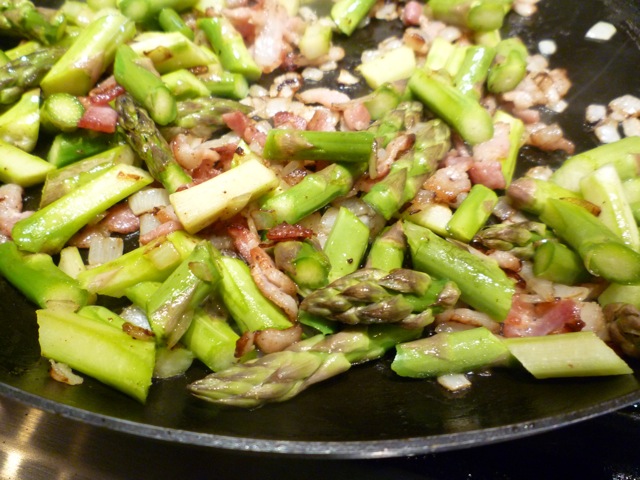
Heat the olive oil in a large skillet over medium-high heat. Add the pancetta/guanciale/bacon and onion. Cook until the onion begins to soften and the pork begins to render a bit of its fat. It should remain a bit soft.
Add the asparagus, and cook until tender. Add the garlic, and cook just until aromatic, about 1 more minute. Remove from heat.
When the water is boiling, salt the water. Add the pasta and cook until just al dente.
While the pasta is cooking, place the eggs in a small bowl and whisk until combined.
Drain the pasta, and place the pasta back into the pot. Add the asparagus/pork/onion mixture. Pour in the eggs and add the grated cheese. Stir until the pasta is thoroughly combined with the rest of the ingredients. Season liberally with freshly ground black pepper, and serve.
I would pair this with a not-too heavy, rustic, indigenous red wine – a Schiava/Vernatsch from Trentino would be wonderful; this one from Baron Widmann was quite enjoyable!
Spring Oat Risotto with Peas, Radicchio, Asparagus & Pecorino
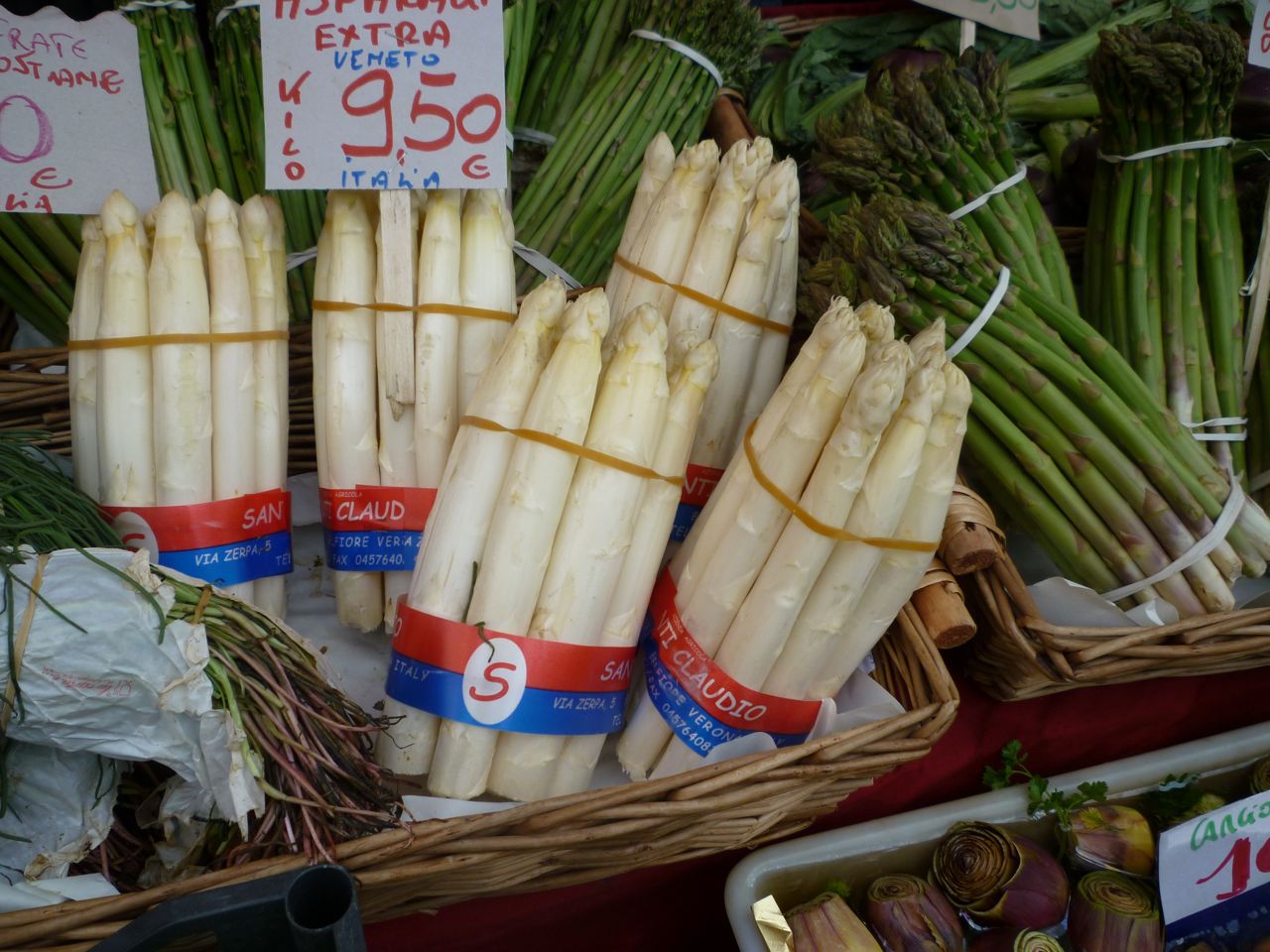
Spring is the time of year when my cooking enthusiasm gets a shot in the arm from the wonderful fresh products that begin to appear in the local markets. I am just back from a bike trip in Italy, where baby radicchio, the famed white asparagus of Bassano del Grappa, and fresh peas were just making their first appearances. Asparagus season is right around the corner here as well. I was looking forward to working some of these ingredients into my dishes back home.
White asparagus in Italy market
The spring weather is finally warm enough to move my bike off of my indoor trainer and being enjoying rides in the great outdoors. The next few months bring a lot of time on the road, as I train for the Pan Mass Challenge, a two day, 200 mile ride to raise money for cancer research. Fueling the body for the long hours in the saddle training, and during the ride itself, is a huge part of the preparation. Carbohydrate intake is very important, and I prefer to avoid the highly processed white breads and starches in favor of whole grains. A little more time consuming to cook, harder to find in the grocery story, but certainly worth the time when you consider all the health benefits, and of course the wonderful dishes you can create with these.
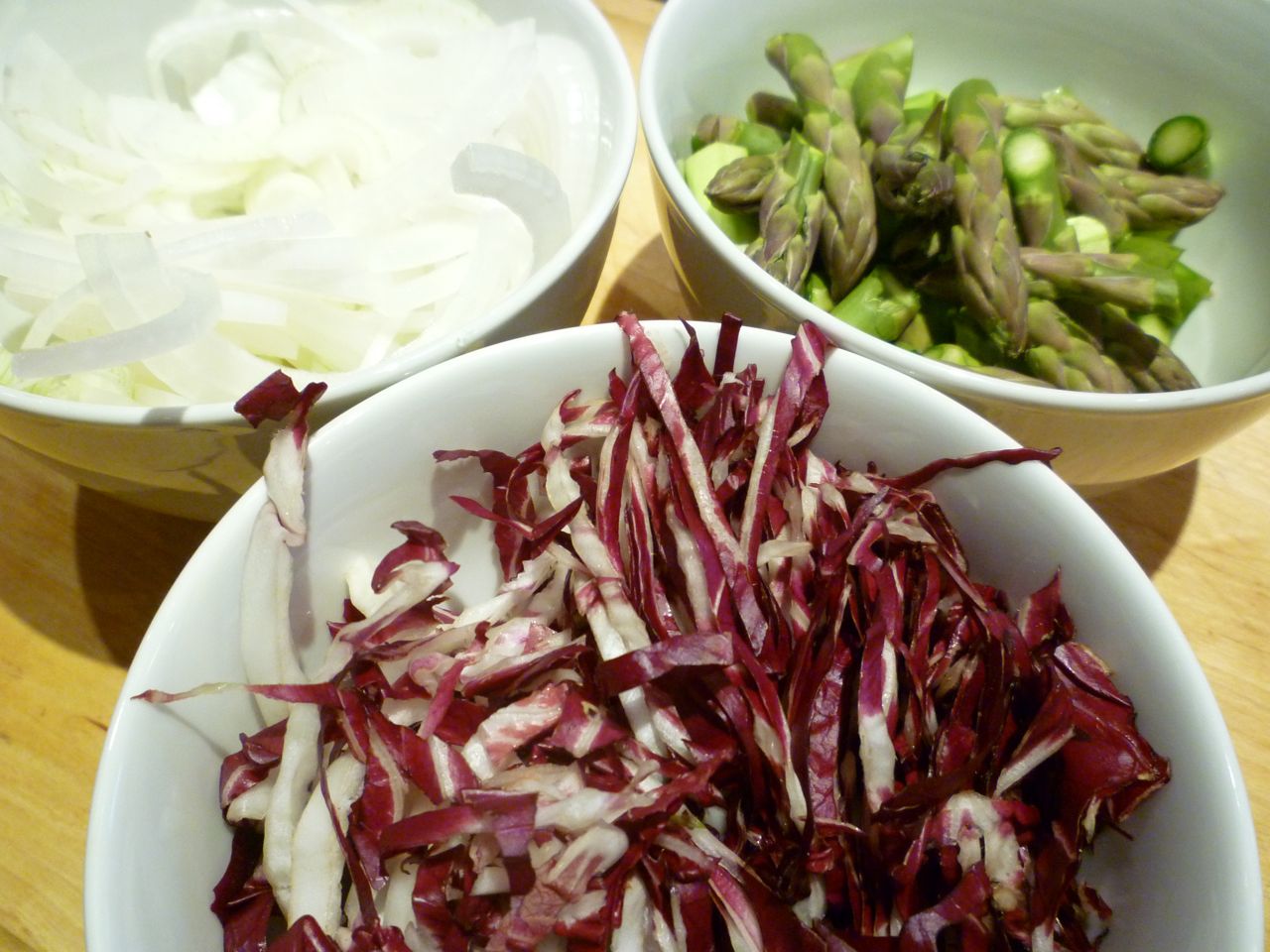
Radicchio, spring onions, asparagus
Whole grains are not a key part of the cuisine in Italy. You will find barley, rice and farro. But I am discovering that many of these grains can be prepared easily using a classic Italian technique – a risotto. I’ve included several recipes in past posts for rice risottos, as well as a barley risotto (orzotto) traditionally prepared in Friuli, and a farro risotto. Here’s a new one, using steel-cut oatmeal as the grain.
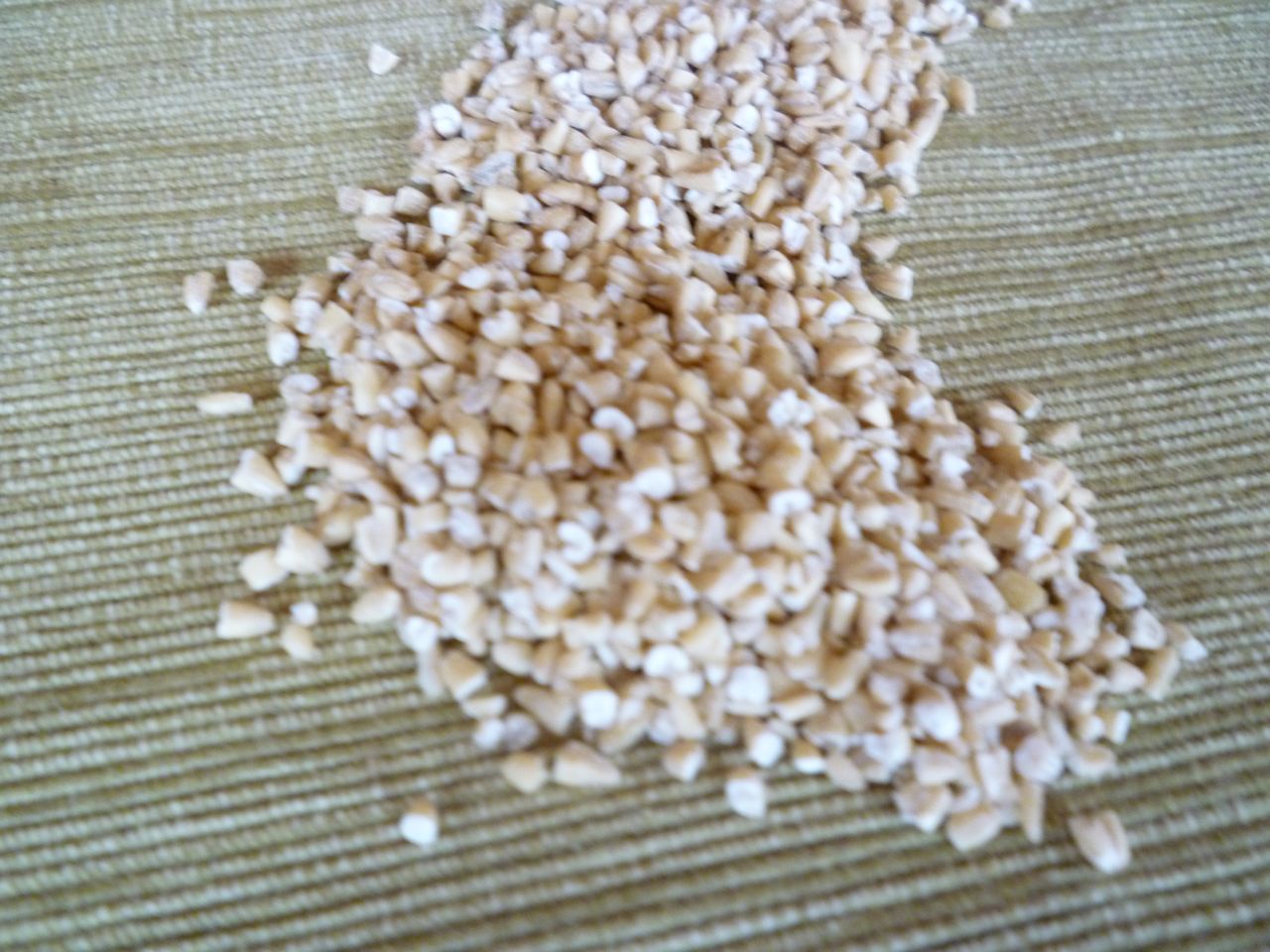
Steel-Cut Oats
Oats are not used often in Italian cooking or baking; I think most Italians would consider this animal fodder, although it is commonly found in the muesli that is part of almost every hotel breakfast buffet in Italy. Steel-cut oats are the whole grain version of your morning instant oatmeal. Called groats, they are the inner portion of the oat kernal, which have been cut into 3 to 4 pieces. They are commonly used in Scotland or Ireland to make a breakfast porridge, and take longer to cook than either instant or rolled oats, typically 15-20 minutes. You can reduce the cooking time by a presoak. They have a nuttier flavor and a chewier texture than the more processed versions, both an improvement in my mind.
The health benefits of oats are fairly well publicized, thanks to Quaker. LDL “bad” cholesterol levels are reduced, and the high amount of soluble fiber in oats slows digestion of starch, helping to control blood sugar levels and so can aid diabetics.
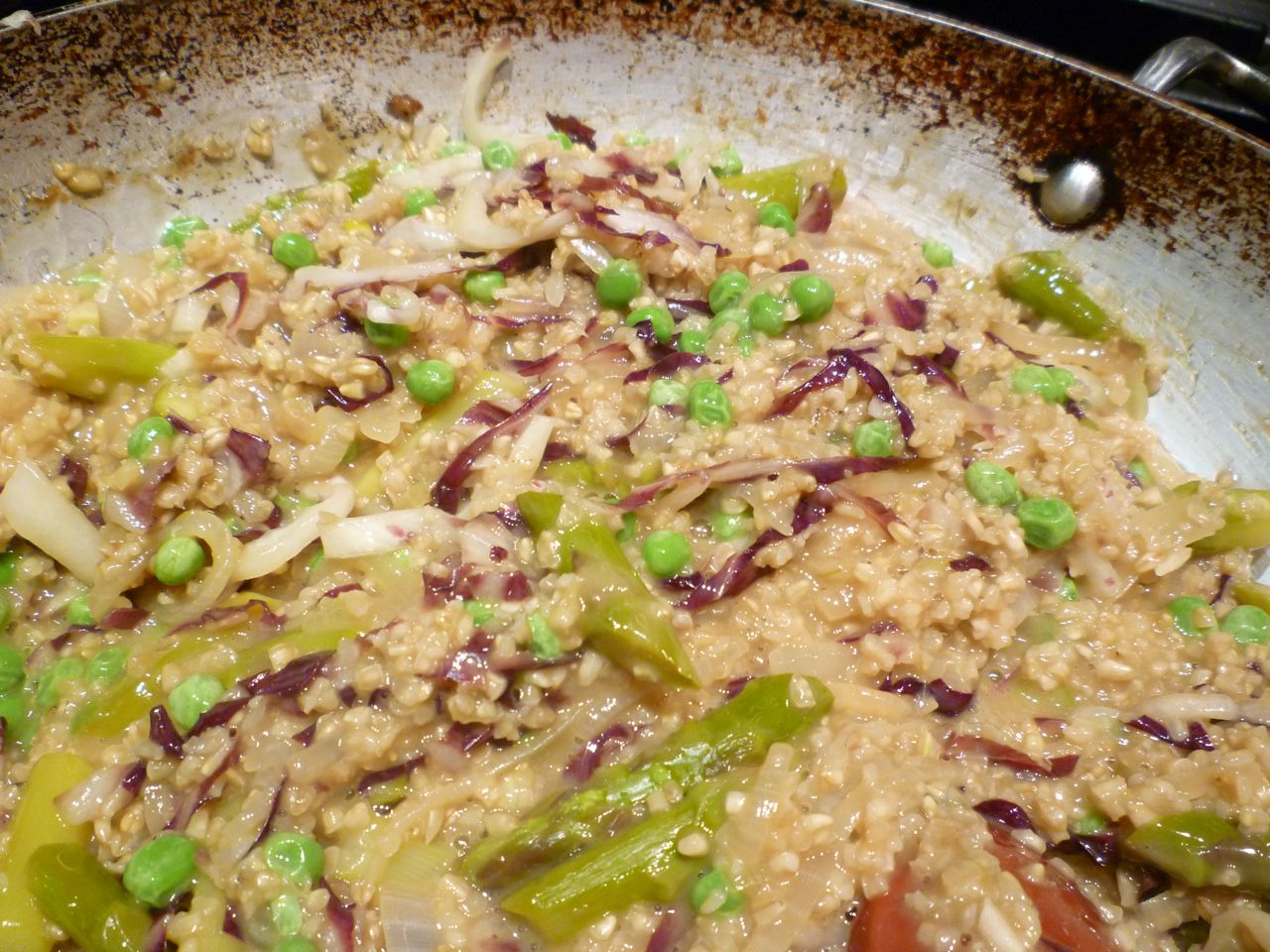
Finishing spring risotto
Oats are also a good source of insoluble fiber, which can lower the risk of cancer, as well as vitamin E, zinc, selenium, copper, iron, manganese, and magnesium. Steel cut oats, as they are less processed, may hold even greater nutritional value than rolled oats.
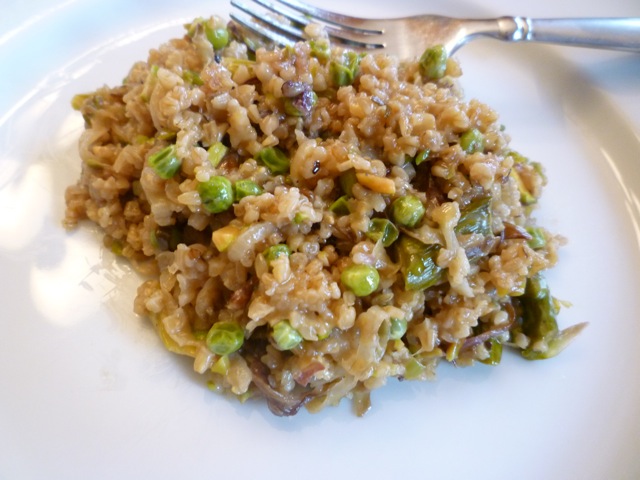
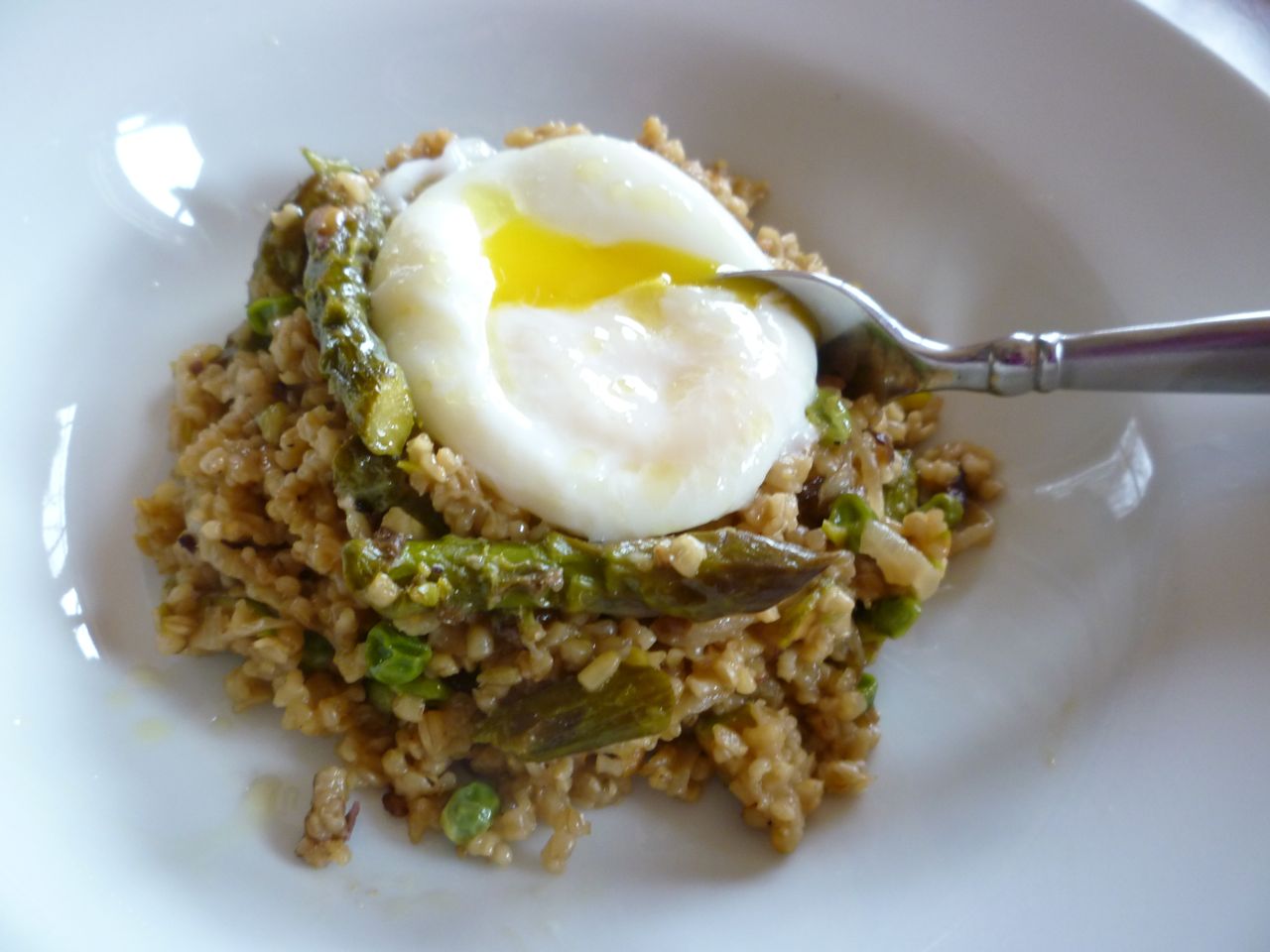
So here is my latest recipe – a spring vegetable “risotto”, using steel-cut oats instead of rice. Asparagus, radicchio, spring onion, peas and pistachios, and a bit of pecorino cheese. A great side dish for dinner to accompany a roast chicken or grilled fish, and a wonderful lunch the next day topped with a fresh poached egg! Asparagus and eggs are a very traditional combination in Italy.
Spring Oat Risotto with Poached Egg
Spring Oat Risotto with Peas, Radicchio, Asparagus & Pecorino
Serves 6
4 cups unsalted chicken stock
2 tablespoons unsalted butter
1 tablespoon extra virgin olive oil
1 spring onion, halved, sliced thin
12 ounces asparagus, peeled, thick end snapped off, and cut into 1 inch pieces
1 large garlic clove, finely chopped
1 1/2 cups steel-cut oats
1 cup white wine
1 cup baby peas, fresh or frozen
1/2 head radicchio, thinly sliced
1 cup grated Pecorino Romano
1/2 cup pistachios, chopped
Kosher salt, to taste
Bring the stock to a boil in a large pot. Reduce heat to a very low simmer
Heat the butter and olive oil in a large saute pan over medium heat. Add the onion and asparagus, and cook until slightly soft, about 4 minutes. Add the garlic; cook for 1 minute, just until aromatic.
Add the oats to the pan, and stir for about 1 minute, allowing them to toast a bit. Add the wine, and simmer until it has evaporated.
Stir in a ladelful of the stock. Cook, stirring frequently. When almost all of the stock has been absorbed, add another ladelful. Continue adding the stock a ladelful at a time, and allowing it to be absorbed by the oats before adding more. Cook until the oats are just tender to the bite. You may not use all of the stock; but that is all right. Stop cooking before the oats get mushy.
Stir in the peas, radicchio, and cheese. Cook until the peas are heated through and the radicchio begins to soften, about 2 minutes. Season with salt.
Divide between 6 serving plates, garnish with the pistachios, drizzle with a bit of olive oil (or truffle oil) and and serve.
A nice pairing would be a Terlaner from Alto Adige, or a Friulano from Friuli.