Sauerkraut is a classic German dish that is not usually associated with Italy, but is often seen in the Northeastern regions of Trentino and Friuli-Venezia Giulia. Both regions have been ruled by the Germanic peoples to the north before becoming part of Italy as we know it today. On our Italiaoutdoors bike, hike and ski trips to these regions we see the germanic influence everywhere – in the dress, the architecture, the foods and use of both German as well as Italian languages. And my research into this food has uncovered many surprising health benefits to sauerkraut as well – including some pretty amazing cancer fighting properties. A Polish study, undertaken to discover why Polish women who moved to the US had higher rates of breast cancer than those who stayed behind found a link to the consumption of sauerkraut, especially amongst adolescent girls – sauerkraut not playing much of a role in any US teenager diet that I am aware of!
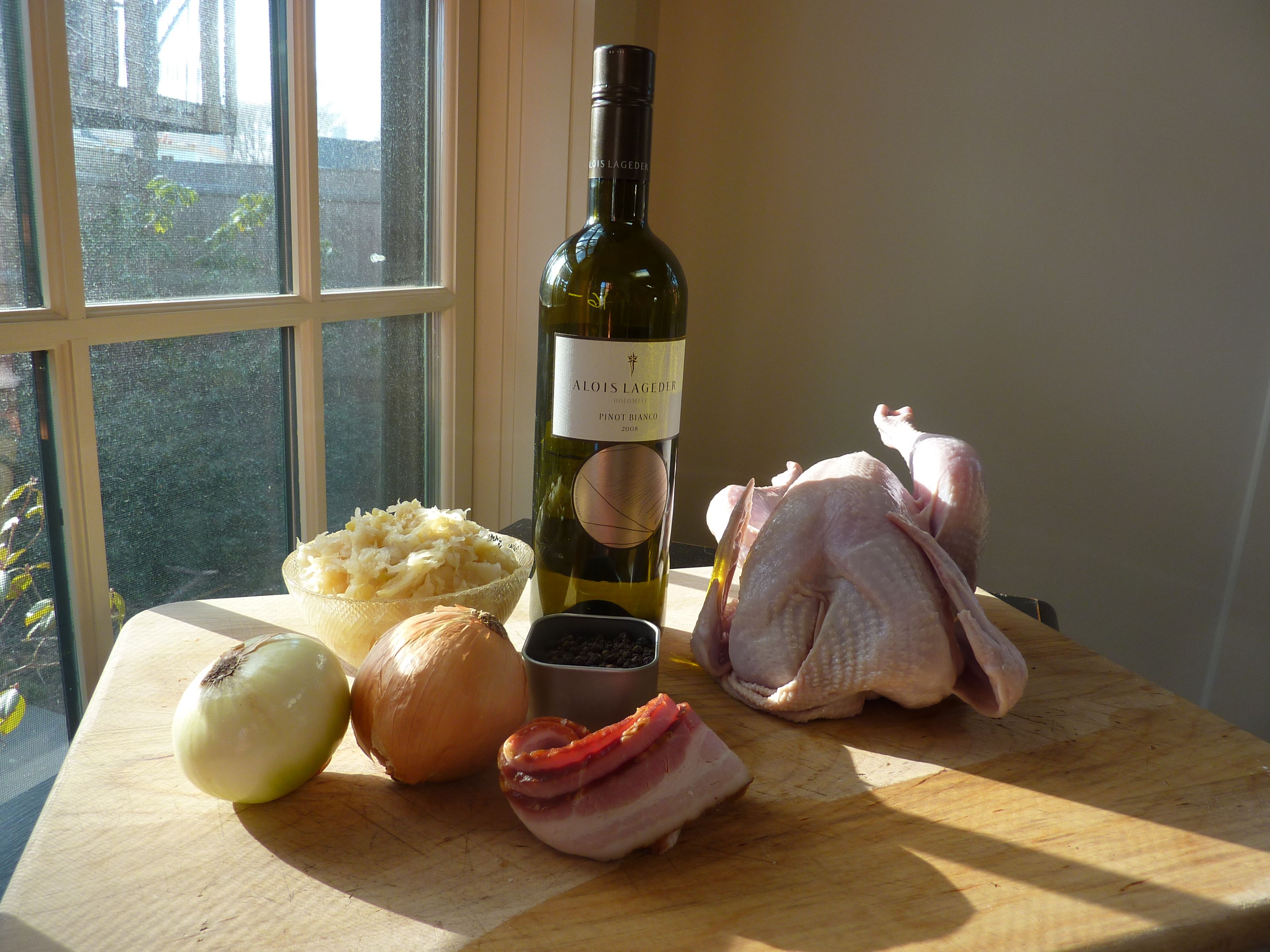
Sauerkraut, bacon, chicken, wine, onions
Sauerkraut, which translates to ‘sour cabbage’ in German, is thinly sliced cabbage that is fermented in order to preserve it. The sliced cabbage is salted and packed into a crock. The salt draws the liquid from the cabbage, and creates a brine. Lacto-bacteria then ferments the sugars in the cabbage, giving the sauerkraut its’ distinctive sour flavor. It is traditionally served with pork. In Trieste, the many restaurants that serve buffets (a Trieste mainstay) will offer a piatto misto con kraut, mixed pork with kraut. This recipe, adapted from La Terra Fortunata by Fred Plotkin, hails from the farmhouses in the Corso region of Friuli-Venezia Giulia, along the Slovenian border. It gives a nice variation to the traditional pork and kraut combination, a braise with chicken. The sauerkraut that is served in Italy is a bit more mild than that found in the US, but the 40 minutes or so of cooking here will mellow it a bit. Rinsing the sauerkraut before using it will also help.
A nice white wine from the Carso DOC in Friuli-Venezia Giulia would make a wonderful pairing – this region, located right on the Slovakian border, produces a nice Malvasia, as well as Vitovska, both made from grapes grown here since ancient times.
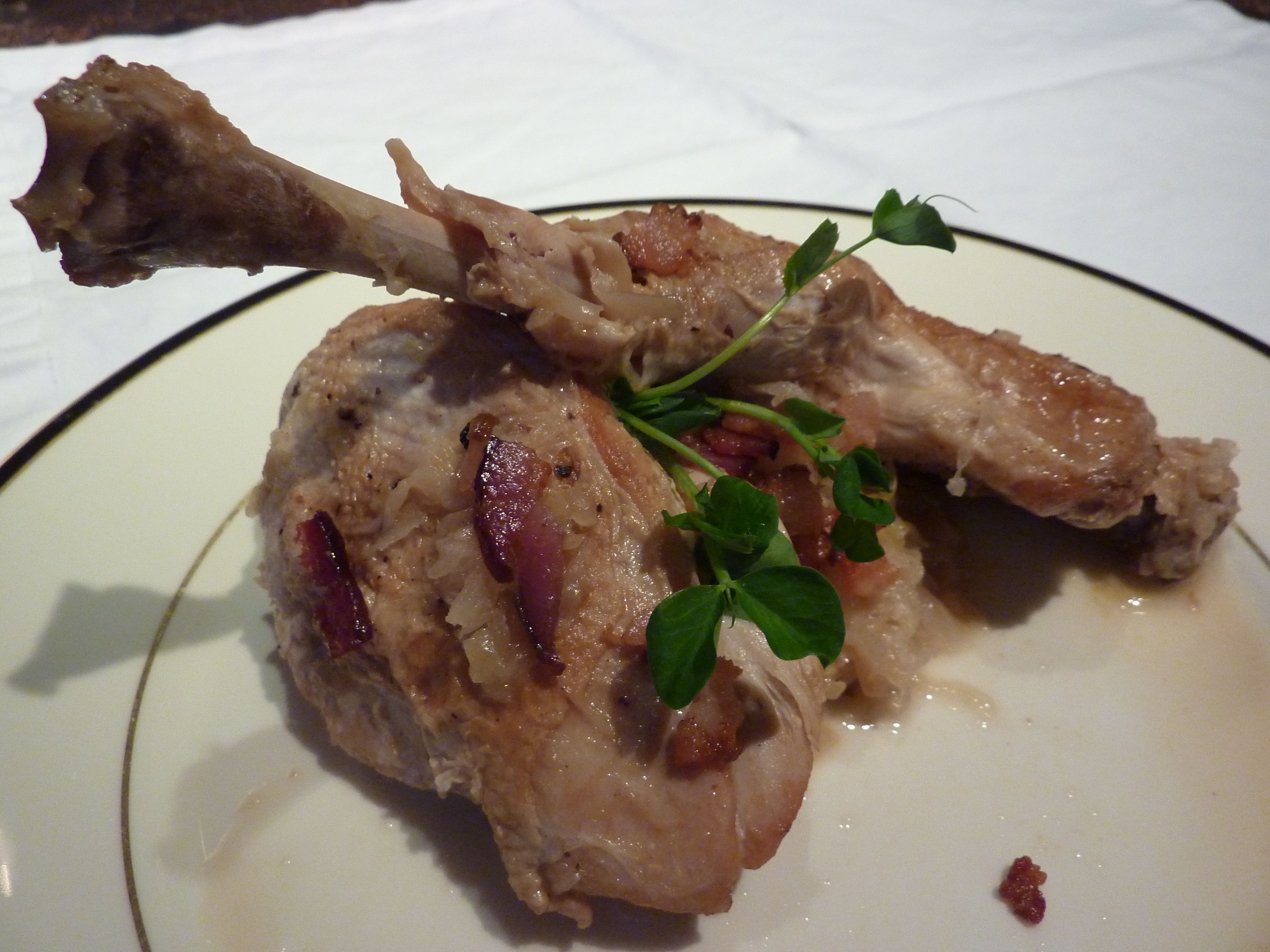
Pollo del Carso con Crauti
Serves 4
1 organic chicken, cut into two legs and two breasts
Kosher salt and freshly ground pepper
2 tablespoons bacon fat, or 1 tablespoon butter and 1 tablespoon extra virgin olive oil
4 slices bacon, chopped
1 medium onion, cut into 1/4 inch dice
2 pounds sauerkraut
1/2 teaspoon whole black peppercorns
1/2 cup white wine
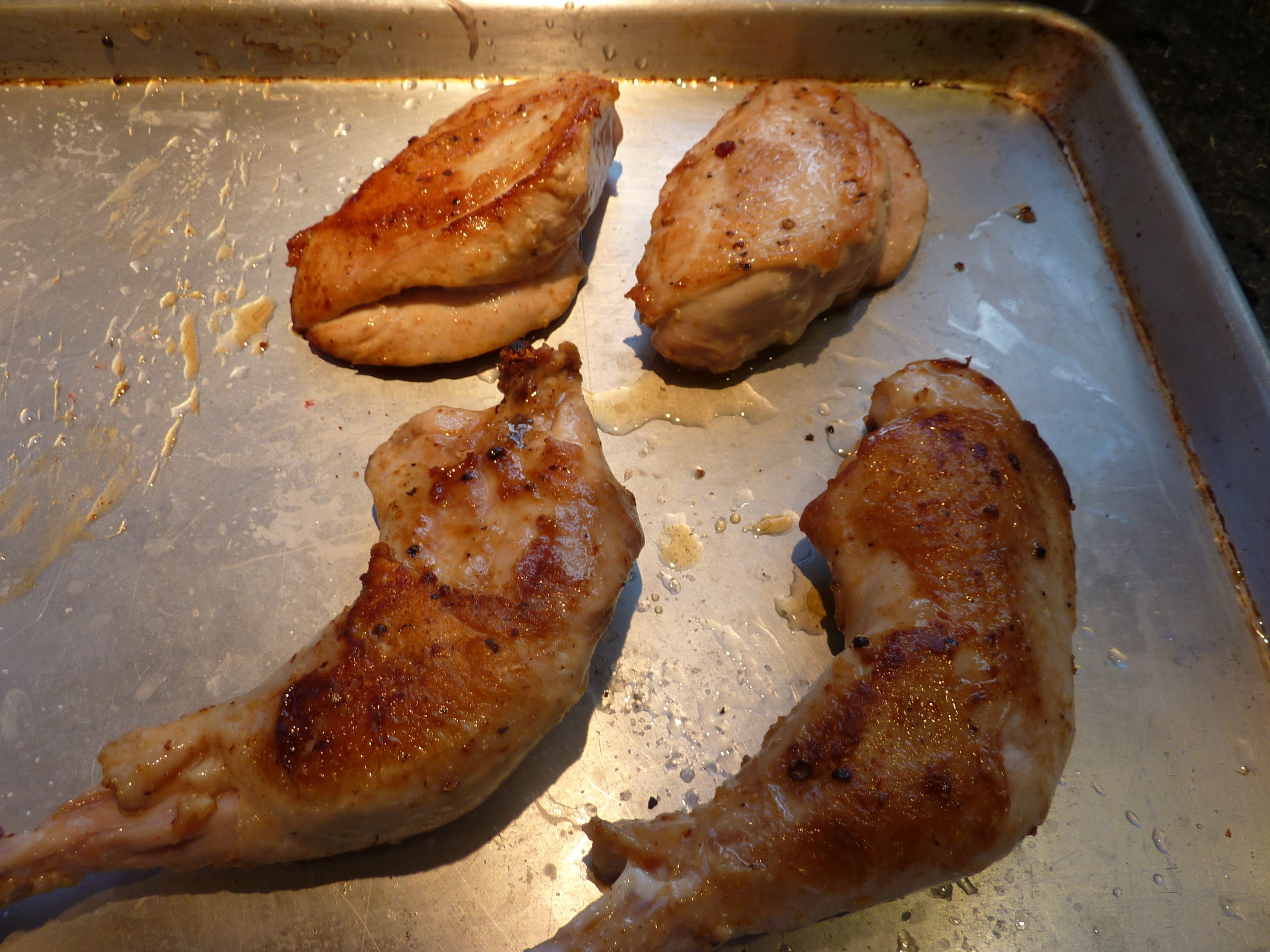
Place the chicken pieces on a sheet pan, and season with salt and pepper.
Seared chicken
Heat the bacon fat or butter and oil in a large enamel or other heavy bottomed pan over medium high heat. When the oil is hot, sear the chicken pieces on all sides, until nicely golden brown all over. Remove from heat and place on sheet pan. Do not crowd the chicken pieces in the pan while searing; they will steam rather than sear if they are too close together.
Add the onion, and cook until softened. Add the peppercorns and sauerkraut, reduce the heat and cook for about 10 minutes, stirring occasionally. Season with salt.
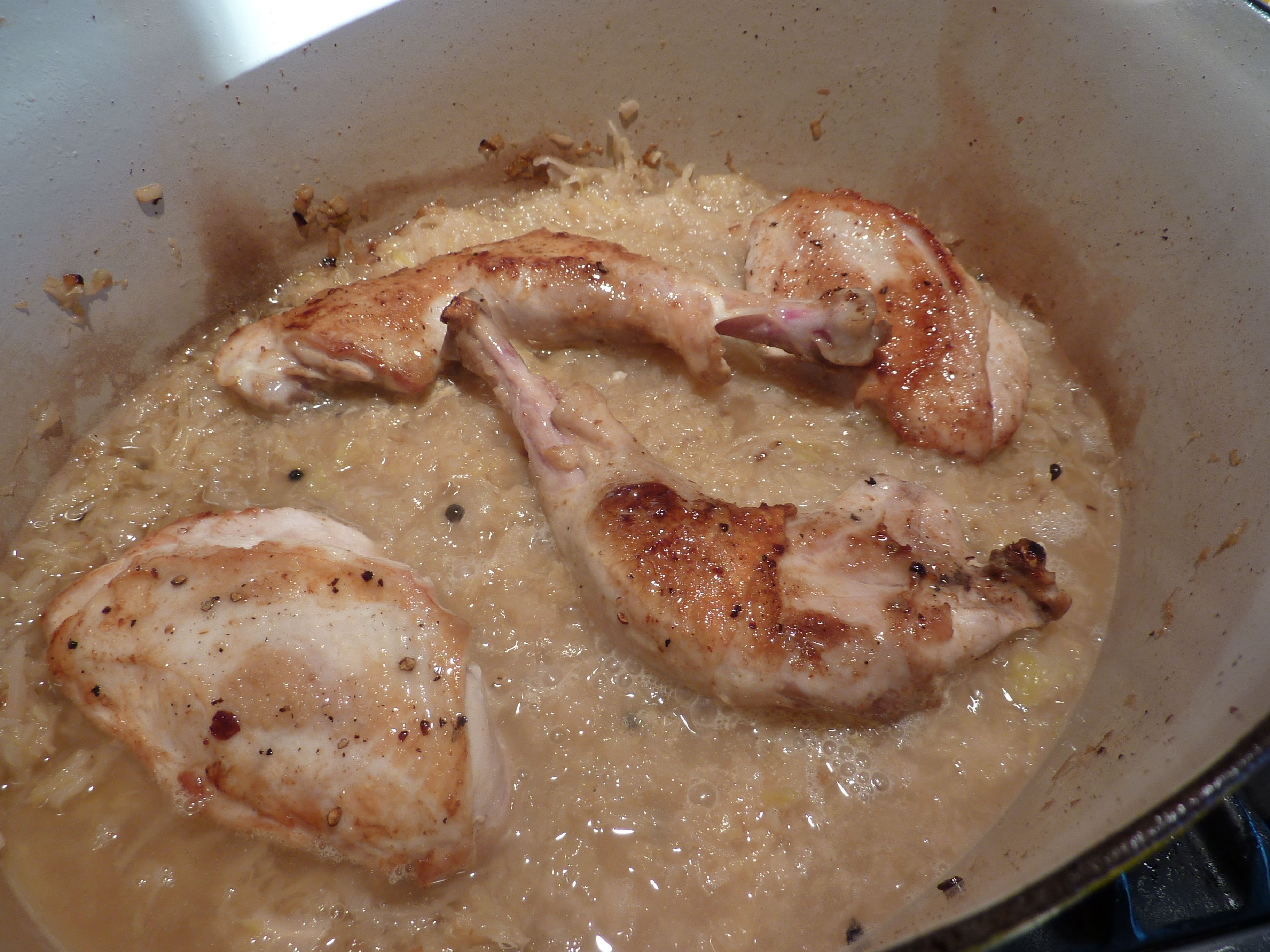
Chicken braise
Place the chicken on top of the sauerkraut. Pour the wine over the chicken and bring to a boil. Reduce the heat, and cover with a sheet of parchment and foil, then cover with the lid. Cook for 40 minutes, until the chicken is quite tender. Serve with the sauerkraut on the side.
Tortellini, and their larger relative, tortelloni, are homemade stuffed pastas originally from the Emilia-Romagna region of Northeastern Italy. This region is renowned for its’ many wonderful varieties of stuffed pastas, which date back to the Middle Ages. In Bologna, these small ‘dumplings’ are referred to as tortellini; in the Romagna provinces of Rimini, Forli and Ravenna they are called cappelletti, or “little hats”. Traditionally, these pastas were handmade in the home kitchens of this region, often to serve as a Sunday lunch dish. Pasta dough is made from two simple ingredients: eggs and soft-wheat flour, with the addition only of spinach or chard should a green pasta be desired. The dough is kneaded until soft and smooth, then rolled out with a long rolling pin until almost transparent. It is then sliced into strips for square shapes, or cut into circles for rounded shaped pasta.
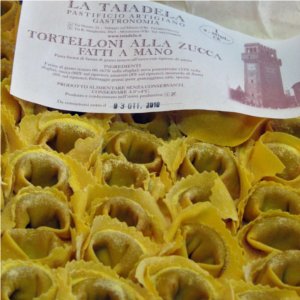
Tortelloni in market in Italy
A ‘traditional’ stuffing recipe would not have made much sense to a woman making her own Sunday lunch tortellini – the stuffing would be made from whatever leftovers were on hand. And you would not purchase these from a store; who could know what would be inside! But today, busy lifestyles are the norm worldwide, and both here and in Italy homemade pastas are becoming a lost art. But luckily, specialty stores and even large multinational pasta companies are producing their own versions of these stuffed pastas, making them even more popular today than ever. No longer do we need to wait for Sunday lunch to enjoy these!
Tortellini are synonymous with Bologna, and Bologna’s own Learned Confraternity of the Tortellino has arisen to ward off the ersatz imitators who may want to capitalize on the popularity of this favorite traditional dish. Tortellini alla bolognese is the classic dish, traditionally served in capon broth. The Confraternity specifies all the pertinent details involved in producing the traditionally correct version of this – including the size of the pasta squares (3.7 cm), the filling recipe, which includes mortedella, prosciutto, parmesan, eggs, nutmeg, and pork loin that has been allowed to sit for two days in a mixture of salt and herbs before being cooked in butter. A small dollop of the filling is placed in the center of one of these 3.7 cm squares, then the square is folded in half diagonally, forming two triangles. The edges are then pressed together and sealed with a bit of water or egg.
To shape the final tortellini, one would pick up a triangle by the folded over end, with the tip pointing up toward the ceiling, and wrap that folded end around your index finger, preferably an index finger that is 18 millimeters in diameter (thanks again to the Confraternity for this detail.) Bring the two corners together and pinch to seal. Slip it off of your finger, and place on a floured sheet pan. Repeat with the remaining tortellini.
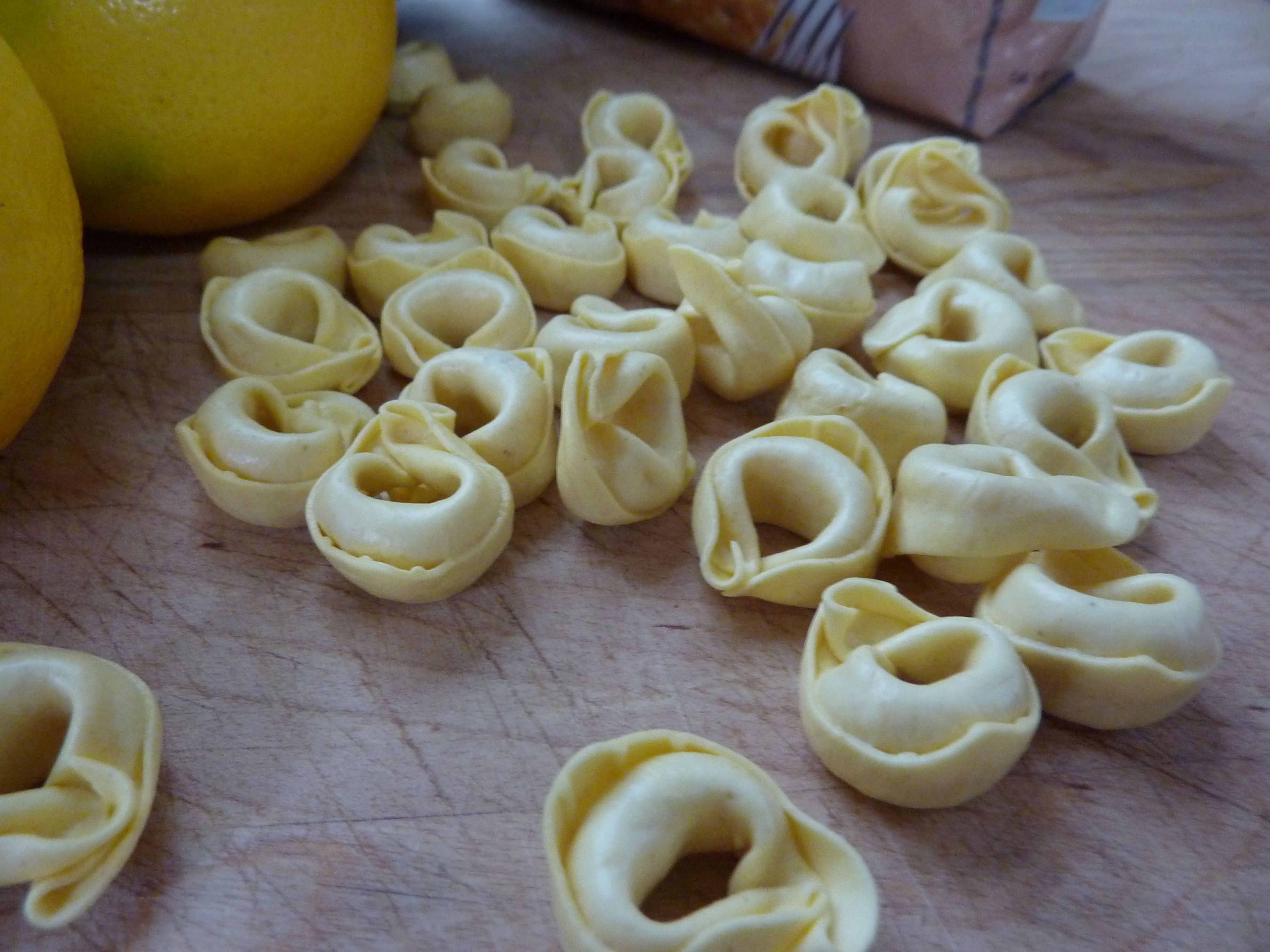
Tortellini
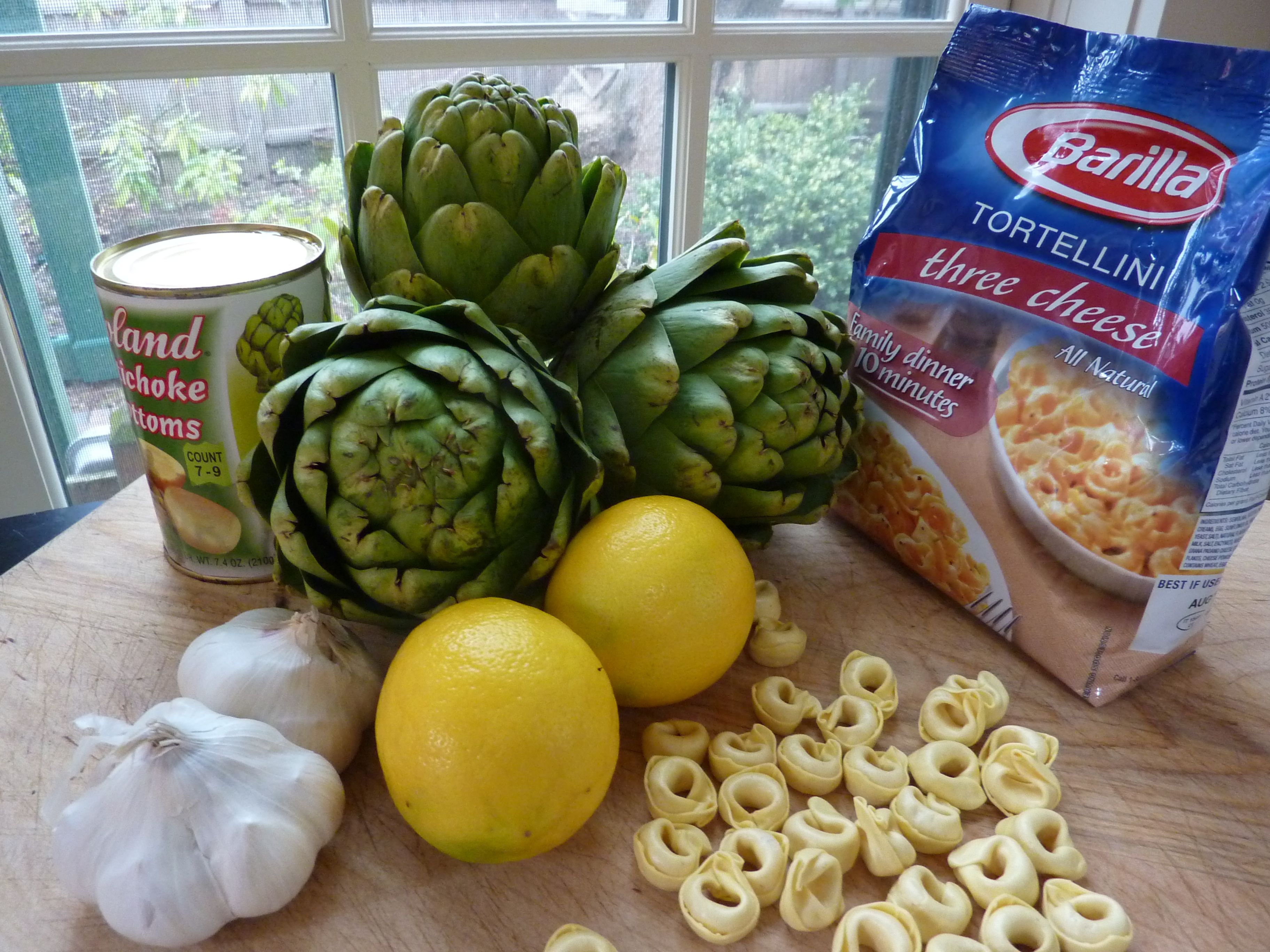
At this point, we can all appreciate why this labor-intensive task is unfortunately disappearing. Even when I go to the effort of making my own stuffed pastas, I usually opt for a larger and easier shape to form. But here I’ve used some packaged tortellini (Barilla) to create these two spring pasta dishes – same flavors in each, but a little change in preparation creates two different dishes.
Lynne Rosetto Kasper, author of The Splendid Table, developed her stuffed tortelloni recipe to reproduce the original which she discovered in Tamburini, a gourmet store in Bologna. Their pasta stuffing was a combination of artichokes, mascarpone, and fresh white truffles. It is currently pea season in the Veneto region of Northern Italy, a neighbor of Emilia Romagna, and the home of the first business to produce and distribute pre-made tortellinis. So I thought peas would be a nice addition here.
If you are lucky enough to have a white truffle, you could shave that on top of the pasta – for those of us without a pig, I’ve suggested a drizzle of white truffle oil as a final garnish.
On our Italiaoutdoors web site, you will find a description and pictures of how to trim the artichokes for cooking, should you choose to use fresh artichokes. Trimmed artichokes were found at just about every market we visited last year on our culinary bike trips, the vendors would pass the time between customers trimming artichokes and adding them to the basin of lemon water.
So here you are, a tortellini with sauce, and a baked tortellini version – let me know which one you prefer!
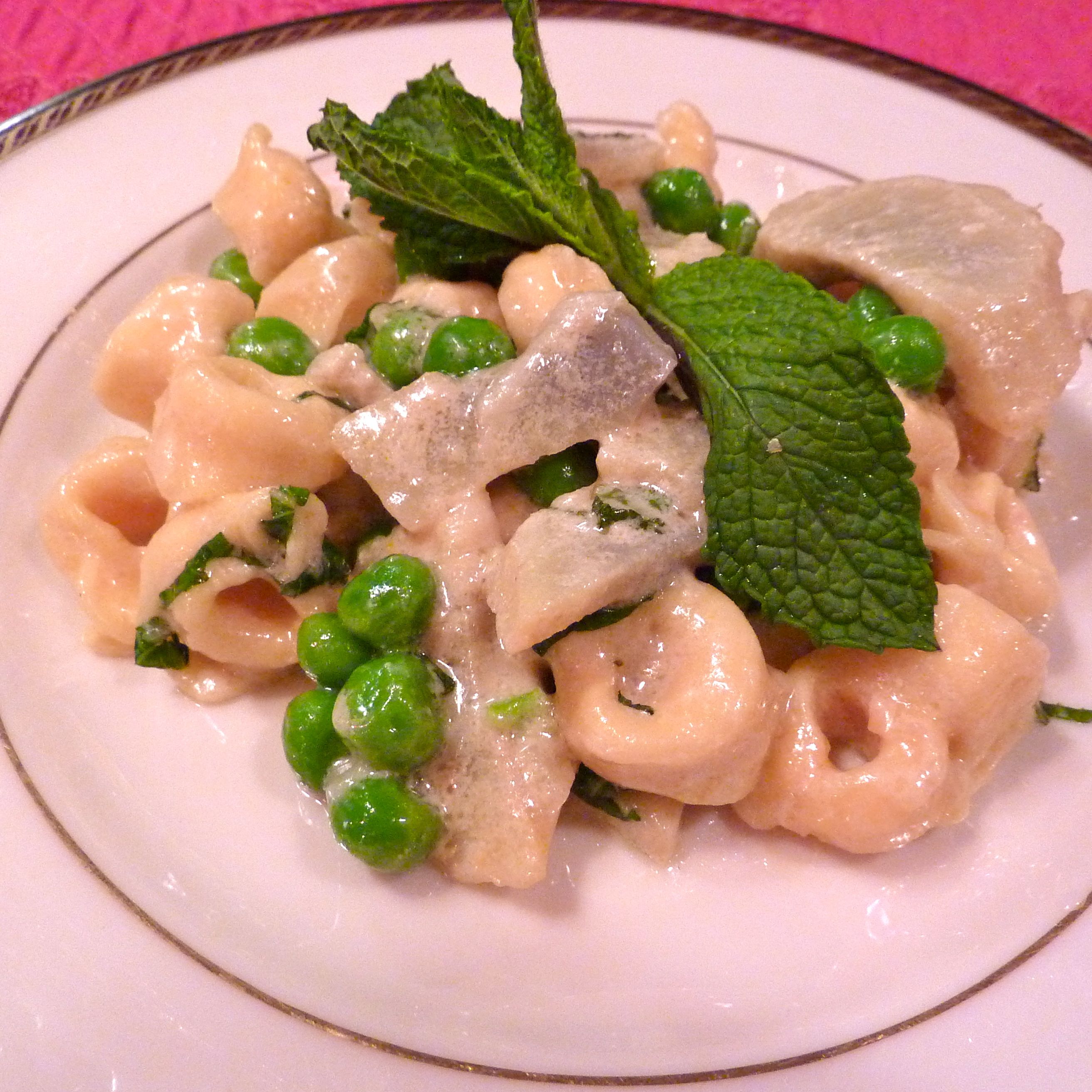
Tortellini with Artichokes, Mascarpone, Peas and Mint
Tortellini with Artichokes, Peas, Mascarpone and Mint
Serves 4
4 trimmed, raw artichoke hearts, soaking in 1 1/2 cups acidulated water
3/4 cup white wine
2 cloves garlic, smashed
Zest of one lemon
Sprig of basil
Sprig of mint
or:
4 canned artichoke hearts
1 tablespoon lemon juice
Zest of one lemon
1 tablespoon extra virgin olive oil
1/2 cup white wine
for both:
8 ounces mascarpone
1 clove garlic, minced
4 artichoke hearts, thinly sliced
1/2 package (5 ounces) frozen baby peas, defrosted
3/4 cup grated Parmigiano-Reggiano cheese
10 leaves mint, chiffonade (thinly sliced)
Kosher salt and freshly ground pepper
1 pound tortellini
4 whole small mint leaves
White truffle oil (optional)
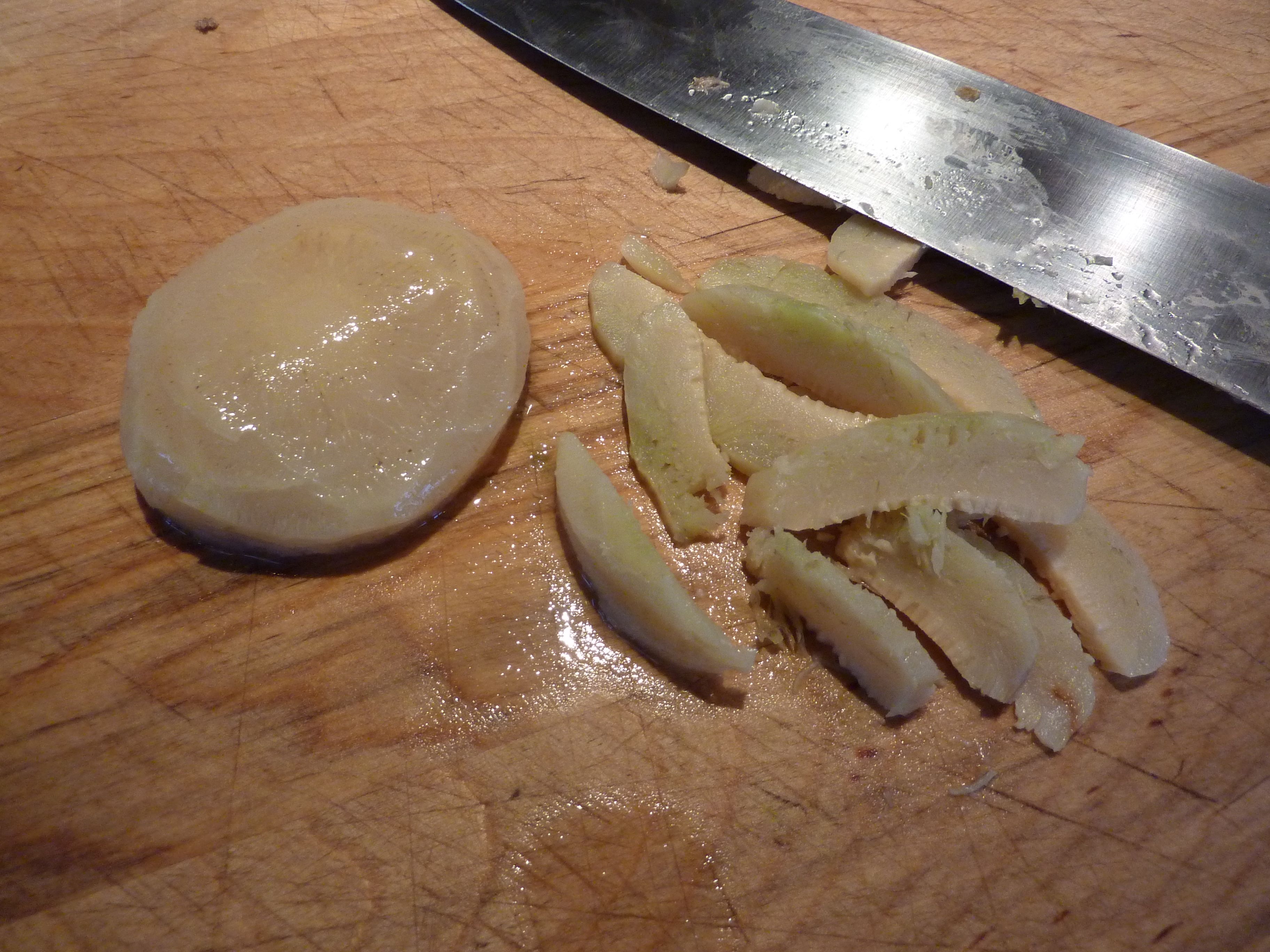
Artichoke hearts
If you are using raw artichoke hearts, you must cook them before continuing with the remainder of the recipe. If you are using canned hearts, you can skip on to the step in which you slice the cooked artichokes.
Place the 4 raw artichoke hearts and the acidulated water into a large saute pan. Add the white wine, garlic cloves, lemon zest, basil and mint. Bring to a boil, then reduce the heat and simmer until the hearts are tender enough to be pierced with a skewer, about 20-25 minutes. If your hearts are quite different in size, they may not all be done at the same time. As they finish cooking, remove the hearts and set aside. When all have been removed, use a slotted spoon to extract the garlic cloves and herbs from the cooking liquid. Increase the heat, and reduce the liquid to a glaze, 1 to 2 tablespoons.
For both canned and fresh versions:
Bring a large pot of water for the pasta to boil over high heat.
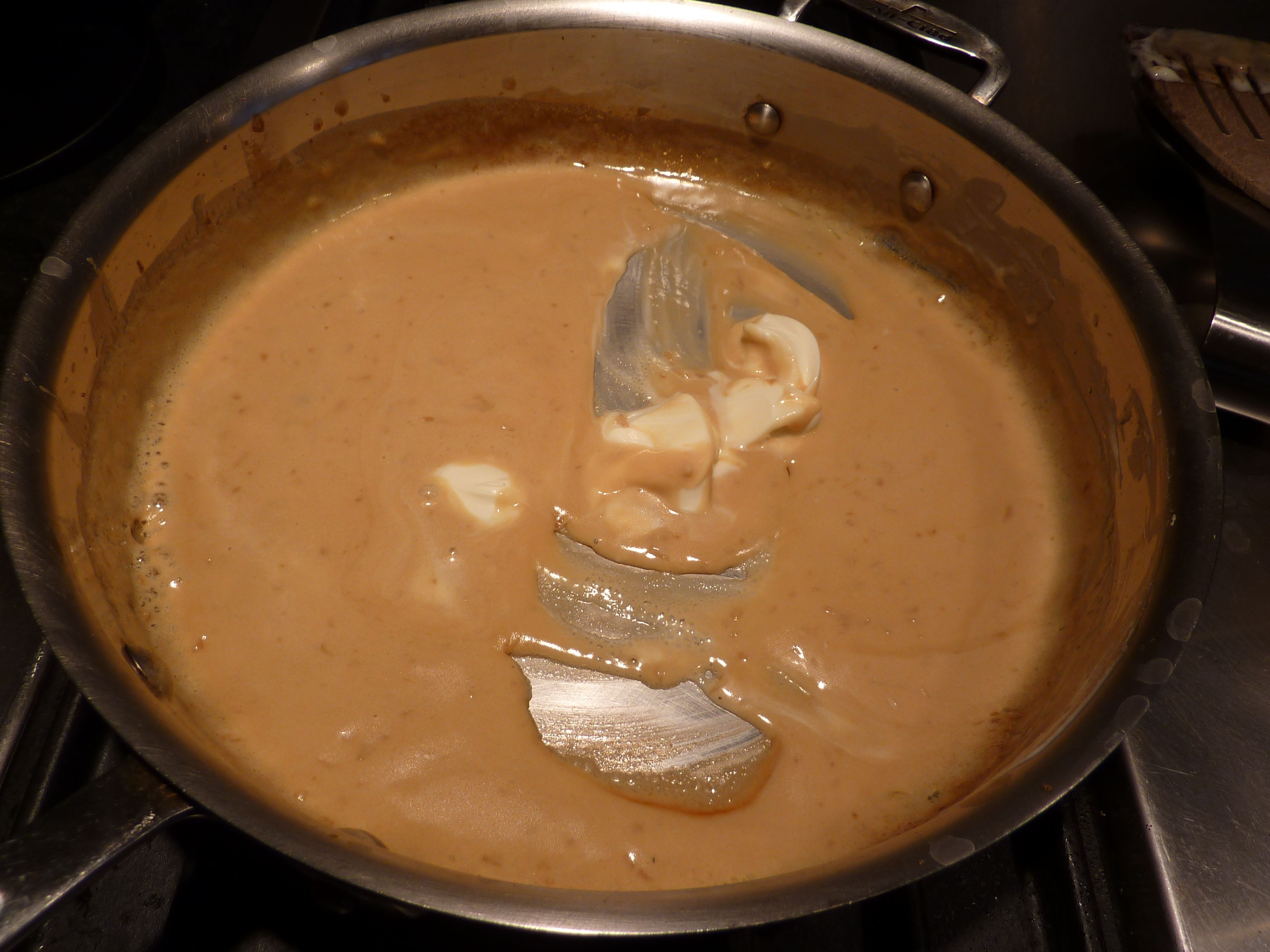
Sauce for tortellini
If using canned artichokes, add the lemon juice, zest, olive oil and wine to a large saute pan. Cook until reduced to a glaze. If using the raw artichokes, use the saute pan in which you cooked the artichokes, as this contains the glaze, ready to use.
Add the mascarpone, stirring as it softens. Add the garlic and cook for 1 minute. Add the sliced artichoke hearts, peas, and the Parmegiano-Reggiano cheese. Stir until combined into a smooth sauce. Season with the mint, salt and pepper.
When the pasta water is boiling, add salt, return to a boil, and then add the tortellini. Cook until al dente, about 5-6 minutes. Remove and drain, reserving 1 cup of pasta cooking water. Add the drained tortellini to the sauce in the saute pan, stirring to combine. If the sauce seems a bit thick, you can use a little of reserved pasta cooking water to loosen it up a bit, but this may not be necessary.
Serve in four bowls, garnished with a mint leaf and a drizzle of truffle oil.
Baked Tortellini
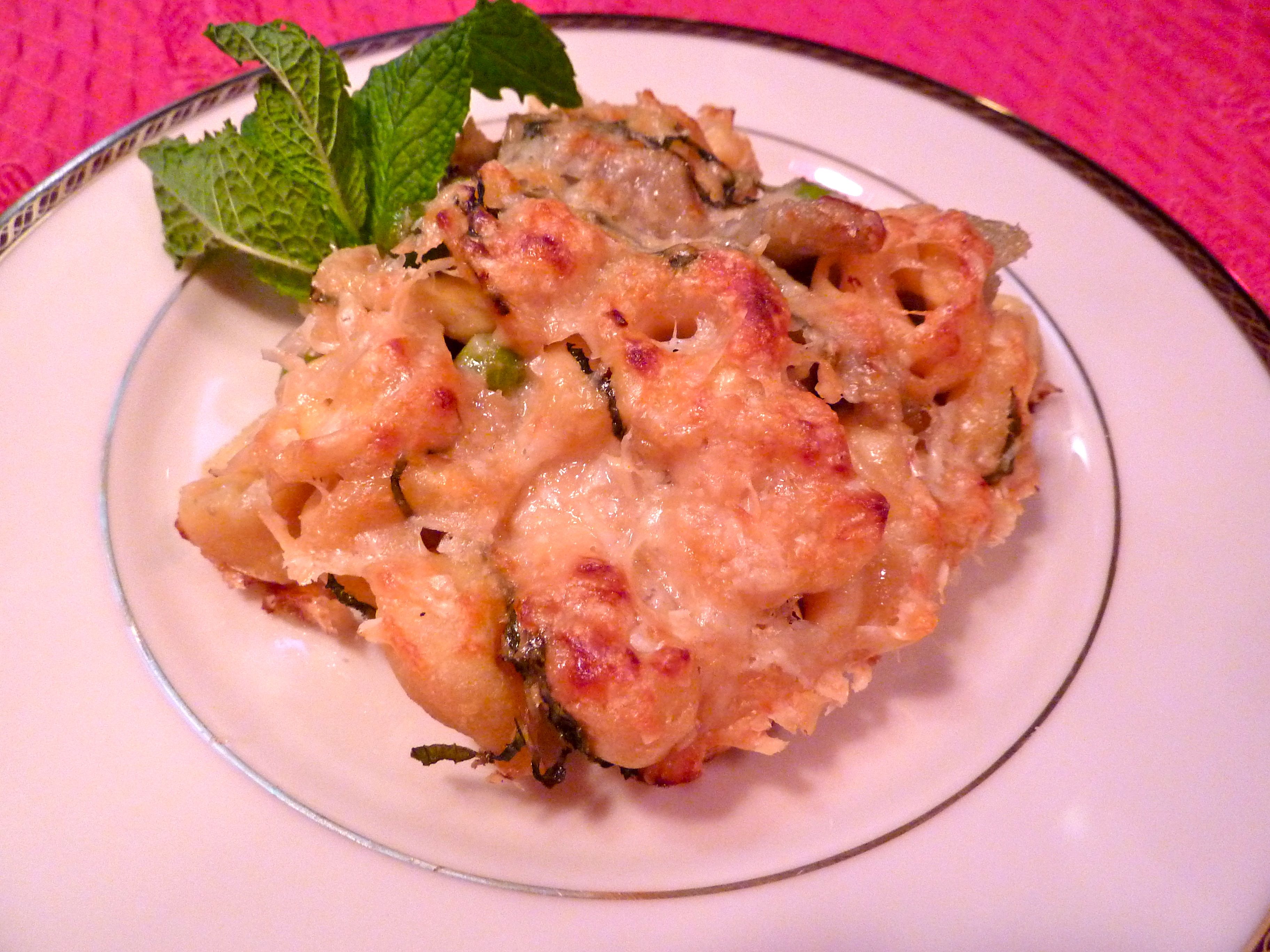
Baked Tortellini with Artichokes, Peas, Mascarpone and Mint
Same ingredients, with an additional 1/2 cup grated Parmigiano-Reggiano cheese.
Preheat the oven to 400°.
Complete the recipe above, but instead of serving the pasta in four bowls, pour the tortellini and sauce into a casserole pan. Top with the 1/2 cup grated cheese. Bake until bubbling and golden brown, about 15-20 minutes. Place for a minute or two under the broiler if the top is not browned to your liking. Serve, with an optional drizzle of truffle oil.
I think these various additions would be wonderful as well!
The freshwater lakes of Trentino and Friuli-Venezia Giulia abound with many varieties of trout. The northern provinces of Friuli not only produce more trout than any other region of Italy, they also consume more of it than any other region. In Friuli, trout is found in both the rivers and in lakes near San Daniele and Venzone. In Trentino, there are approximately 70 trout farms along the Avisio, Brenta, Chiese and Sarca rivers. The first trout farm was established in Val Rendena in 1902, and the introduction of rainbow trout occurred even earlier.
The Trentino Trout Farmers Association unites fifty or so trout farmers who are dedicated to continual improvement of breeding techniques and developing the highest quality product. These farmers produce not only the adult fish for consumption, but trout eggs for breeding purposes, which requires special conditions on the farm and an all natural diet. This association, known as ASTRO, also handles selling and distributing the Trentino trout to specialized shops in Northern Italy, Austria and Germany. A major objective of this association is achieve the ‘certification’ of trout farming in Trentino, so that Trentino trout will be included under the Trentino products trademark now being established.
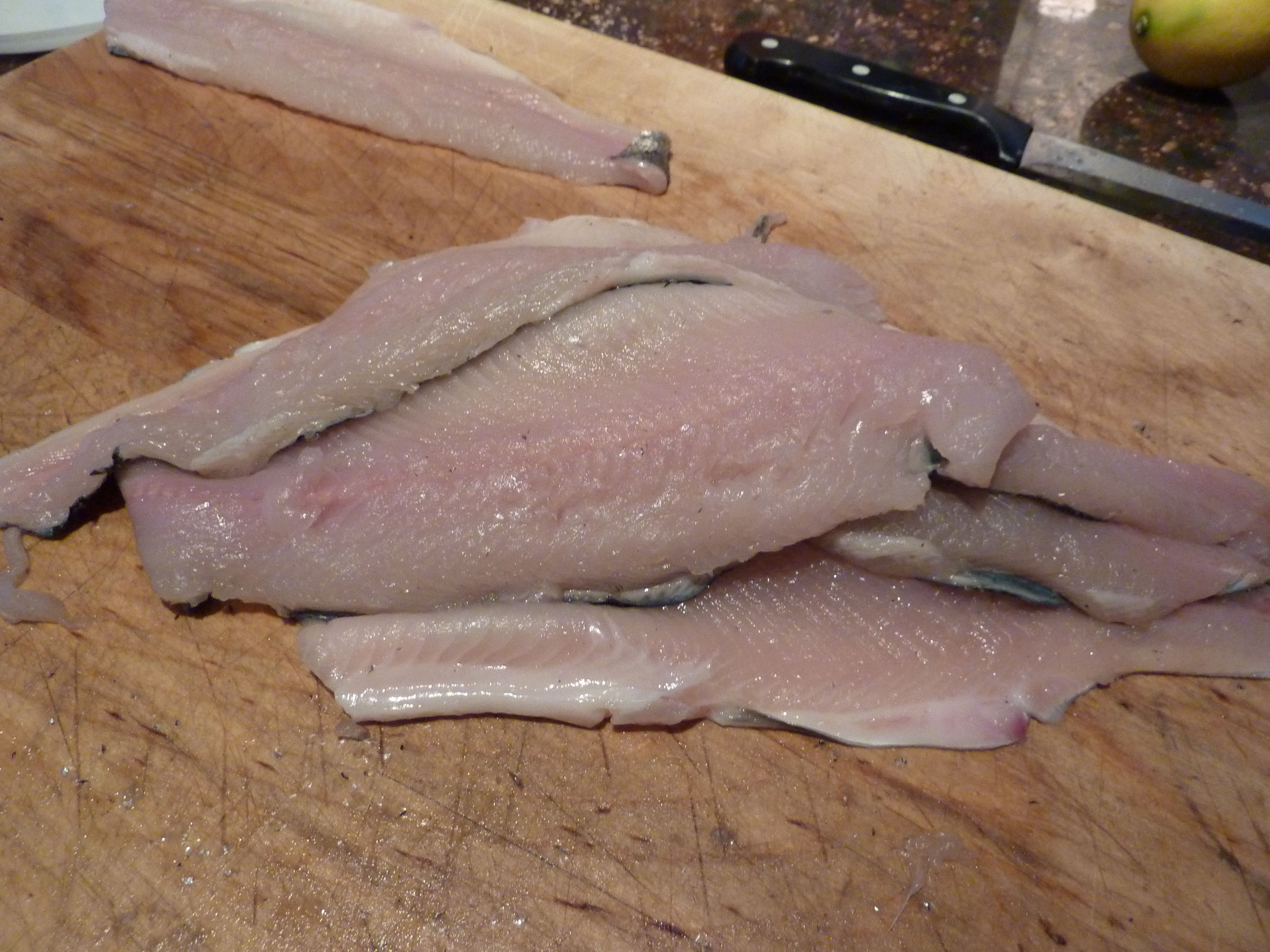
Trout fillets ready for cooking
There are several different trout species found in these regions; most common these days are rainbow trout, which were actually imported from North America. Also present are lake trout, brook trout, and the marbled trout.
For centuries, trout, salmon and herring have been smoked in order to preserve them. Today, the area around San Daniele in Friuli-Venezia Giulia has become known for its high quality smoked fish products, which are now being exported. The producers of these high quality smoked products use the extremely fresh fish available from their local lakes in conjunction with traditional smoking techniques to obtain the highest quality products.
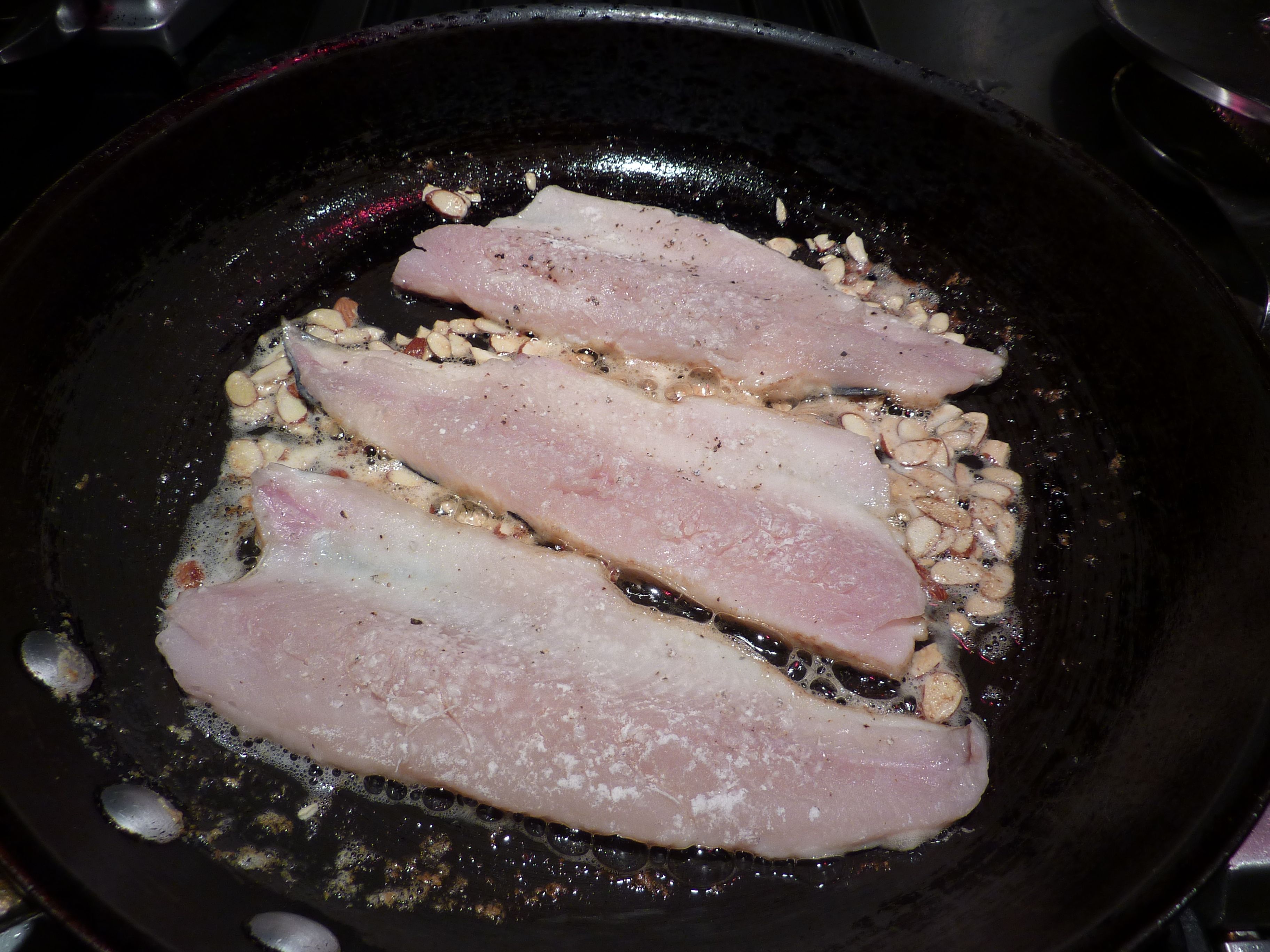
Trout frying in butter and grappa
The following recipe is a very simple preparation – trout pan fried in butter, with a little grappa for a bit of a kick. Olive trees are not common in these Northern regions, so butter is used. Grappa is the most famous distillate of Friuli and Trentino. The almonds are my own addition, and not necessarily something hailing from this region. But I have vivid memories of a visit to New Orleans when I was 20, to visit my father who was enjoying a sabbatical at Tulane. He was very happy to have his two oldest daughters’ visit and join him as he explored the restaurants. We had a great meal at Galatoire’s, with a trout almondine.
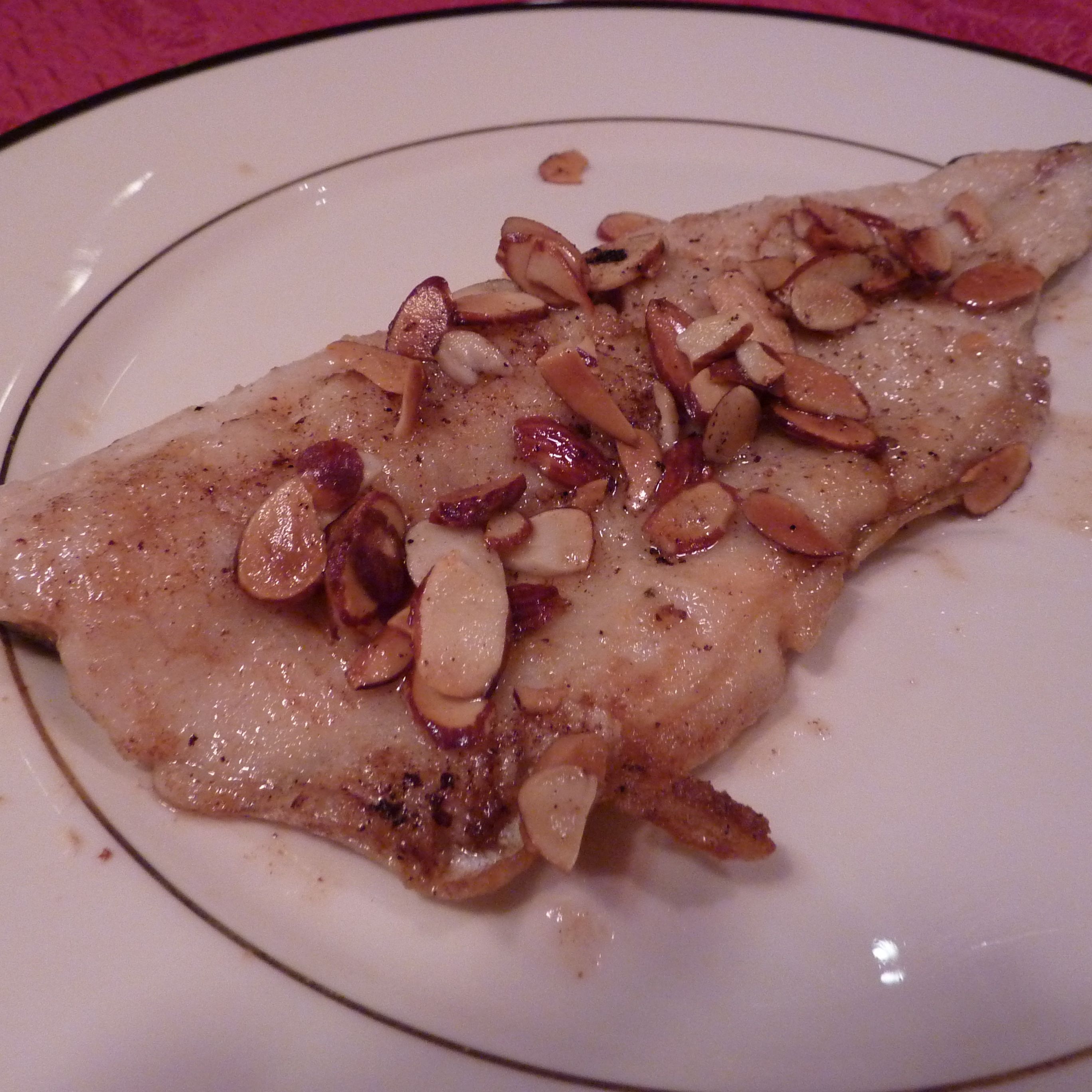
Trout with Grappa and Almonds
Serves 4
Last of the homemade grappa
4 whole trout, heads removed, boned, and cut into 2 fillets each
kosher salt and freshly ground pepper
1/4 cup flour
2 tablespoons butter
1 clove garlic, minced
2 tablespoons grappa
1/4 cup sliced almonds
Season the fillets with salt and pepper. Dredge in the flour, shaking to remove the excess.
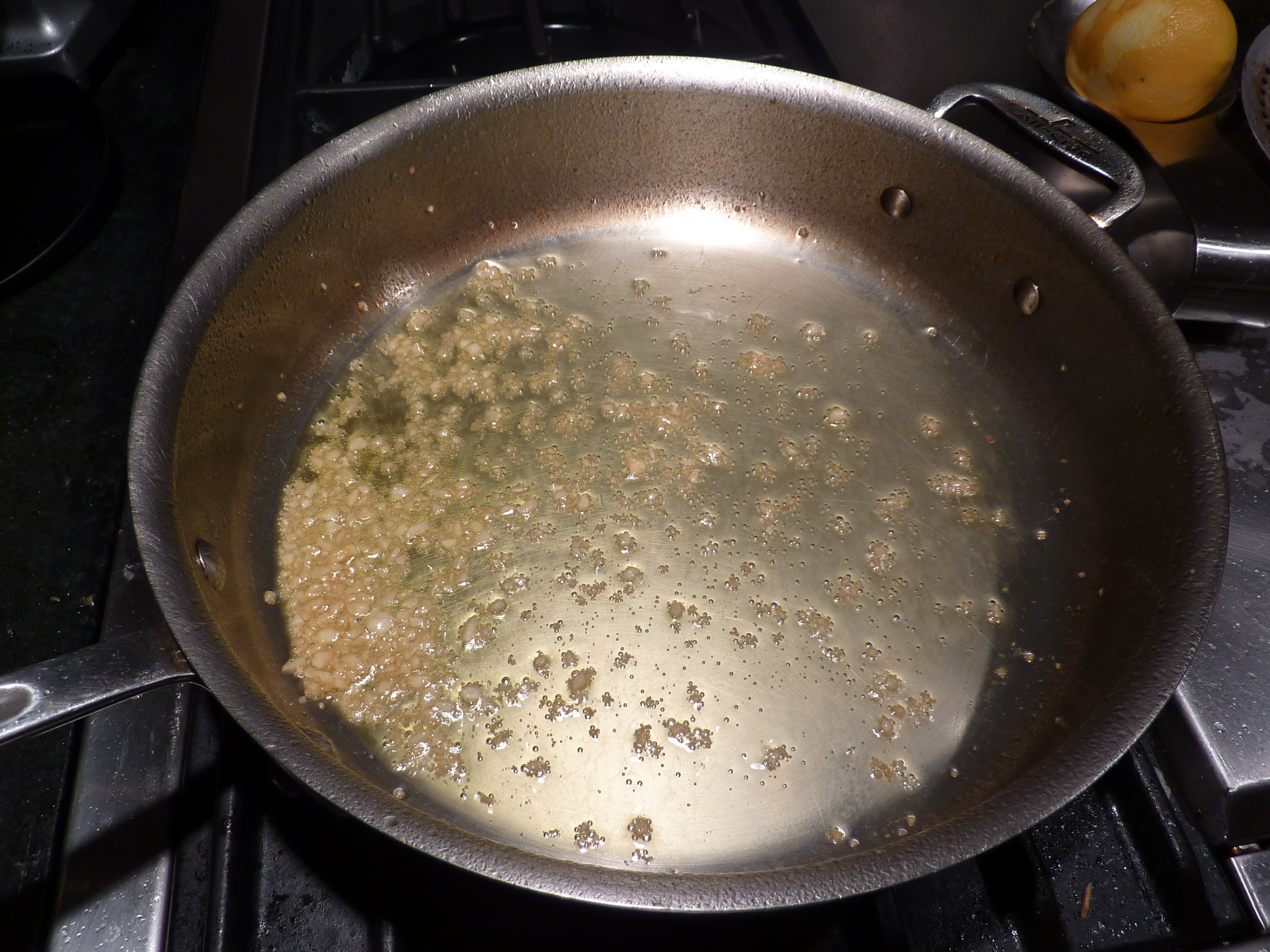
Garlic in butter
Cook the 8 fillets in two batches in a large saucepan. Over medium high heat, melt half of the butter. Add half the garlic, half the grappa and half the almonds. Place 4 fillets in the pan, skin side down. Cook for 2 minutes or so, then flip. Cook until just done. Remove fillets from pan and place on warm plate. Top with almonds and butter from pan.
Trying to maintain a food blog while you are on the road is a challenge! I am writing this from Colorado, where I am skiing with my two sons for a couple of days. So my quick post from here will be another using peas – the subject of my last post earlier in the week. I’ll refer the readers to that post for the background and history of peas in Northern Italy, the site of our Italiaoutdoors bike tours – the season for the fresh new peas is just about upon that region now. We’ve got a few more weeks here in the Northern US, still under feet of snow in ski country. But the crocuses and daffodils are up in Massachusetts, and the arrival of seasonal produce is not far behind!
I am often asked where I get ideas for antipasti. It’s pretty simple – whatever food combinations you enjoy as an entree can be redesigned into an appetizer. I figure out some sort of ‘platform’ for it; a toasted slice of bread (crostini or bruschetta), a pastry envelope (dumplings or empanadas), a skewer, a frico shell, a vegetable (an endive leaf, a cucumber slice), a mini sandwich, a mini pie shell, the list goes on. I look through my selection of cookbooks dedicated to appetizers for inspiration.
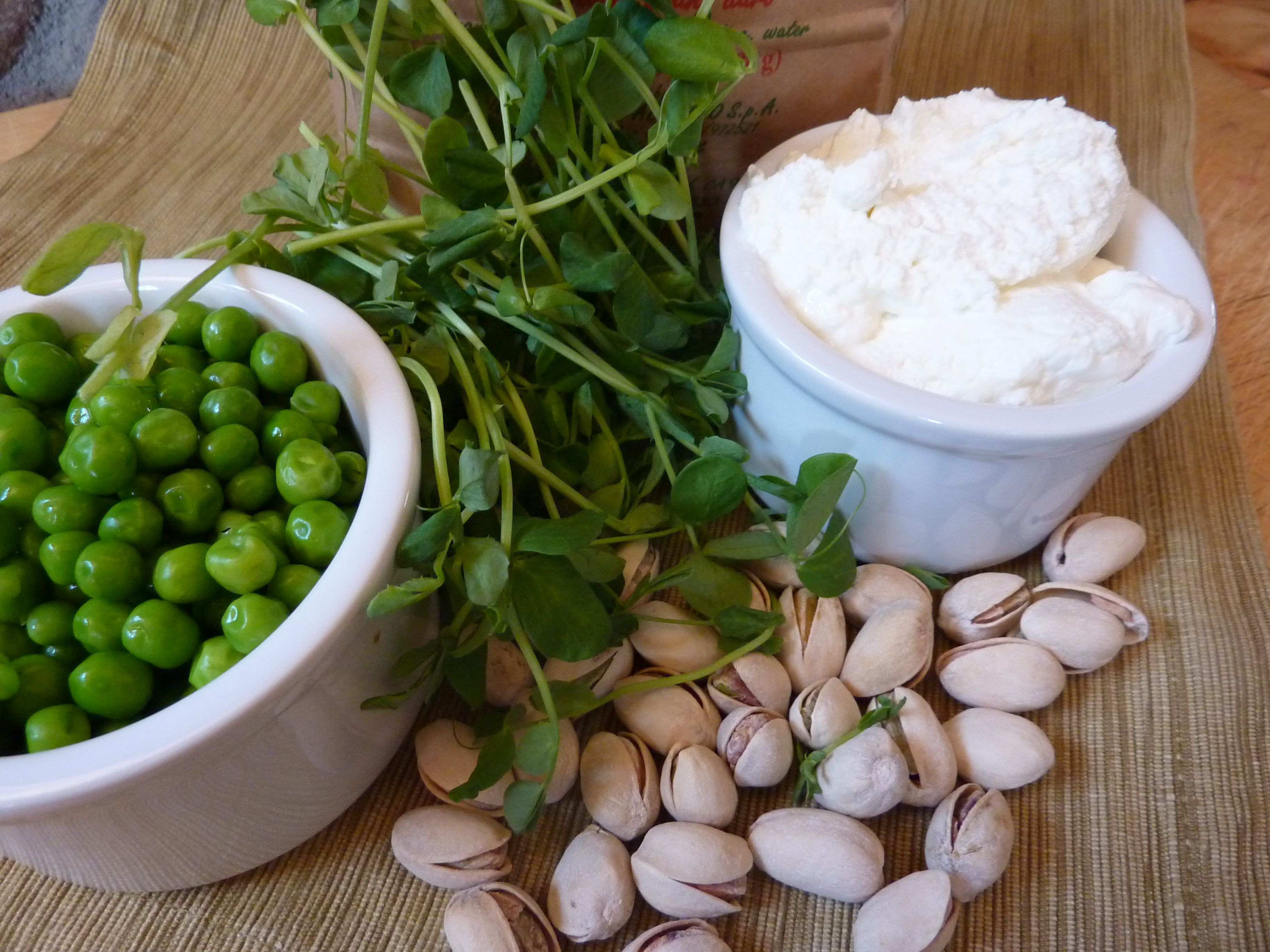
Peas, pea tendrils, ricotto, pistachios
Then I take 3-4 ingredients that I think go together well, and create a ‘topping’ for the platform. It should be small enough so people are comfortable picking it up and eating it – people will avoid those they can’t figure out how to eat gracefully! It should hold together well, so I usually have some sort of paste or something spreadable to hold everything together. It needs to look pretty, so it should have an attractive garnish on top.
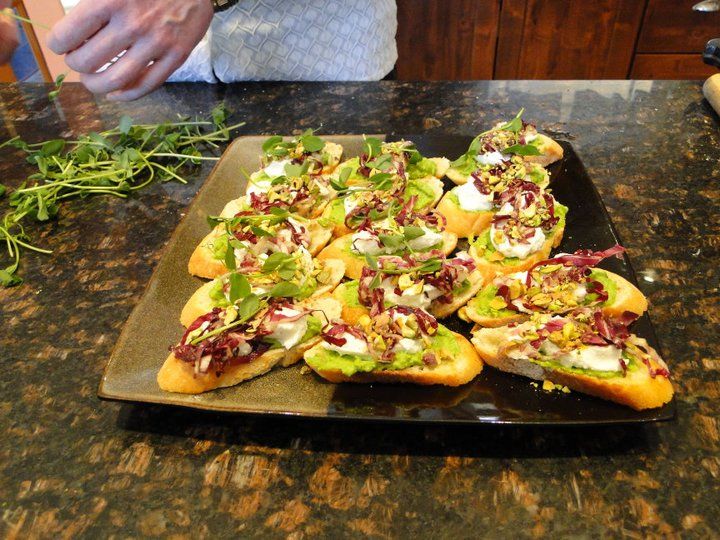
In this recipe, I took the same ingredients I used for my last post – peas, mint pesto, homemade ricotta, radicchio, pea tendrils and pistachios – and created a beautiful spring vegetable antipasti.
Thanks to my good friend Nancy Marshall for the great pictures!
Crostini with Pea Pesto, Radicchio, Pea Tendrils and Pistachios
Makes 16 crostini
1 baguette, 1/4 inch slices on the diagonal
1/4 cup extra virgin olive oil
5 ounces frozen peas, thawed or 1 pound fresh peas, unshelled
1 tablespoon mint pesto, or 1/4 cup mint leaves
1/4 – 1/2 cup extra virgin olive oil
1/4 cup ricotta
kosher salt and freshly ground black pepper
1/2 cup thinly sliced radicchio
1/2 cup pea tendrils
2 tablespoons pistachios, chopped
Preheat oven to 350°.
Place baguette slices on a sheet pan, and toast in the oven until just starting to brown. Don’t allow them to get too brown and hard, as they will fall apart easily when constructing the crostini, or when eaten. Remove from the oven, and brush each slice with the olive oil.
If working with fresh peas, shell them. Set a large pot of water over high heat and to a boil. Salt the water. Cook the peas in the boiling water until just tender. Scoop them out with a slotted spoon or spider. If using frozen peas, skip this step, as they have already been blanched.
If using fresh mint, blanch the mint leaves in boiling water. You can use the same water you used for the fresh peas. I blanch small amounts of fresh herbs by placing them in a strainer, lowering it and holding it in the boiling water. They blanch quite quickly (1 minute or less), and then I can just lift the strainer out of the water and place it directly under cold running water. This way I don’t have to frantically fish around in the boiling water for each and every loose mint leaf. Press on the leaves to remove as much water as possible.
Place the peas, mint pesto or mint leaves into a blender. Add 1/4 cup olive oil, and puree. Add more olive oil as needed to make a nice paste.
Remove the pea pesto from the blender and place in a small bowl. Place the ricotta in another small bowl, and season with salt and pepper.
To assemble, spread each crostini with the pea pesto, and then top with a small spoonful of the ricotta mixture. Top with a bit of the sliced radicchio, then a nice pea tendril, and finish with a sprinkle of pistachios. Any leftovers can make the pasta dish from my last post!
The Colli Berici (Berici Hills) are located in the Veneto region of Italy, south of Vicenza. Here, in the spring, one finds a local variety of peas that have been highly prized by the residents for centuries. Introduce by the Benedictine monks around the year 1000, the Lumignano peas are cultivated in Lumingnano, Castegnero, Nanto, Mossano and San Germano dei Berici.
The monks reclaimed the land at the foot of the Colli Berici (a wonderful hiking and biking destination, by the way), making this area ideal for the cultivation of peas, with the perfect habitat for exceptionally early production – lots of sun exposure, and heat held by the rock formations. Using this prime habitat, however, requires a lot of hard work on the part of the farmers, as they are grown in small terrace gardens cut into the steepest positions on the cliffs, in order to make best use of the sun exposure. Everything needed to build the terrace and cultivate the peas had to be carried up by the farmers. The result, however, is an extremely delicate and tasty product.
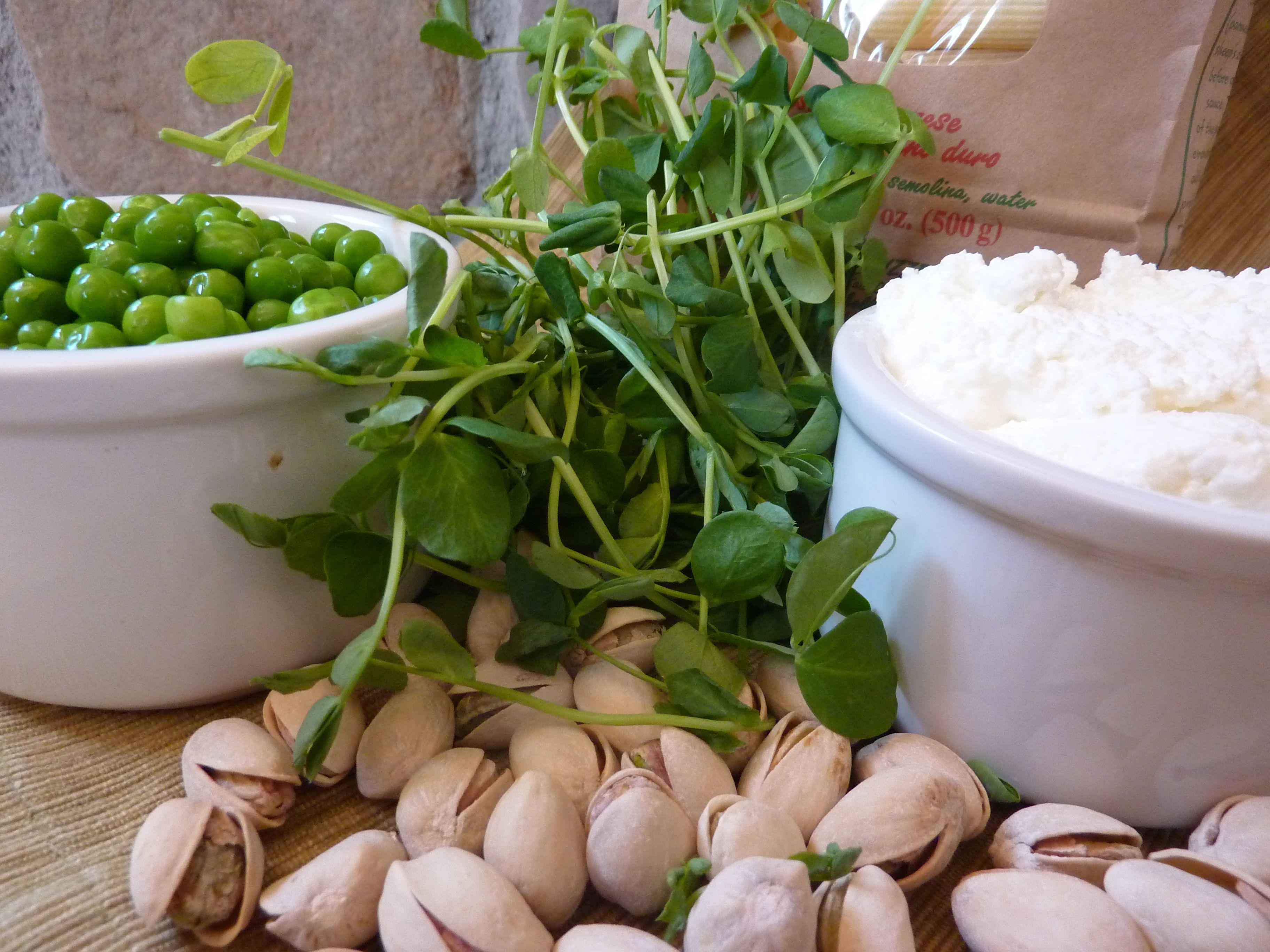
Peas, pea tendrils, pistachios, homemade ricotta
The peas of Lumignano have been prized for centuries. The Doges of Venice demanded that the peas of Lumingnano be the primary ingredient of their risi e bisi (rice and peas) that was traditionally served to the Doges for the Feast of Saint Mark, the patron saint of Venice. This feast day, April 25, coincidentally occurs just about the time the peas first arrive in the markets of Venice.
Today, cultivation of these Lumingnano peas is extremely limited, and are produced only by families for the needs of local restaurants and the Peas Festival, which is held every year in May.
The following recipe calls for bacon, which is not commonly used in Italy. Pancetta, which is unsmoked, and a bit spicier, is preferred in most regions of italy. I have seen several versions of a simple vegetable dish, peas cooked with pancetta. However, in the northeast regions we visit, bacon is found occasionally. Here, I have made a nice spring pea pasta. It is quite good without the bacon for a nice vegetarian meal.
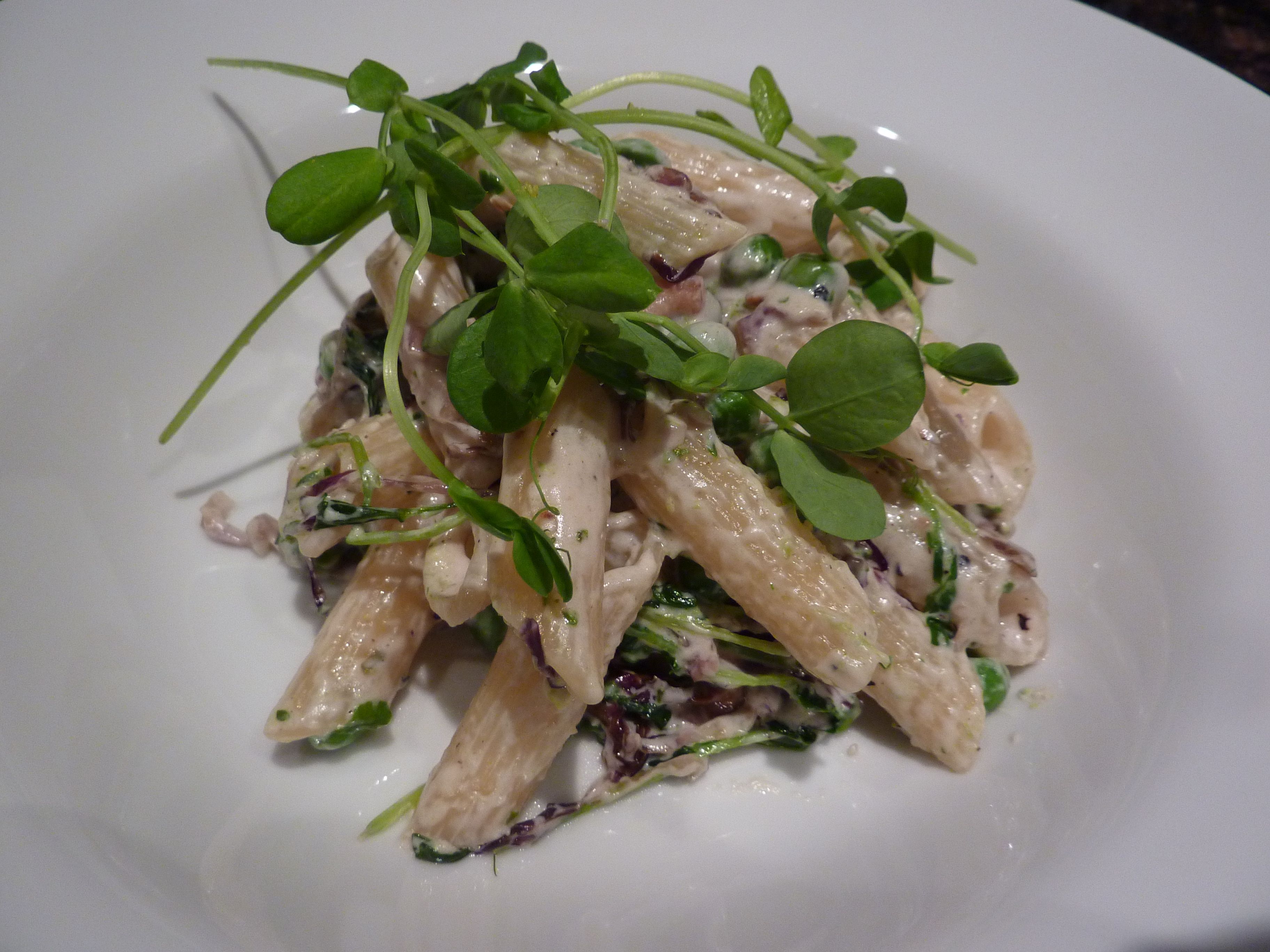
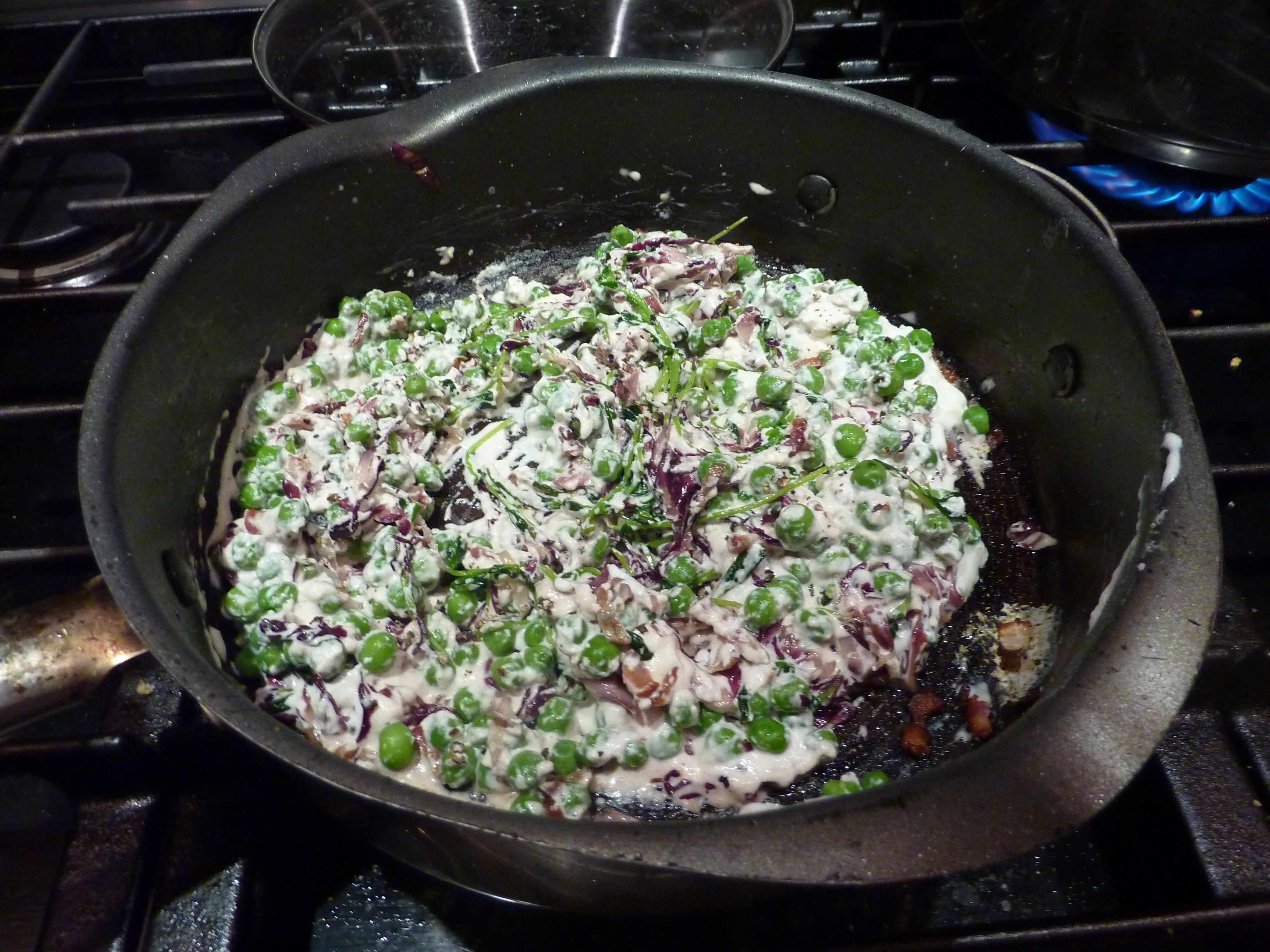
Sauce ready for penne
Every summer, when I can get plenty of fresh herbs, I make lots of herb pestos. I use herbs such as mint, basil, chives, even garlic scapes (the curly green tops of the garlic plant). I first quickly blanch the herbs in boiling water – this preserves their lovely green color, otherwise the pesto can turn a unattractive grayish green. I then put the blanched herbs in a blender, add olive oil, and pureed. I skip the cheese and the nuts; I can always add them later if I choose to use them. I freeze the pesto in ice cube trays, then wrap each individual pesto cube. I can pull one or two out whenever I need to add a little something to a soup, as a nice accompaniment to fish or chicken, or here, in a pasta dish. If you have access to nice fresh mint, don’t bother with the pesto!
Penne with Peas, Bacon, Ricotta, Radicchio and Mint
Serves 4 to 6
5 ounces frozen peas, thawed or 1 pound fresh peas, unshelled
2 pieces bacon, cut into strips
1/2 cup thinly sliced radicchio
1/2 cup pea tendrils
1/2 cup ricotta
1 pound penne
1 tablespoon mint pesto, or mint leaves, thinly sliced
2 tablespoons pistachios, chopped
If working with fresh peas, shell them. Set a large pot of water over high heat and bring to a boil. Salt the water. Cook the peas in the boiling water until just tender. Scoop them out with a slotted spoon or spider. Keep the water hot for the penne. If using frozen peas, skip this step.
Heat a large saute pan over medium high heat, and add the bacon. Saute until lightly browned, but not crisp. Pour off all but 2 tablespoons of the bacon fat.
Add the radicchio to the saute pan, and cook until wilted. Add the peas and ricotta, and stir until combined and the ricotta is heated through. Turn off the heat.
Bring the large pot of water to a full boil, and add the penne. Cook until al dente, reserve 1 cup of pasta cooking water, then drain. Add the penne to the pea and ricotta mixture. If the sauce is too thick (this will depend on the water content of the ricotta), as a bit of ther reserved pasta water to loosen it. Stir to combine.
Stir in the mint pesto or mint leaves and pistachios. Serve, garnished with pea tendrils.
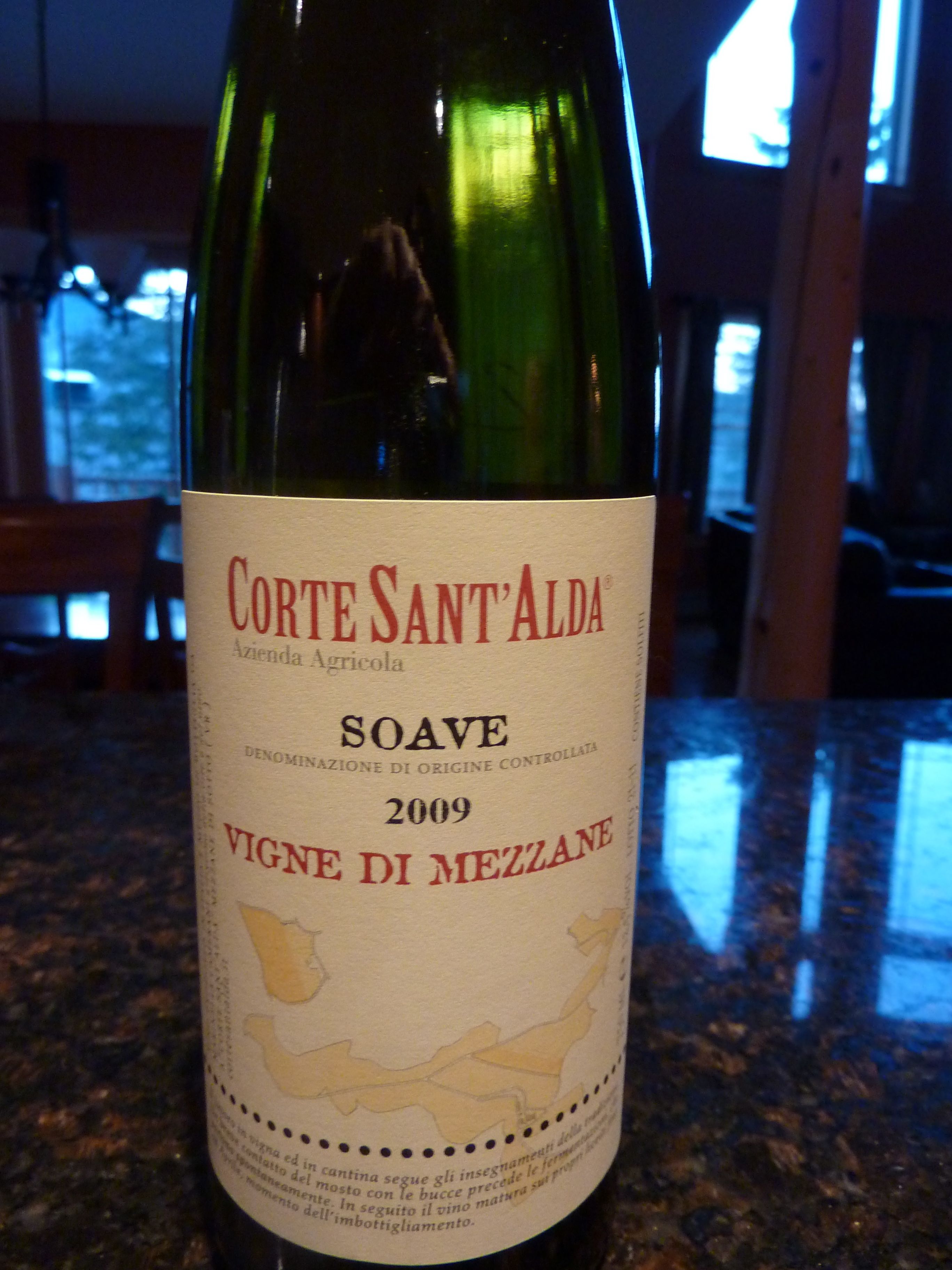
A great wine accompaniment:
Soave Corte Sant’Alda
Soave Corte Sant’Alda 2009 Vigne di Mezzane
Marinella Camerani at Corte Sant’Alda has dedicated much time and energy to the study of the micro-zones in her holding at Corte Sant’Alda. Each micro-zone has its own unique characteristics – sun exposure, soil type, temperature and rainfall variations. Determining which grapes will thrive in which micro-zone is an enormous undertaking, but the wines that result from this attention to detail are superb. All vineyards are managed using bio-dynamic agriculture methods.
Gargenega and Trebbiano di Soave grapes. Native, natural yeasts are used, with aging partly in wood and partly in stainless steel. Fresh, floral nose. Crisp, nice balance. Citrus, apple with hints of almonds.