My Favorite Tricep Exercises

Tricep Pushup on Ball

I am frequently asked about what exercises I use to keep my arms strong. I keep active all year round, biking, hiking, or skiing, but no matter the season, I make a point to include weight training a couple of times per week. I try to keep it fun and mix it up constantly, but I believe that no matter the sport being strong in a balanced way (upper body, lower body, and core) is a key component of both performance and injury prevention. As I continue to try and challenge myself physically (Pan-Mass Challenge this year with Team Rialto) and ramp up for the 2011 bike season with Italiaoutdoors, I want a strong, balanced body that is ready for the road this summer!

Here are a few of the exercises that I use to work my triceps.

Tricep Workout

Your triceps are the muscles on the back of your upper arm, responsible for extending and bending the elbow. Those muscles that, as we age, tend to hang a little bit lower and looser, making us a little self-conscious in our sleeveless summer shirts! However, there are a few very effective exercises we can do to strengthen these. In addition to our physical appearance, these muscles are used every time we push something, so it is important to keep them strong. If you are working your other upper body muscles like your chest and biceps, it is crucial to work the triceps as well, to keep everything balanced.

All tricep exercises involve extending and bending the elbow, either using weights or your own body weight to add resistance. You can work out your triceps up to 3 non-consecutive days per week, going down to 1 to 2 times if you are lifting heavier weights. Your triceps are fairly small muscles, so you won’t be able to lift as heavy a weight with them as you would with your chest or back muscles. And keep in mind that you also use your triceps when doing chest and back exercises, so if you are doing a full upper body routine, it only needs to include 2-3 exercises to specifically target the triceps.

Here are a few tricep exercises. A beginner to weight training should probably only start with 1 or 2, doing 2 sets of each at a lighter weight. A light weight is one you can lift 12 to 16 times before feeling too much discomfort. A more advanced program might include 3-4 exercises, with a heavier weight, one that gets pretty heavy after only 6-8 repetitions.

Today I did 3 of these exercises as part of a 9 exercise upper body workout. I chose 3  different exercises, and did 25 reps of each. When using a heavier weight, I have to break it into two sets of 12-13 reps. I like to do different exercises that target the same muscles, rather than multiple sets of the same one – that way, if I really hate one, I only have to push through one set! With most of the other 6 exercises also working the triceps to some extent or another, they are pretty tired right now.

Tricep Extension Exercises:

Tricep Extension:
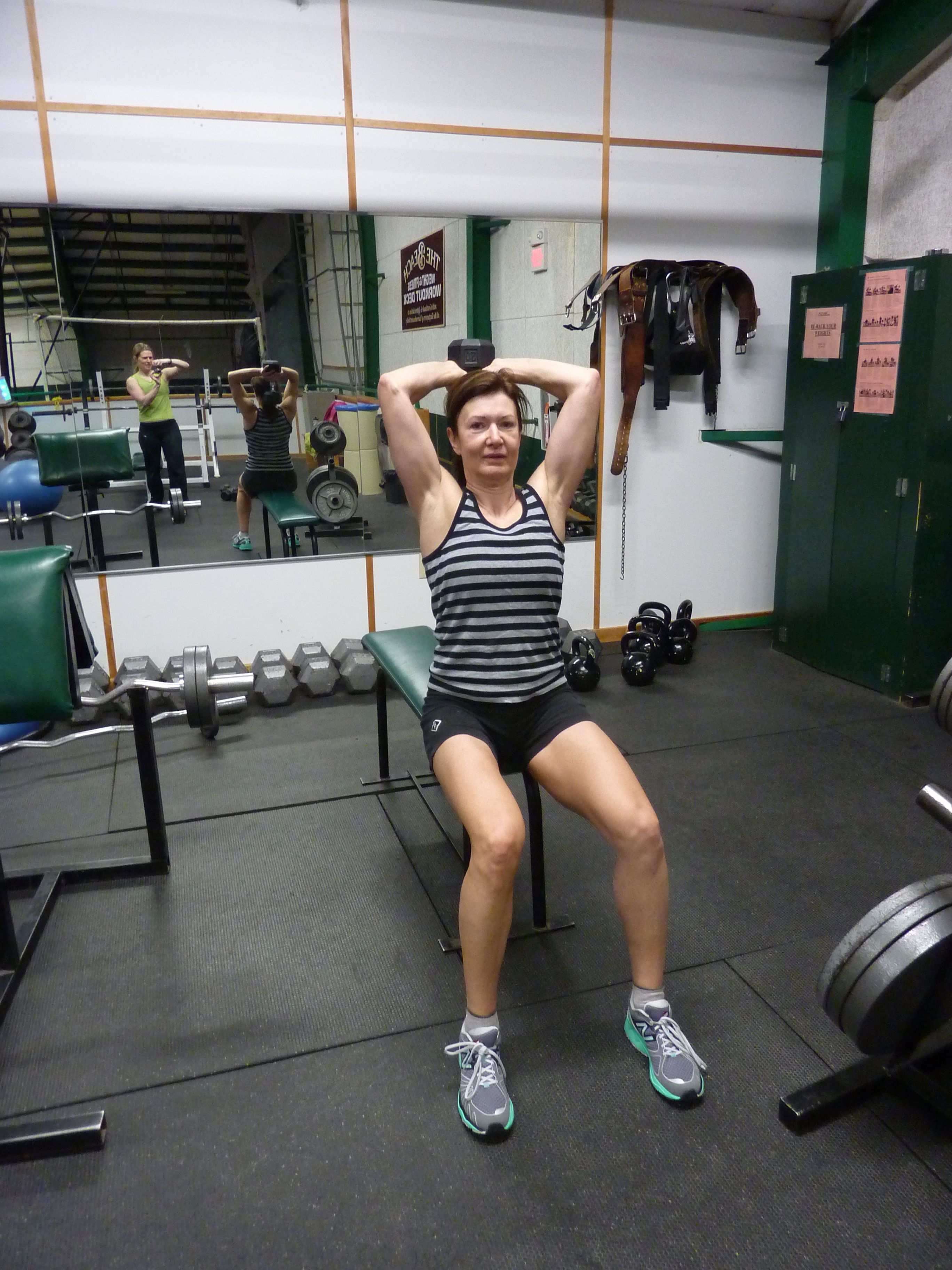
Tricep extension

Sit on a bench, or preferably an exercise ball. I always like to add a bit of a balance challenge to any move – it strengthens all the little muscles that stabilize your body, which I think is so important to preventing injuries. Beginners may want to leave the balance challenge out, and choose a more stable base. Grasp one weight in both hands and extend your arms over your head.  Slowly lower the weight behind your head until the elbows are about at a 90° angle. Raise the arms until straight, without locking the elbows. Repeat.
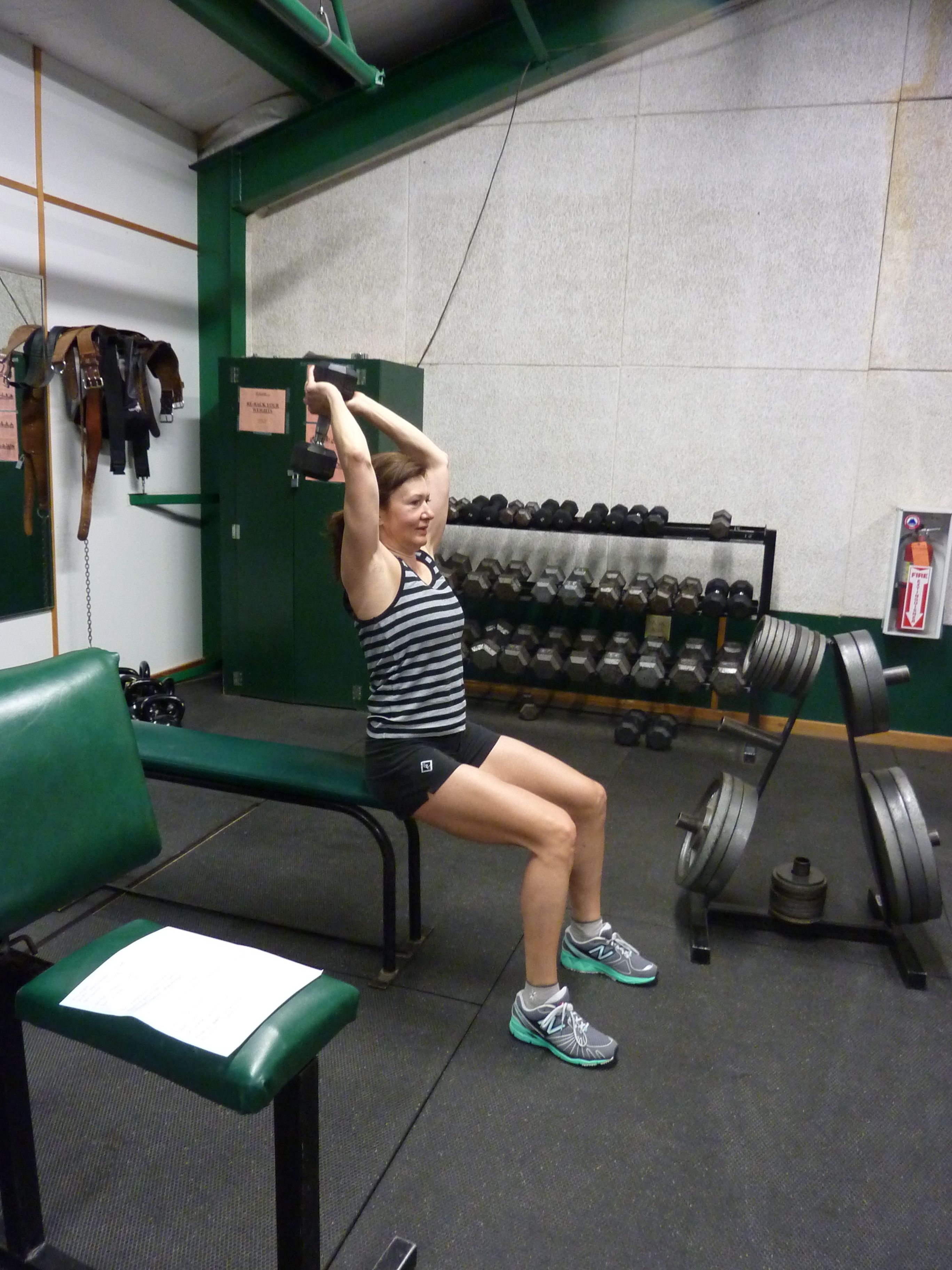
Tricep extension

This exercise can be done on the road or at home with a resistance band. Perform it standing, with your feet on one end off the band and grasp the other end with your two hands behind your head.

Tricep Kickbacks

Tricep Kickback

This should be attempted first with a pretty light weight. Hold the weight in one hand, and bend over until your chest is at a 45° angle or even parallel to the floor. Extend one leg behind you, in line with your chest. The leg opposite the arm holding the weight will be somewhat easier to extend and balance than the one on the same side – or at least I find it that way! You can do this near a bench or chair if you need some balance assistance.

Bend the arm and pull it in toward your chest. Then slowly extend the arm until it is straight, again without locking the elbow. Repeat. Switch and do it on the other side.

Tricep Presses or Pushups

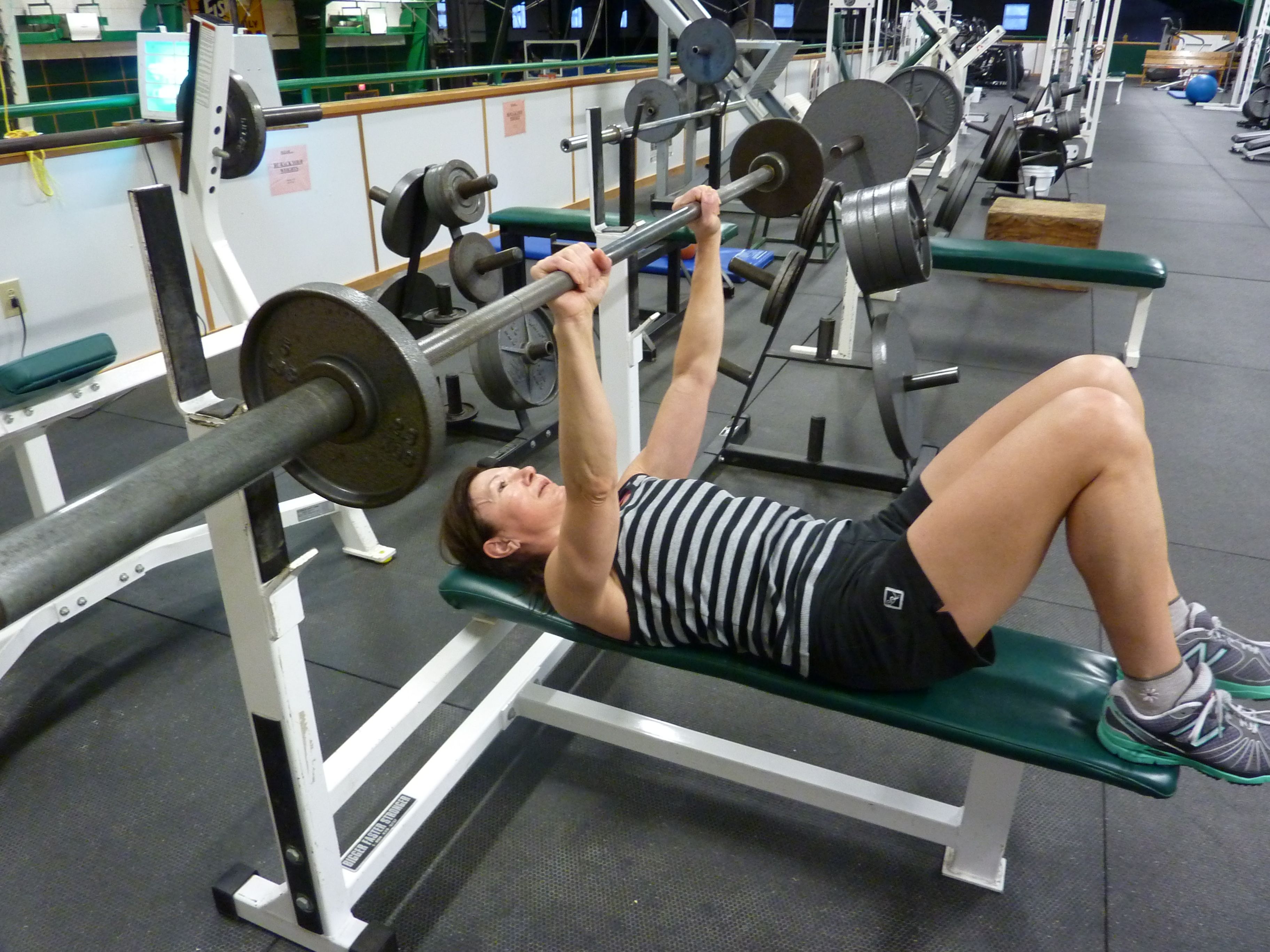
Tricep Bench Press
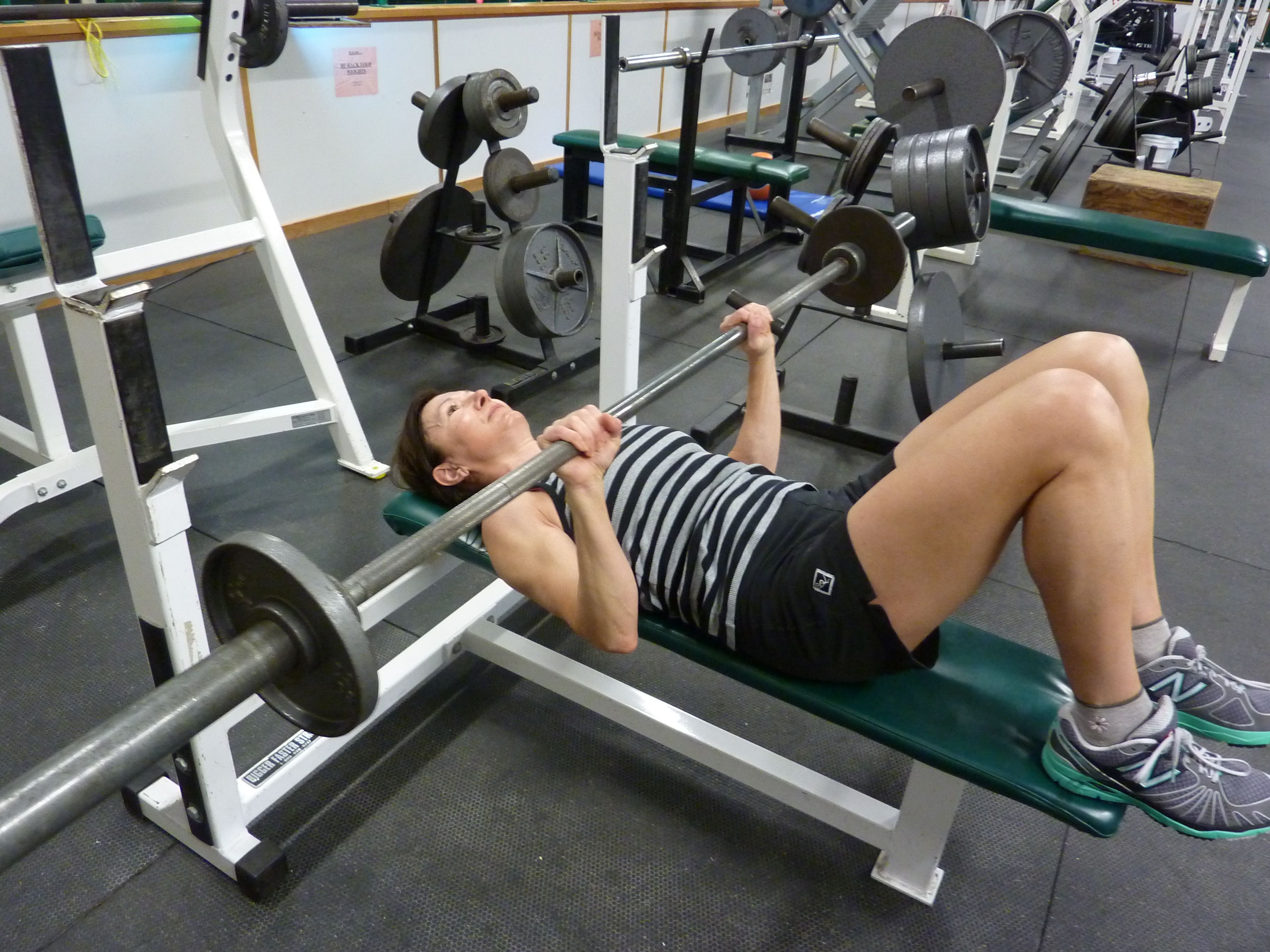
Tricep Bench Press
Tricep Bench Press

Lay on a bench under the chest press frame. Again, you would use a lighter weight than you would for a regular chest press; beginners may want to start with the bar only, or even with two light dumbbells. Grasp the bar with both hands, with your hands positioned only chest width apart. Lift the bar and lower it over your rib cage. If your hands are positioned correctly, your elbows should end up right next to your body and bent at a 90° angle. Slowly lift, keeping your elbows aligned under your hands, until your elbows are extended (but not locked.) Lower, and repeat.

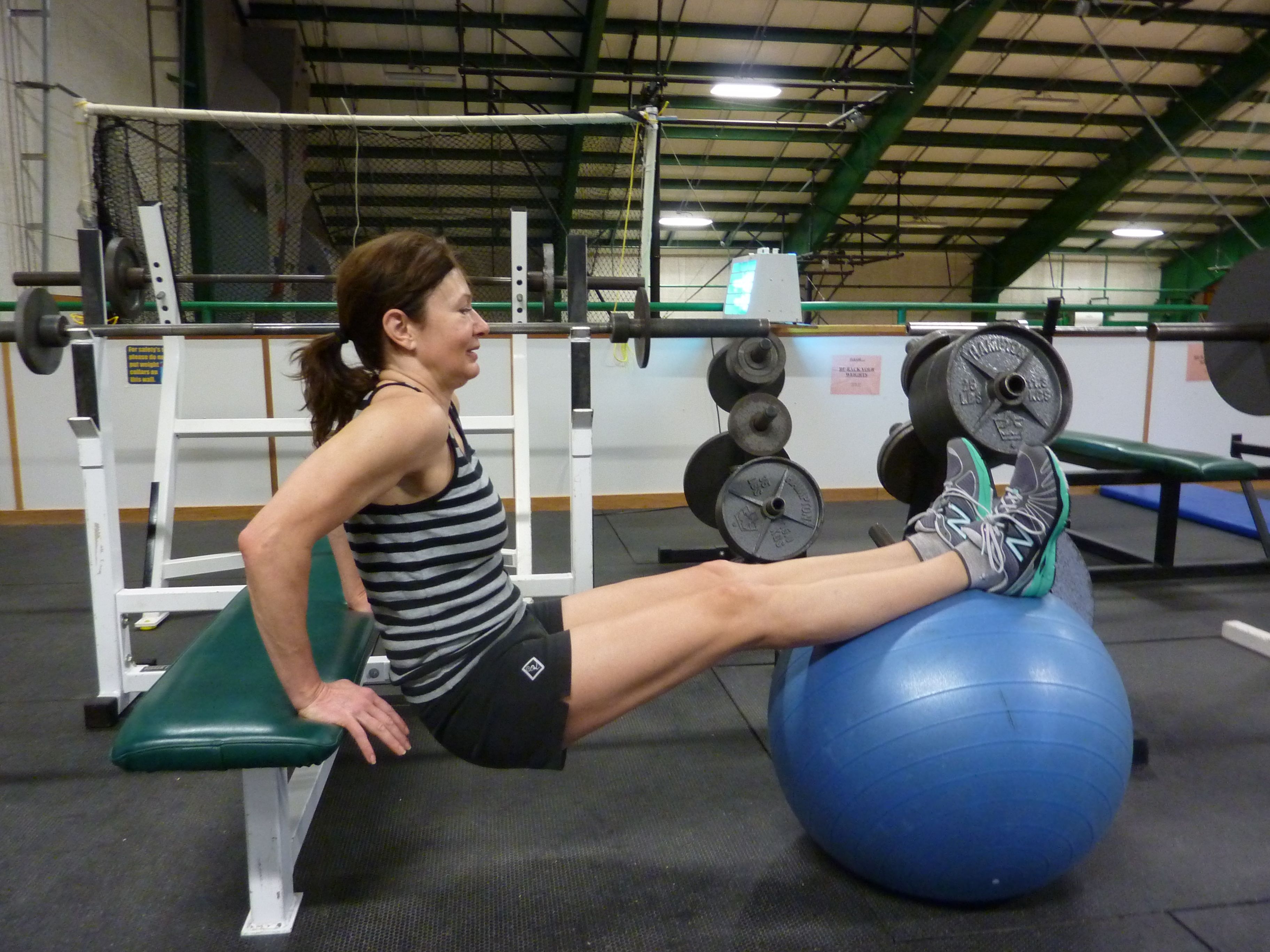
Tricep dip on ball
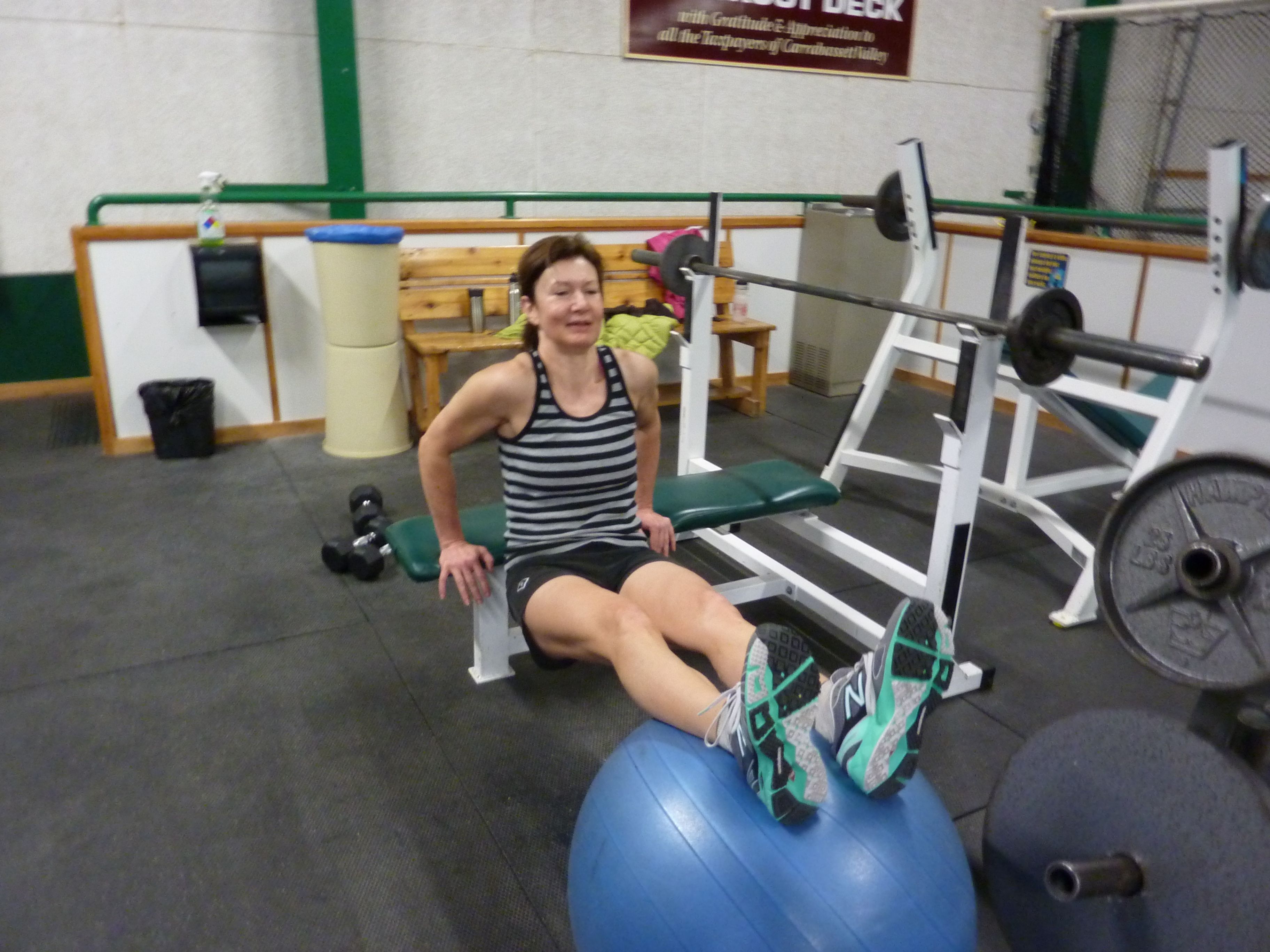
Tricep Dip
Tricep Dip

A tricep dip is a great exercise for on the road – it works both the tricep and shoulder, and can be done anywhere – even on a windowsill!

Sit on a bench or chair, and place your hands next to your hips. Lift up off of your hands and move your butt forward off of the bench. The further away your feet are from your hips, the more difficult this exercise becomes. Beginners start with their knees pretty bent and their feet close to their hips. More advanced perform this with straight legs, or can even balance their feet on an exercise ball.

Lower your hips by bending your elbows – do not bend them more than 90°.  Don’t allow your shoulders to move up towards your ears. Keep your shoulders down. Push back up until your arms are straight – once again, without locking elbows. Repeat.

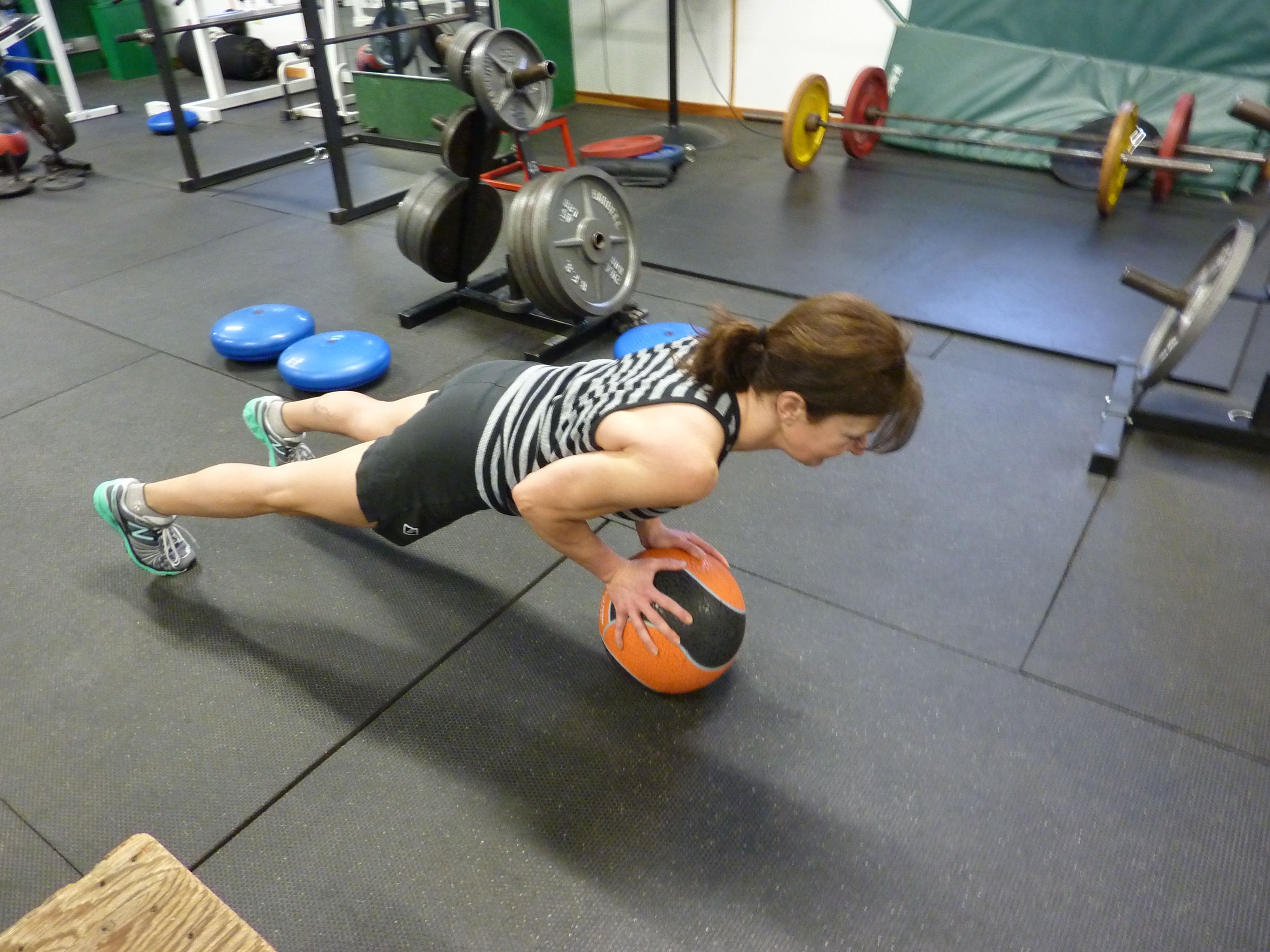
Tricep pushup on medicine ball

Tricep Pushup on Ball

This is a variation on the tricep bench press, in which your body weight is acting as your weight. Beginners would perform this on your knees. This is a surprisingly challenging exercise! And another good one on the road, you just envision having the ball in front of you, and position your hands flat on the floor in a narrow hand placement.

Tricep Pushup on Ball

Kneel in front of a medicine ball and place both hands on either side of the top of the ball. Extend your legs and balance on your toes, just as you would for a standard pushup. Lower your chest down toward the ball, keeping your elbows close to your sides, rather than letting them fan out towards the sides of the room. Remember to keep your core engaged so it remains in a straight line from your head to your feet, rather than sagging down toward the floor. Extend your elbows to raise your chest, again without locking your elbows. Repeat.
Posted in Fitness, Uncategorized | Tagged , , , , , , , , | Leave a comment

The Best Smoked Salmon

smoked salmon ski holidays dolomites
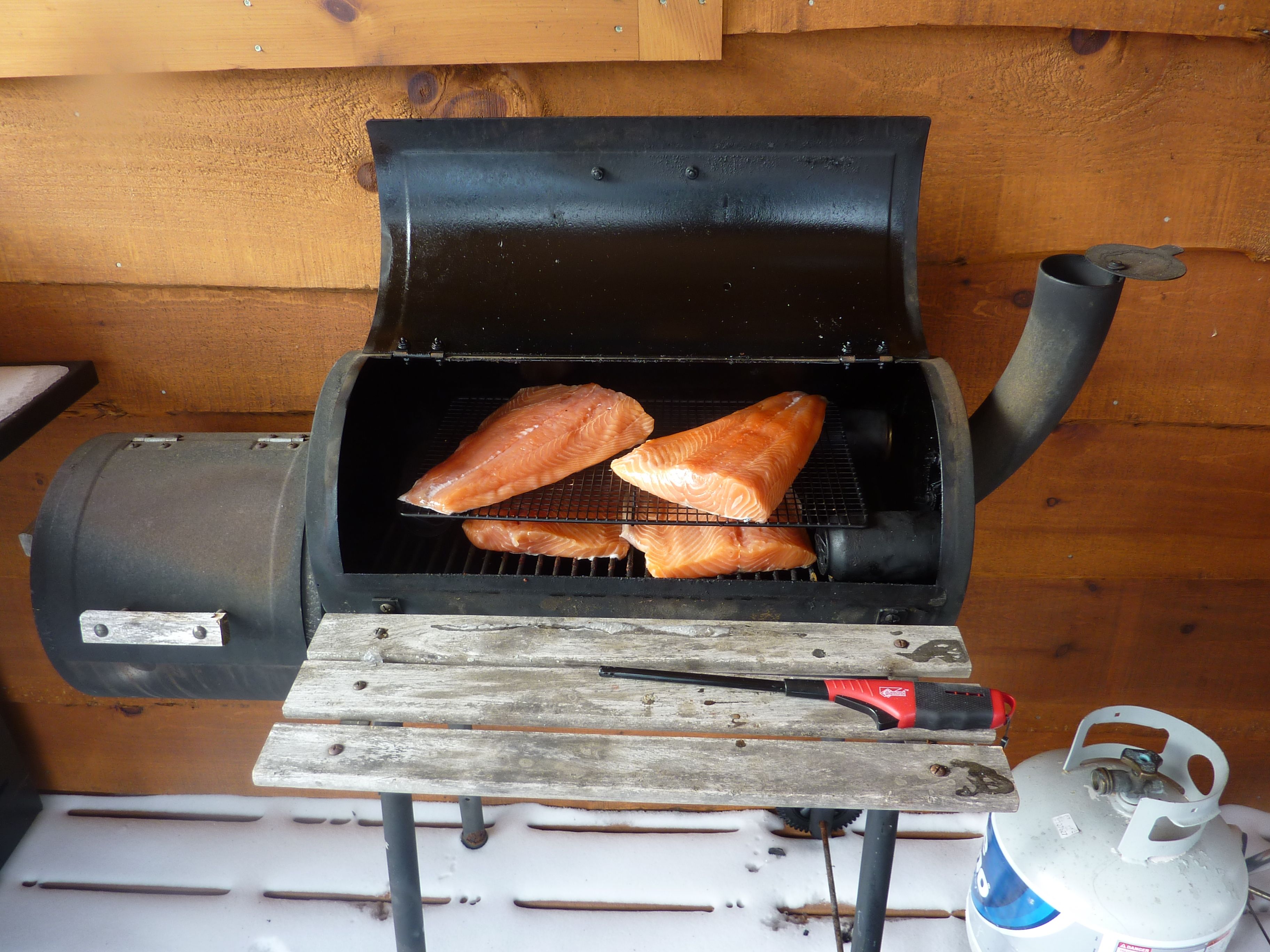
Salmon after smoking

I’ve been smoking salmon for years, ever since we purchased our first smoker around 15 years ago. We now have two, one which I found in my neighbors’ trash heap and dragged home after a 6am run. Both have a cylinder with a grill and a lid, a firebox that hangs off of one side, and a chimney that rises from the other side. We fire up some coals, place them in the firebox, put the item to be smoked in the cylinder, and smoke away! We’ve done salmon, ribs, scallops, tomatoes, even our Thanksgiving turkey. The turkey can take a while – start early, especially on a cold day! But I have lost count of the number of people who have told me this is the best smoked salmon they have ever had.

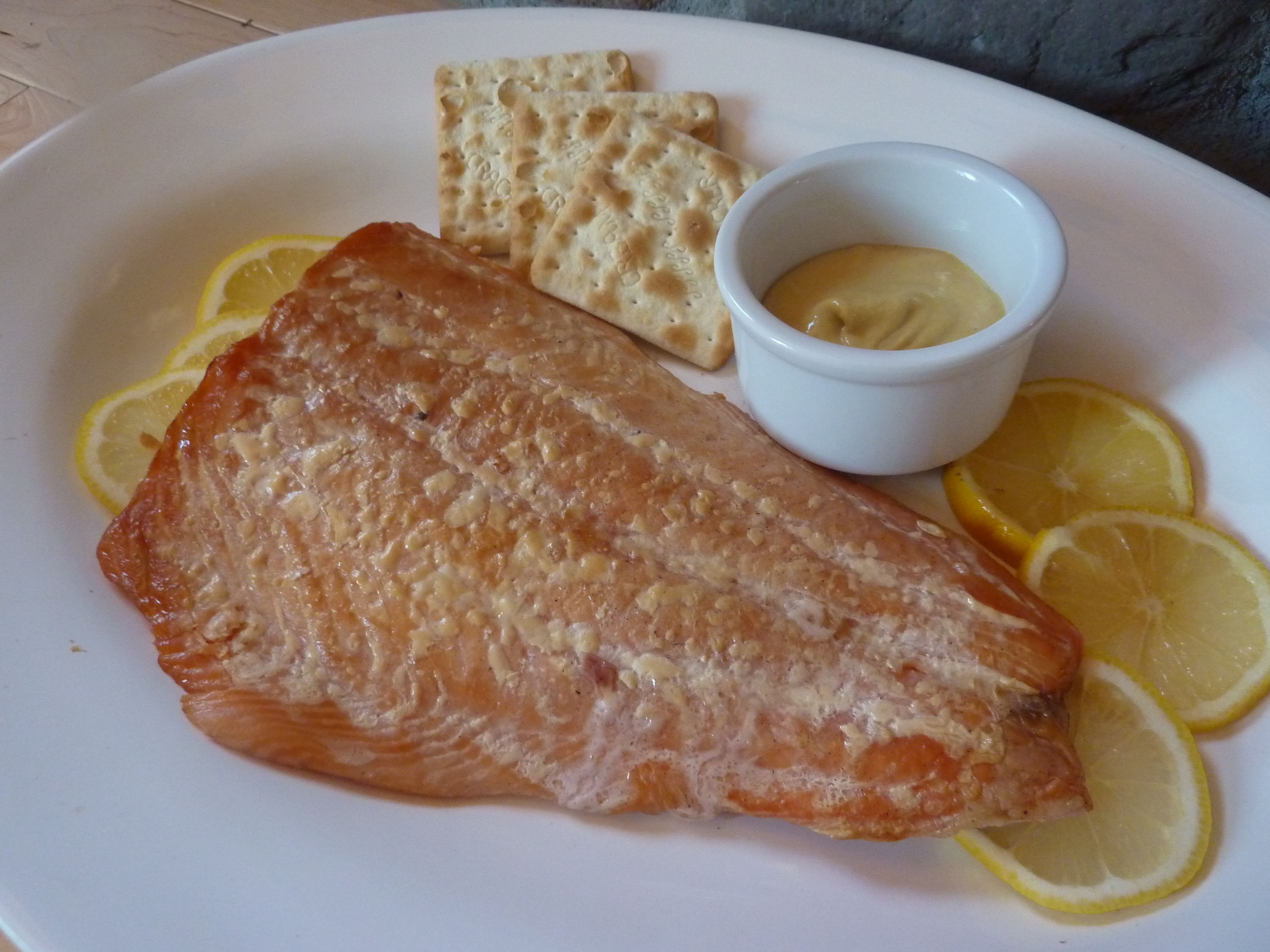
Smoked Salmon antipasti cycling tours friuli
Smoked Salmon

In Italy, trout, salmon and herring have been smoked for centuries in order to preserve them. Today, the area around San Daniele in Friuli-Venezia Giulia has become known for its high quality smoked fish products, primarily trout, which are now being exported. These producers use the extremely fresh fish available from their local lakes in conjunction with traditional smoking techniques to obtain the highest quality products.

I’ve been reading a bit about the methods these producers use, in an effort to understand what makes a great smoked salmon or trout, and how I can perhaps make mine even better.

Small fish are usually smoked whole, while larger fish are filleted. Prior to smoking, the fish are dry salted with a combination of coarse salt and sometimes herbs. This both flavors the fish, as well as dehydrates it, which preserves it. In more industrial methods the dry salting is replaced by salt injection.

Current larger producers have adopted time newer time-saving smoking techniques. Some use a liquid smoke, which is injected or rubbed on the fish to deliver a smoky flavor. Others use an electrostatic method, in which static liquid particles of smoke are attracted to the food, adhering to it. Both methods can result in excessive amounts of hydrocarbons being deposited on the fish, resulting in an unpleasant smell or taste. As is often the case, these efforts to save time result in a poorer quality product.

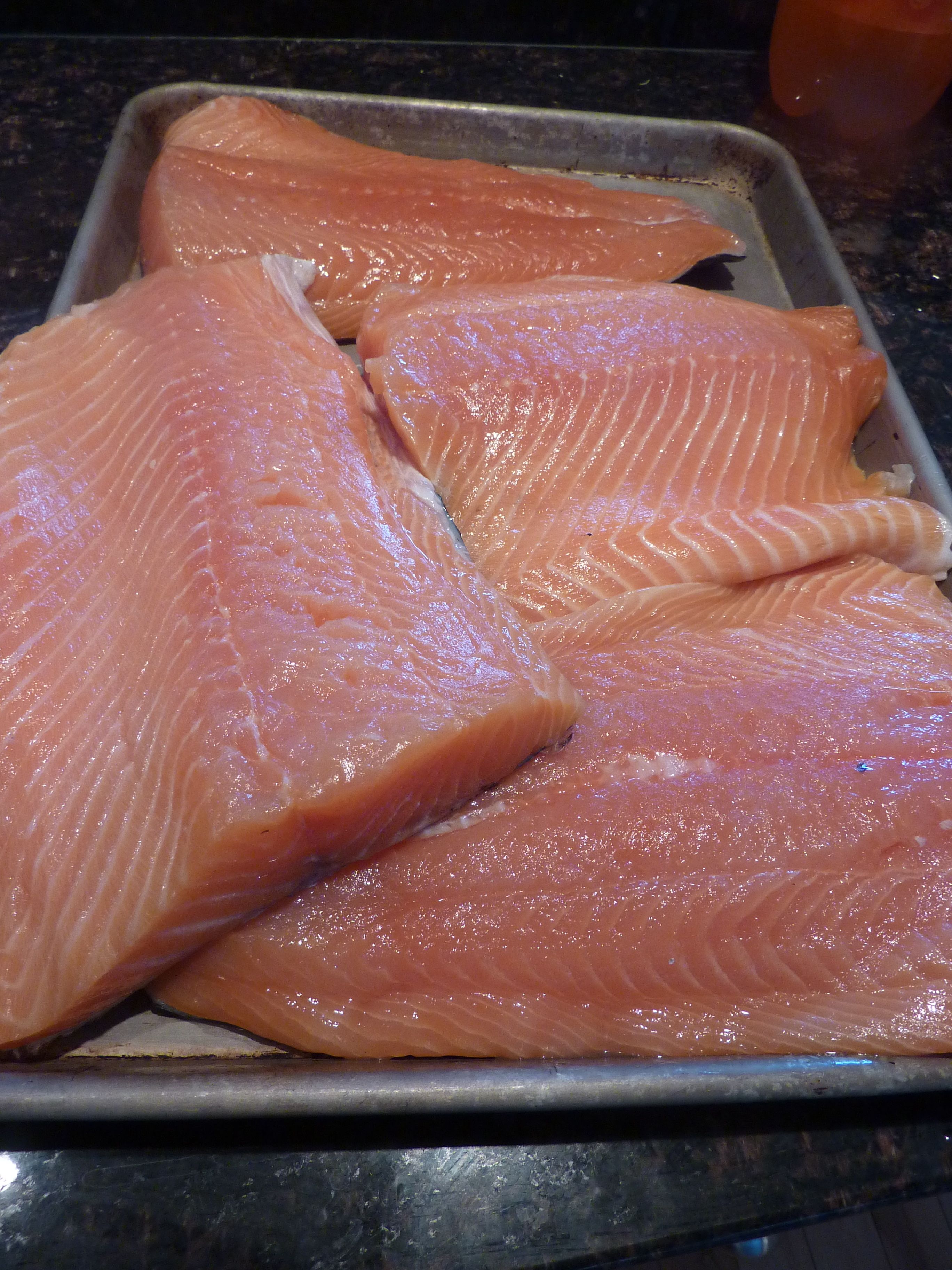
brined salmon culinary bike tours italy
Salmon after brining

In the traditional method used by the artisenal producers in Friuli-Venezia Giulia, the fish can be either hot or cold smoked. This is performed in a smoke house, or room, and the smoke is produced by the flameless combustion of wood chips, or sometimes white flour. In the hot smoking method the fish is smoked at 70°/80°C, so it is cooked as well as smoked. For cold smoking, the smoke is under 27°, so the fish is not cooked. Due to the lower temperatures, the cold smoking takes much longer. In both cases, a precise combination of wood types, herbs and berries are used to create the smoke which delivers a unique flavor profile to the final product, a secret each producer holds close.

My method for smoked salmon uses the traditional hot smoking method. I don’t dry salt, but rather brine my fish. We usually smoke salmon, and it is the one time that I prefer farm raised salmon over wild caught. We have found that the higher fat content in the farm raised salmon produces a moister smoked salmon. The leaner, wild caught can dry out a bit.

I do not salt nor smoke to dehydrate and preserve the fish, so I make no claims that this will keep any longer than salmon that has just been baked. The end product is flaky, just like a cooked salmon. It is still moist, but with a wonderful smoky flavor. I will try the dry salt technique next time we smoke, but I think I’ll have to be careful not to oversalt – we only brine the fish for two hours or so, as we find much more than that makes the salmon too salty.

I keep the flavors simple, just a salt brine. I use a high quality hardwood charcoal, and a bit of apple or maple or whatever wood scraps we may have lying around. Don’t use Kingsford, or any of those charcoal briquettes that have all sorts of additives to make them burn better/longer – you don’t want your salmon to taste of that!

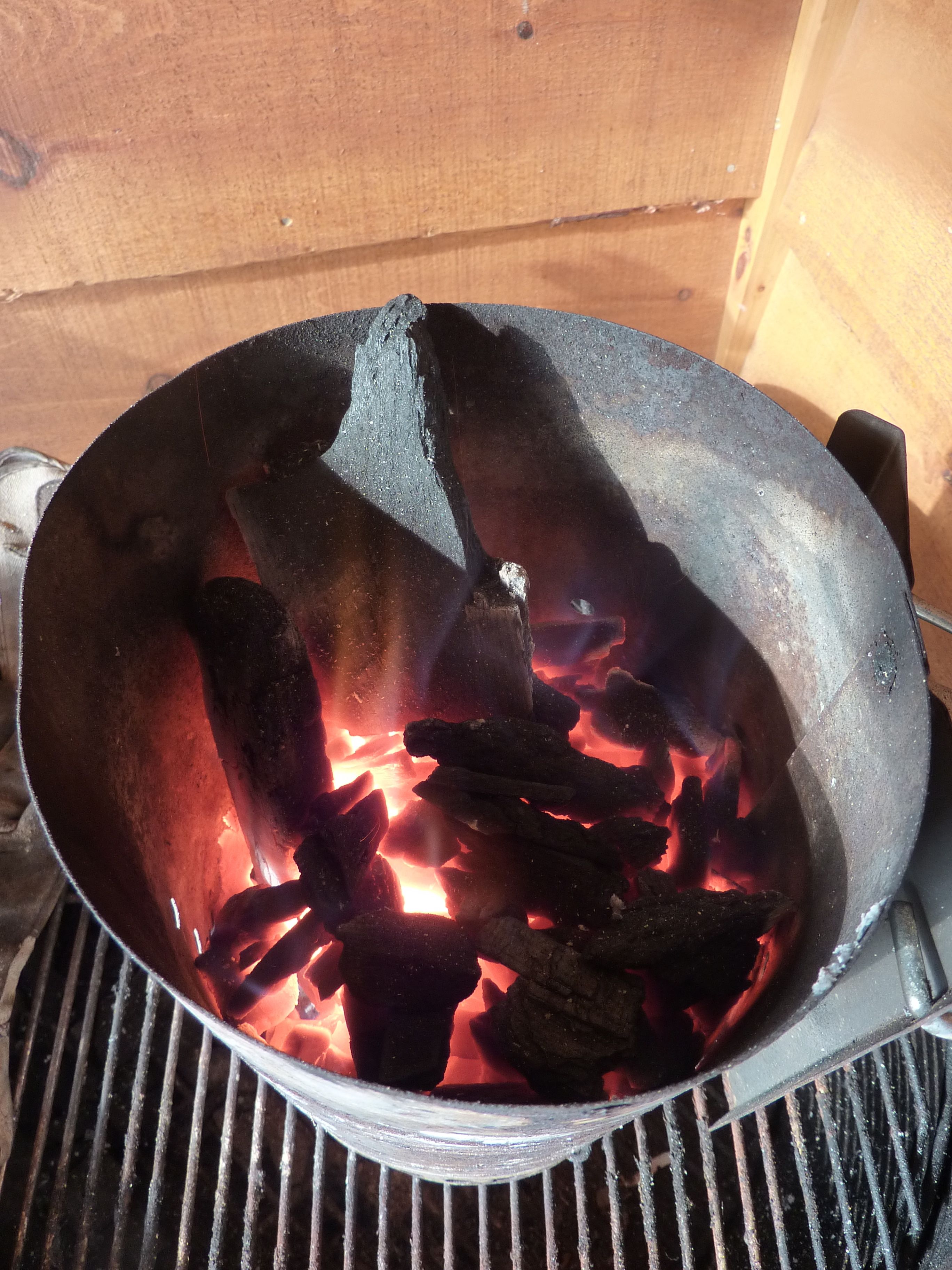
hot charcoal custom bike tours italy
Hardwood charcoal heating up

This is fantastic as an appetizer, on your breakfast bagel, on pasta, in risotto, even on pizza with some arugula and creme fraiche

Hot Smoked Salmon

1 heaping cup kosher salt
1 large salmon filet, about 3 pounds

Fill a large container with about 14-16 cups of water. There should be room enough remaining in the container to hold the fish as well. Stir in the heaping cup of salt until dissolved. Add the salmon filet and refrigerate for 2 hours.

About 30 minutes before smoking (about 1 1/2 hours after adding the filet to the brine), start a charcoal fire, either in a charcoal chimney or in the firebox. Allow the coals to burn and turn gray. If using the chimney, pour the coals out into the firebox. Add a piece or two of wood or flavored wood chips, or anything else you can think of to add some great flavor.

Remove the filet from the brine, lay it on a sheet pan and dry with paper towels.

Place the filet on the grill in the smoking cylinder. Check the vents on the firebox and the smoker chimney to make sure air is flowing through the unit from the firebox, across the filet, and up through the chimney. Smoke for 4-6 hours, until the salmon is a deep brown. This time will vary a bit with outside temperature. Keep checking the smoker, adding more charcoal or wood as necessary.

Serve with crackers and dijon mustard.

Posted in Friuli-Venezia Giulia, Salmon, Smoked Food, Trentino Food, Uncategorized | Tagged , , , , , , , , , , , , , , , , , , , , | 1 Comment

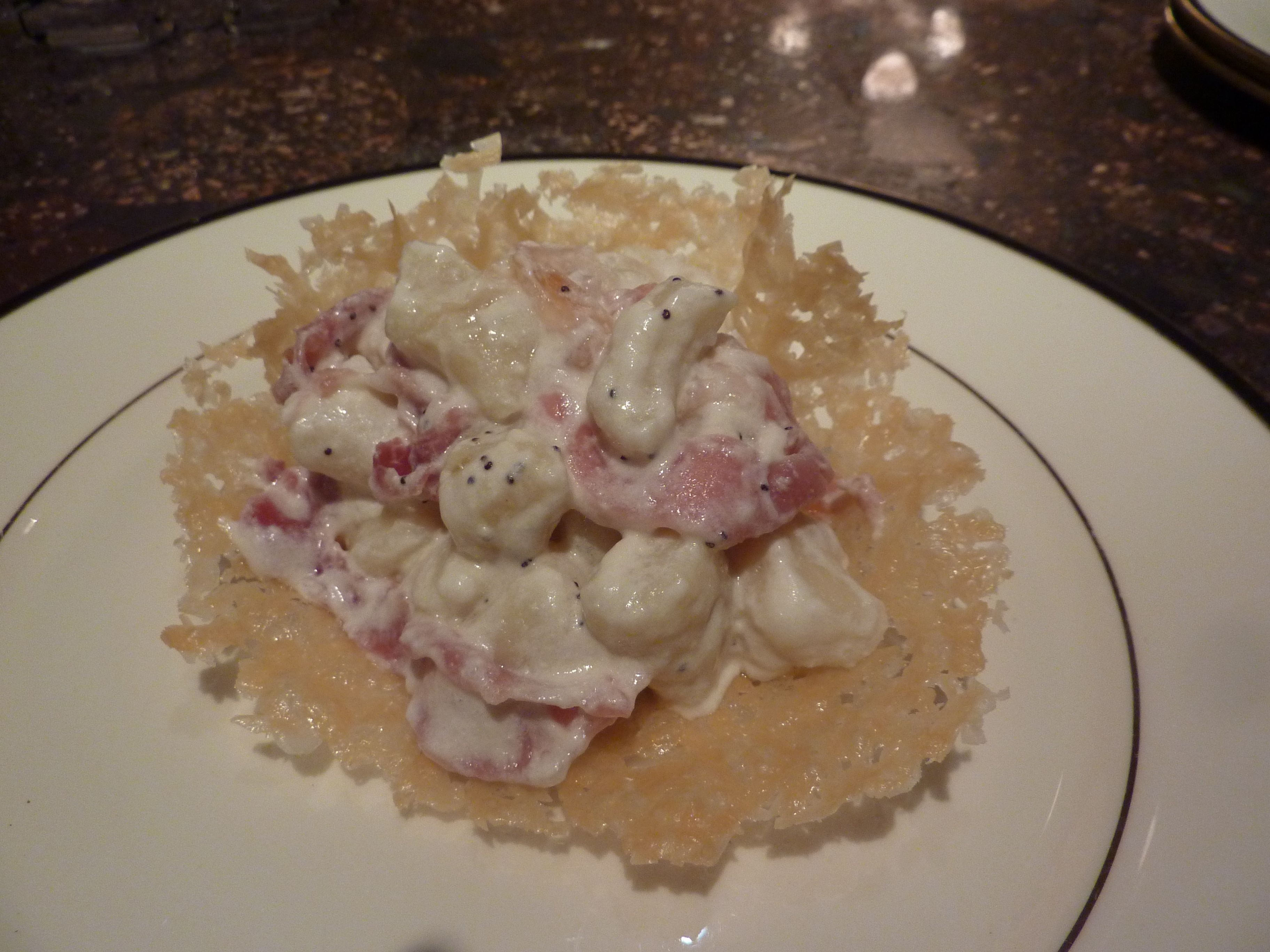
Gnocchi con Crema di Montasio, Speck e Semi di Papavero (Gnocchi with Montasio Cheese, Speck and Poppy Seeds)

gnocchi di montasio bike tours italy

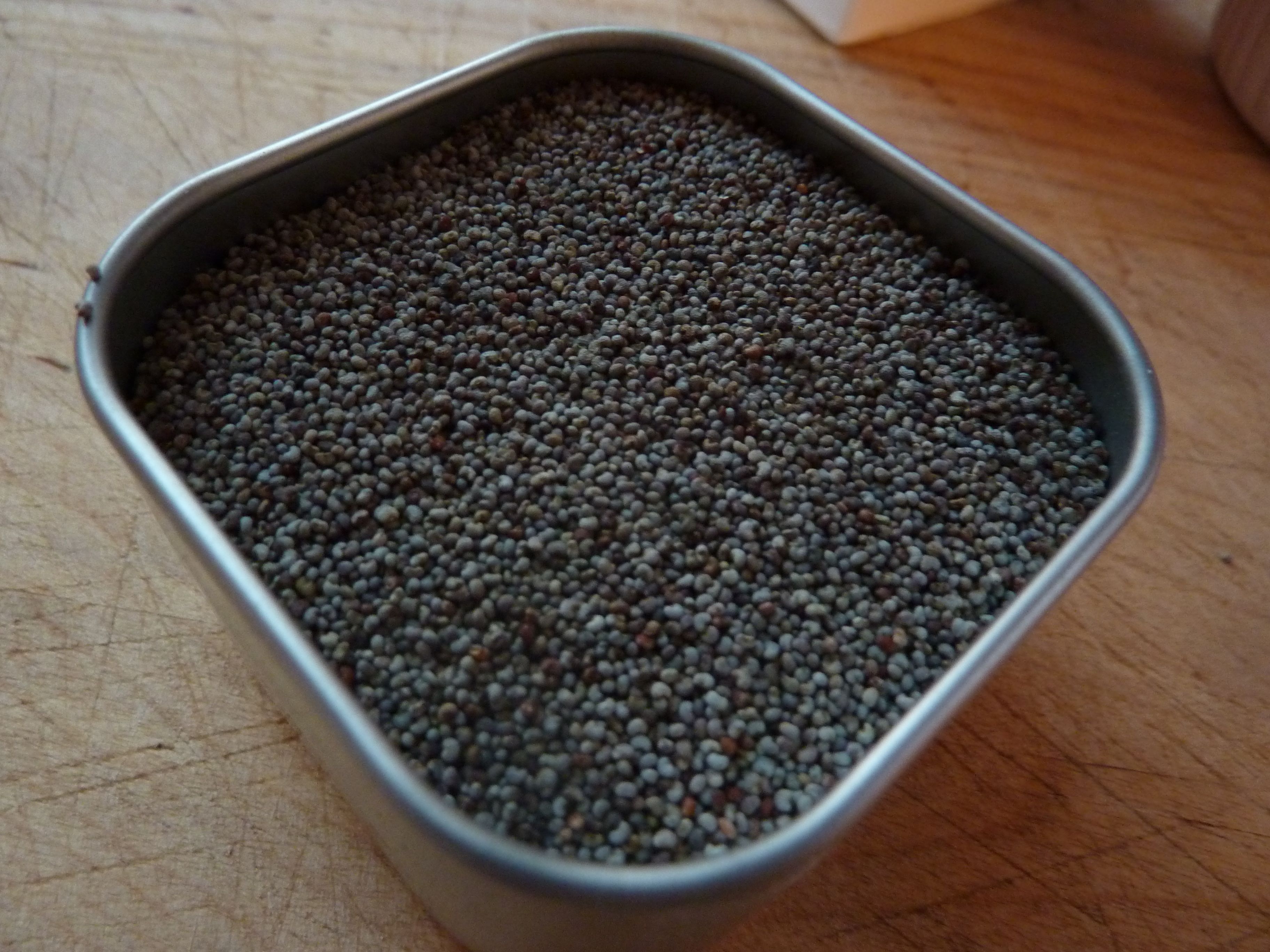
Poppy seeds are quite popular in the cuisine of Friuli-Venezia Giulia, but are seen very rarely in regions outside of Northeastern Italy. These seeds are obtained from the opium poppy. but have no narcotic effect! They can be used whole or ground, or pressed to produce poppy seed oil.

Poppy seeds are used in many cuisines of Central Europe – Austrian, Czech, Hungarian, German and Slovac. There appearance in the cuisine of Friuli-Venezia Giulia is one more example of the influence of these areas on the foods of this region of Italy.

poppy seeds cycling tours dolomites
Semi di Papavero (Poppy Seeds)

The city of Trieste lies on the Adriatic, and throughout history was a very active trading port, as Austria lavished money and attention on the principal port of the Hapsburg and then Austro-Hungarian empire. Here, spices of all types arrived to be carried north to Austria, Germany and elsewhere in Central Europe. These spices were often transported by cramars, traveling peddlers who lived in the mountains of Carnia in the northernmost section Friuli-Venezia Giulia. Originally settled by the Celts, who brought with them a talent for land management, and began by raising livestock in this region. When winter approached, and grazing was limited, these pig farmers would load up with spices, leave their families behind and made a difficult trek north through the Alps to Austria and Germany to pick up some additional income by selling their wares.

As many of these spices were believed to have medicinal benefits, these cramars became a sort of medicinal healer as well, selling mixtures of spices and dried herbs as remedies. Any of these spices that were not sold ended up being used in the kitchens of this region. You see them in many baked sweets, breads, and salad dressings, just as you do here in the US, but they also appear in pastas and sauces.

gnocchi biking and cooking tours italy
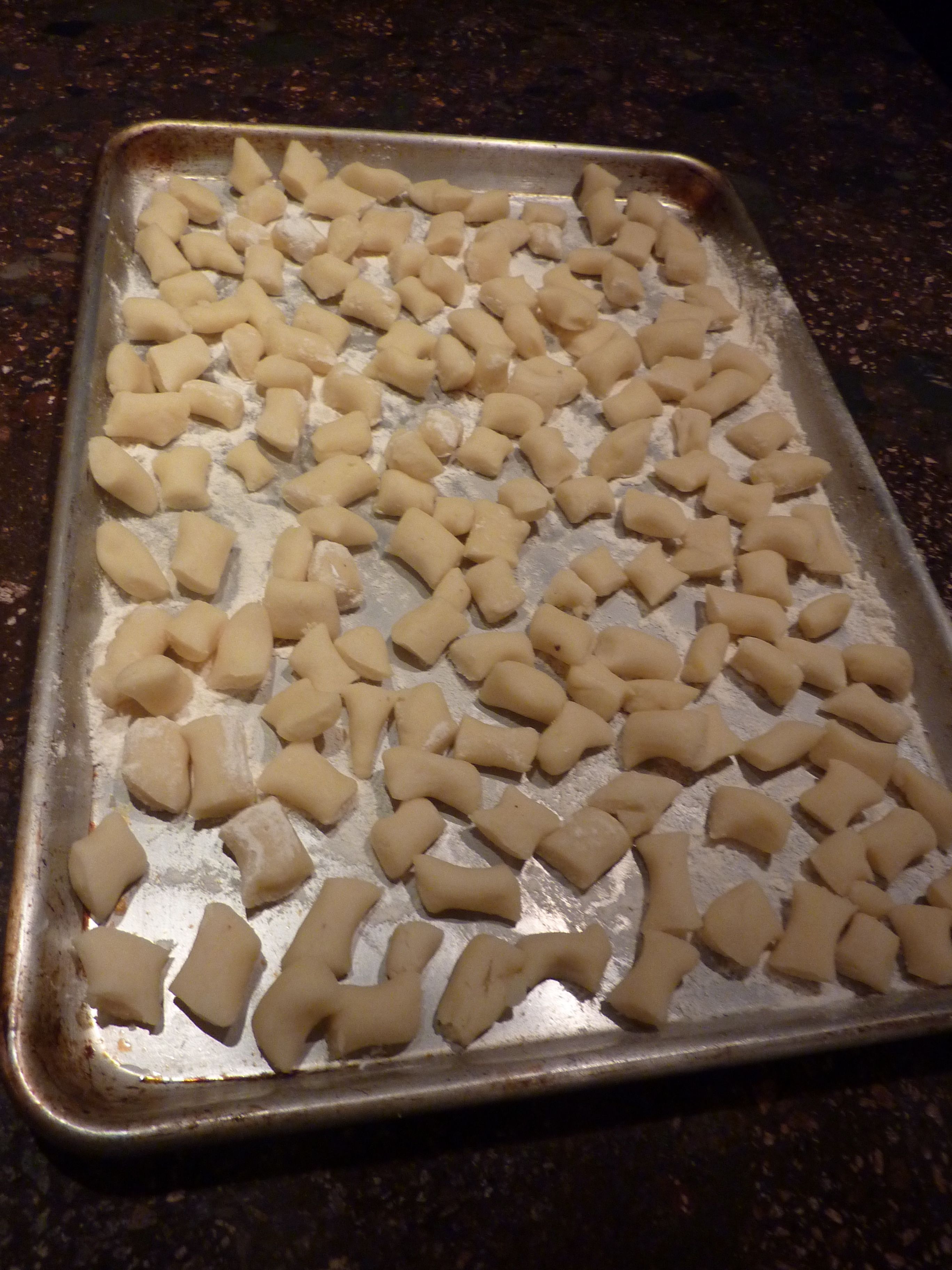
Our finished gnocchi

This recipe is a variation of one from “La Terra Fortunata”, by Fred Plotkin. I used my favorite potato gnocchi recipe, which I have posted before, by Jody Adams. Also, in “La Terra Fortunata”, the photo of the recipe indicates that speck is used, but the recipe itself does not include it. I do. Montasio cheese was not available for me, so I used a combination of cheeses from northeastern Italy, a grana and two types of Piave, a younger and a more aged (stravecchio) version.

This was one of my favorite recipes to play with – I made gnocchi with my 19 year old son Colin and his girlfriend Kelly, both visiting during his spring break. Once the potatoes are cooked, the gnocchi takes only minutes when you have a few willing hands to help. Colin is living on his own next year at college, and is looking to pick up some cooking tips. He is planning on making a big batch of these, and freezing them. But this sauce is great over pasta as well, so if he doesn’t quite get around to making the gnocchi, he’ll still have one dish up his sleeve!

ingredients ski holidays dolomites
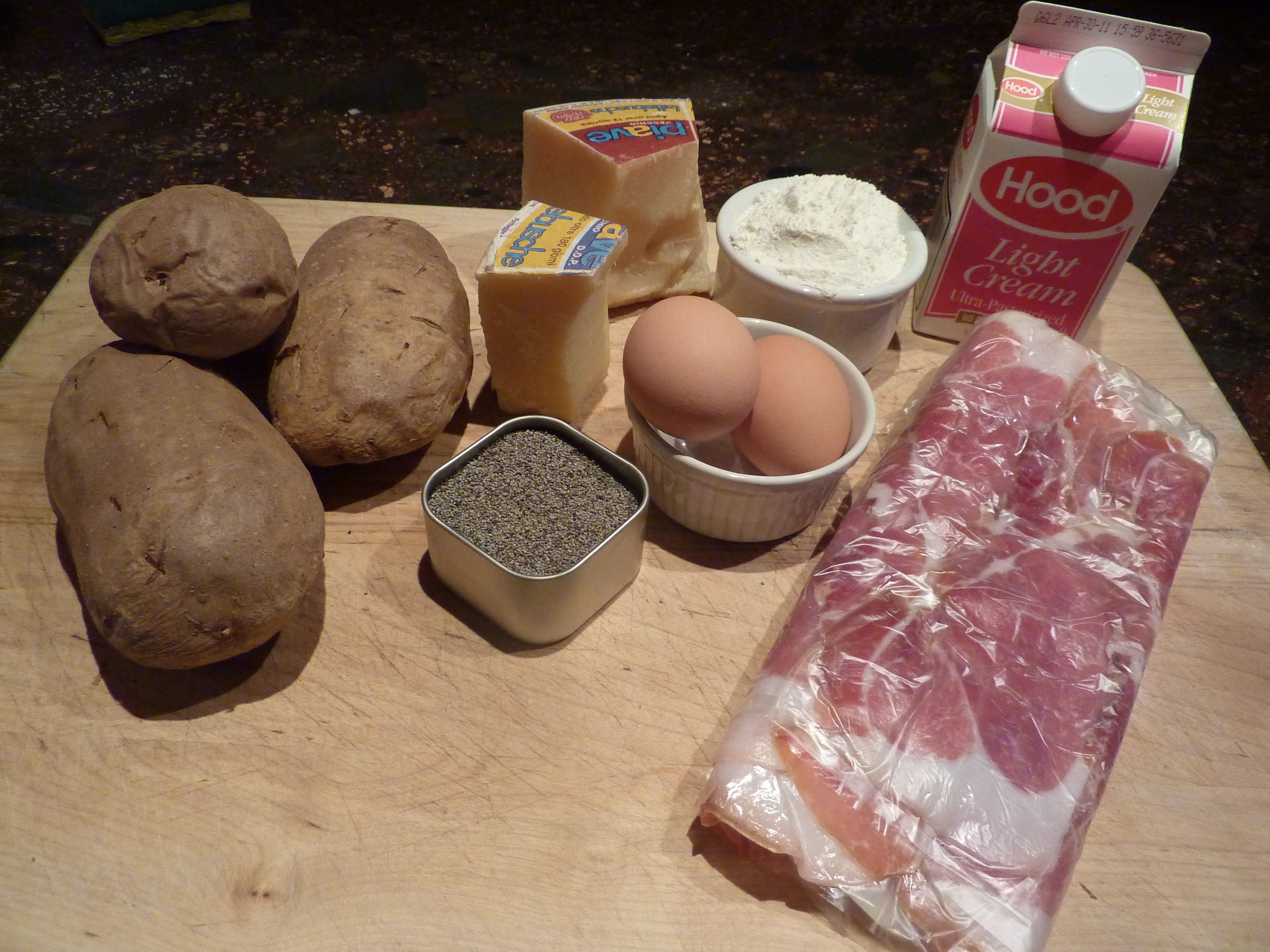
Ingredients

Gnocchi con Crema di Montasio, Speck, e Semi di Papavero

Serves 4 to 6

1 recipe Potato Gnocchi
2 cups grated cheese, an assortment of aged and semi-aged: Montasio, Piave, Grana
1/3 cup light cream
Kosher salt
1 tablespoon poppy seeds
4 ounces speck or prosciutto, roughly chopped

Set a large pot of water over high heat and bring to a boil.

Heat the cream over medium heat in a large saute pan to just a simmer. Add the grated cheese and stir gently while everything melts. Turn off the heat.

Floating gnocchi

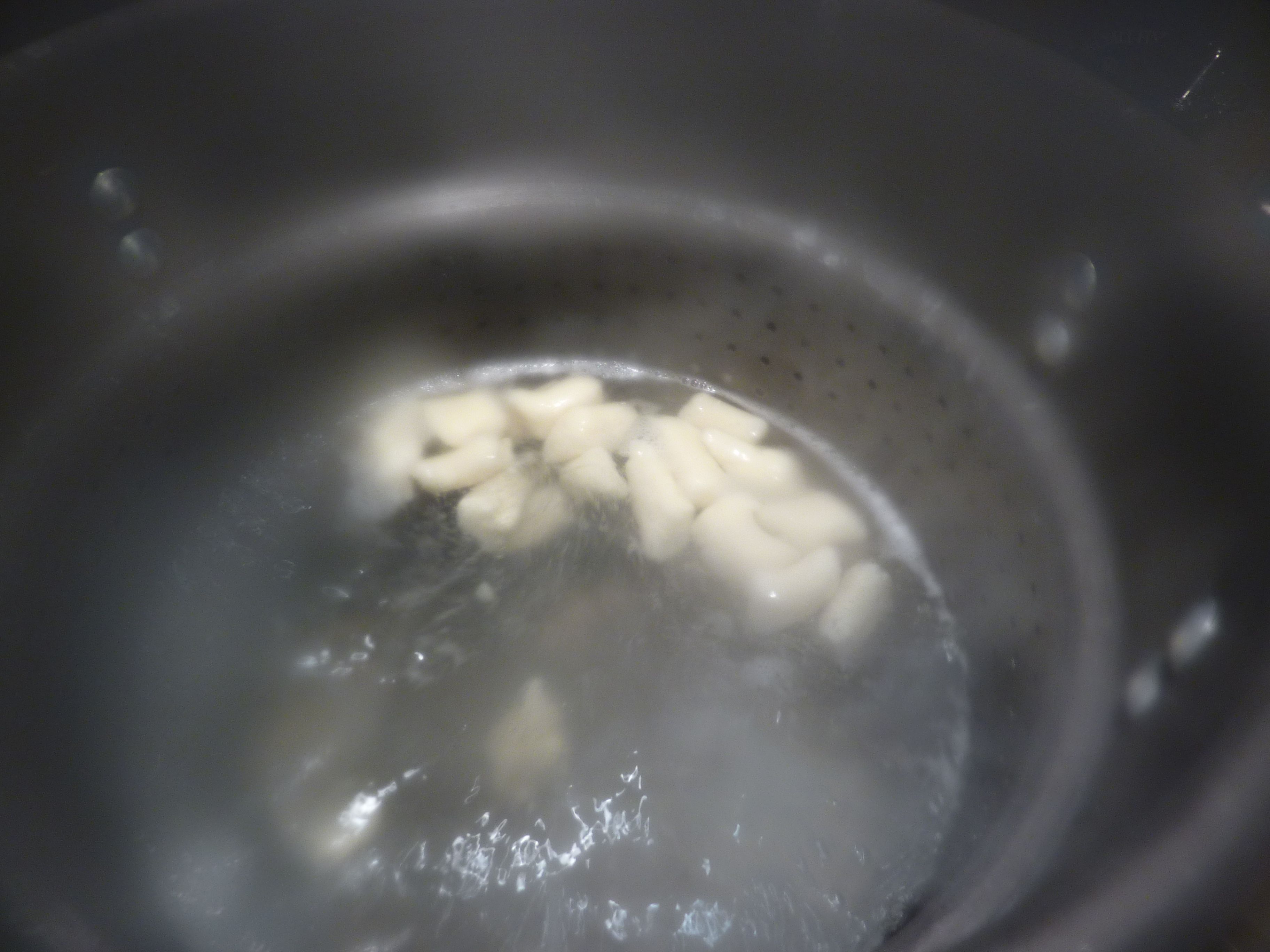
When the water comes to a boil, salt until the water is salty like sea water. Add the gnocchi to the pot. Do not crowd too much; cook in batches. As soon as the gnocchi float to the top, remove them with a slotted spoon or spider, and add to the saute pan with the cheese.

When all the gnocchi has been cooked, add the poppy seeds and speck. Turn on the heat to medium, and stir to heat through. Serve immediately.

Fred Plotkin suggests serving the gnocchi in a frico flower for a more elegant presentation. The instructions for a frico flower are below. I don’t think Colin will be using this presentation at college.

Frico Flowers

Sprinkle grana in mold

Makes 4 flowers

1 cup grated grana or Parmiggiano Reggiano cheese

Also needed:
A 7” square of plastic or cardboard
Two 5” bowls
Parchment paper or Silpat

Preheat oven to 350°.

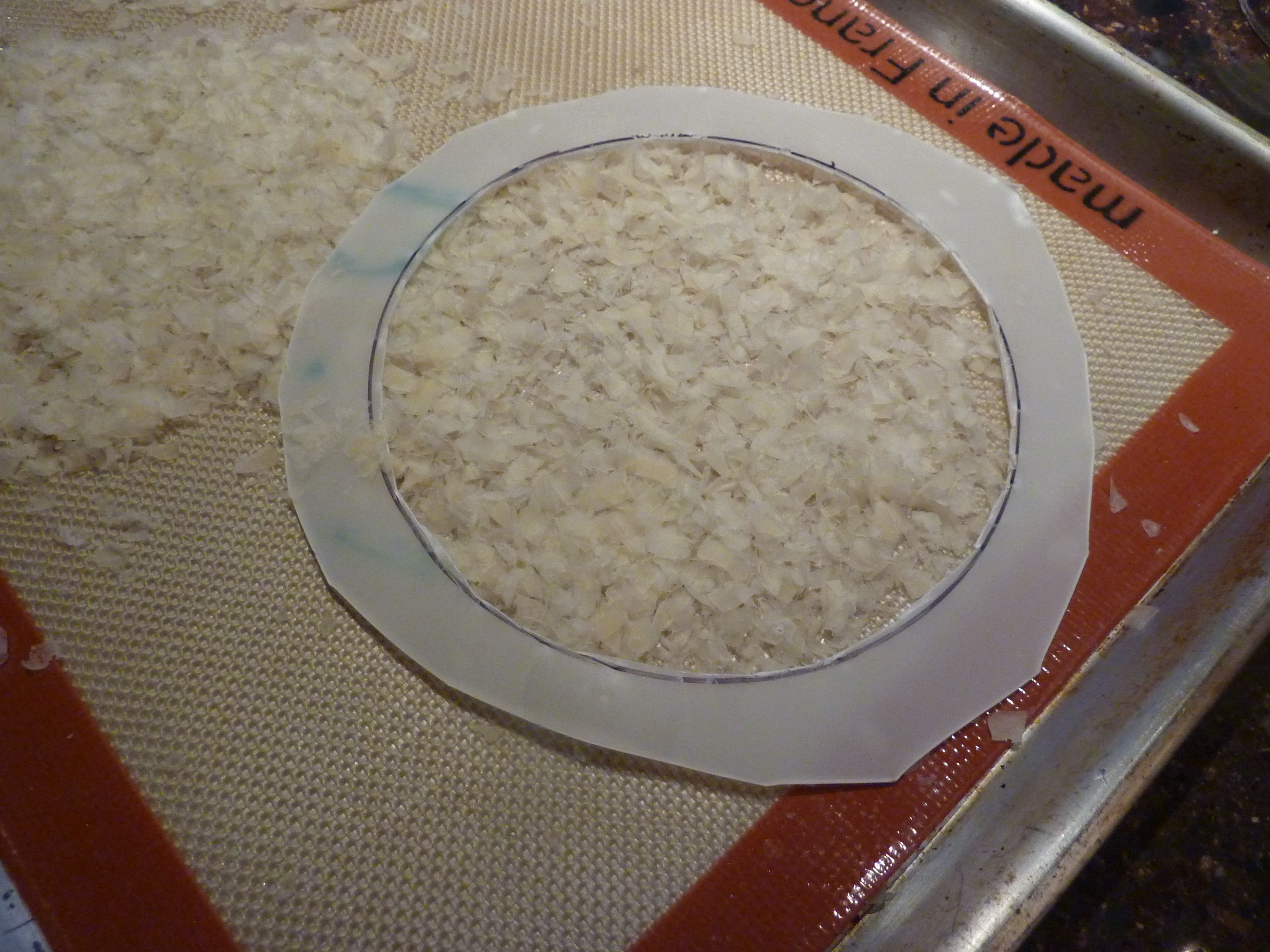
To make the mold: Using a piece of cardboard, or a sheet of plastic, cut a circle 7” in diameter. Cut a second circle, 5” in diameter, in the middle of the 7” circle. You will use the outer ring, not the 5” circle.

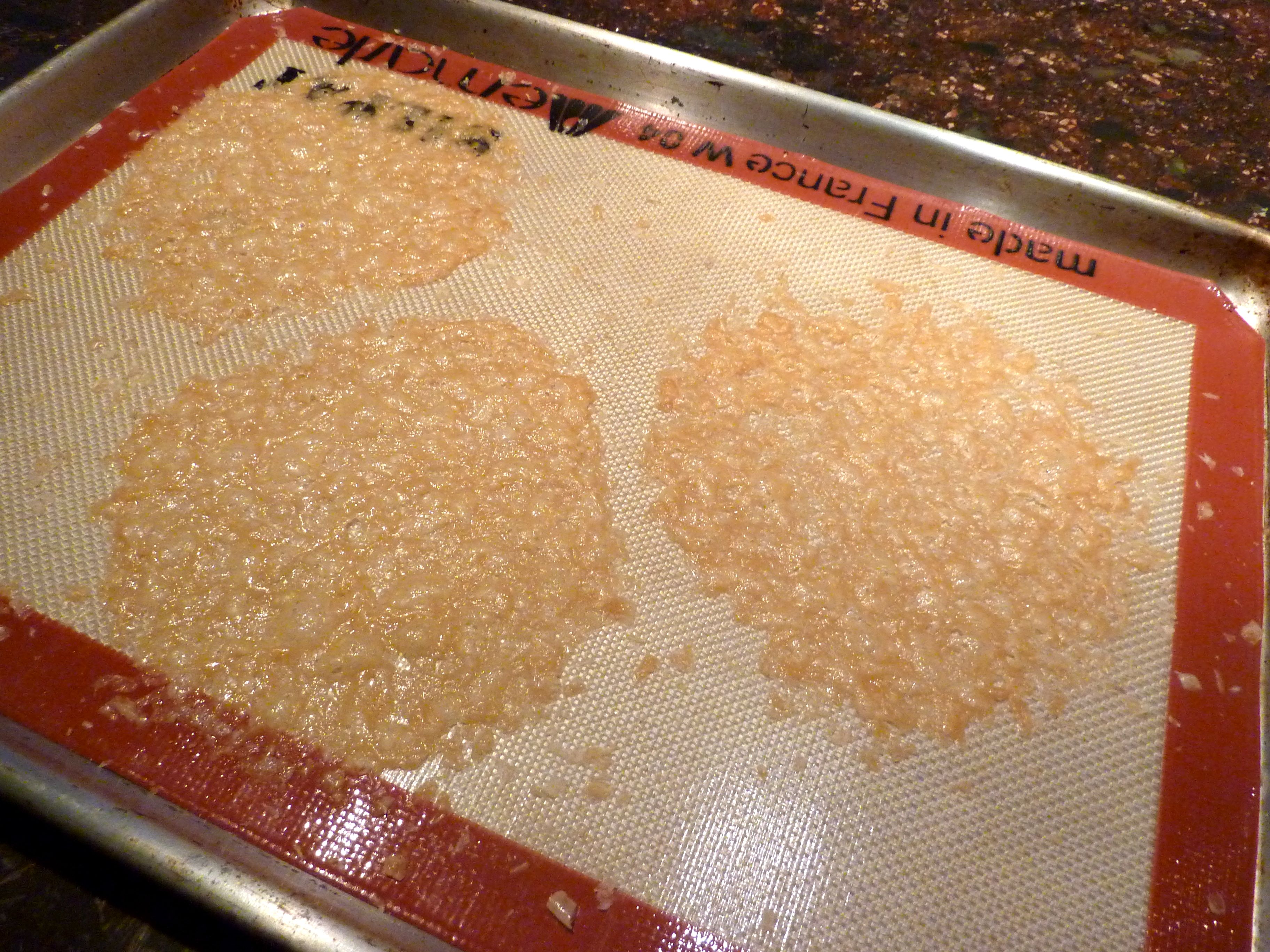
Fricos ready for transfer to bowls

Place a piece of parchment paper or a silpat on a sheet pan. Place the ring on one half of the sheet pan, and sprinkle 1/4 of the cheese in a very thin layer over the empty circle in the middle. Carefully, lift the ring off, leaving a thin circle of grated cheese. Repeat on the other side of the sheet pan.

Place the sheet pan in the oven, and cook until the cheese has melted and is just beginning to brown. Remove from oven, and quickly (the cheese needs to be warm) carefully lift each circle and place in a 5” bowl. Allow to cool, and the circle will harden in the shape of the bowl.

Repeat to make the last two flowers.

Posted in Gnocchi, Uncategorized | Tagged , , , , , , , , , , , , , , , , , , , , , , | 1 Comment

Orzotto con Funghi e Rucola

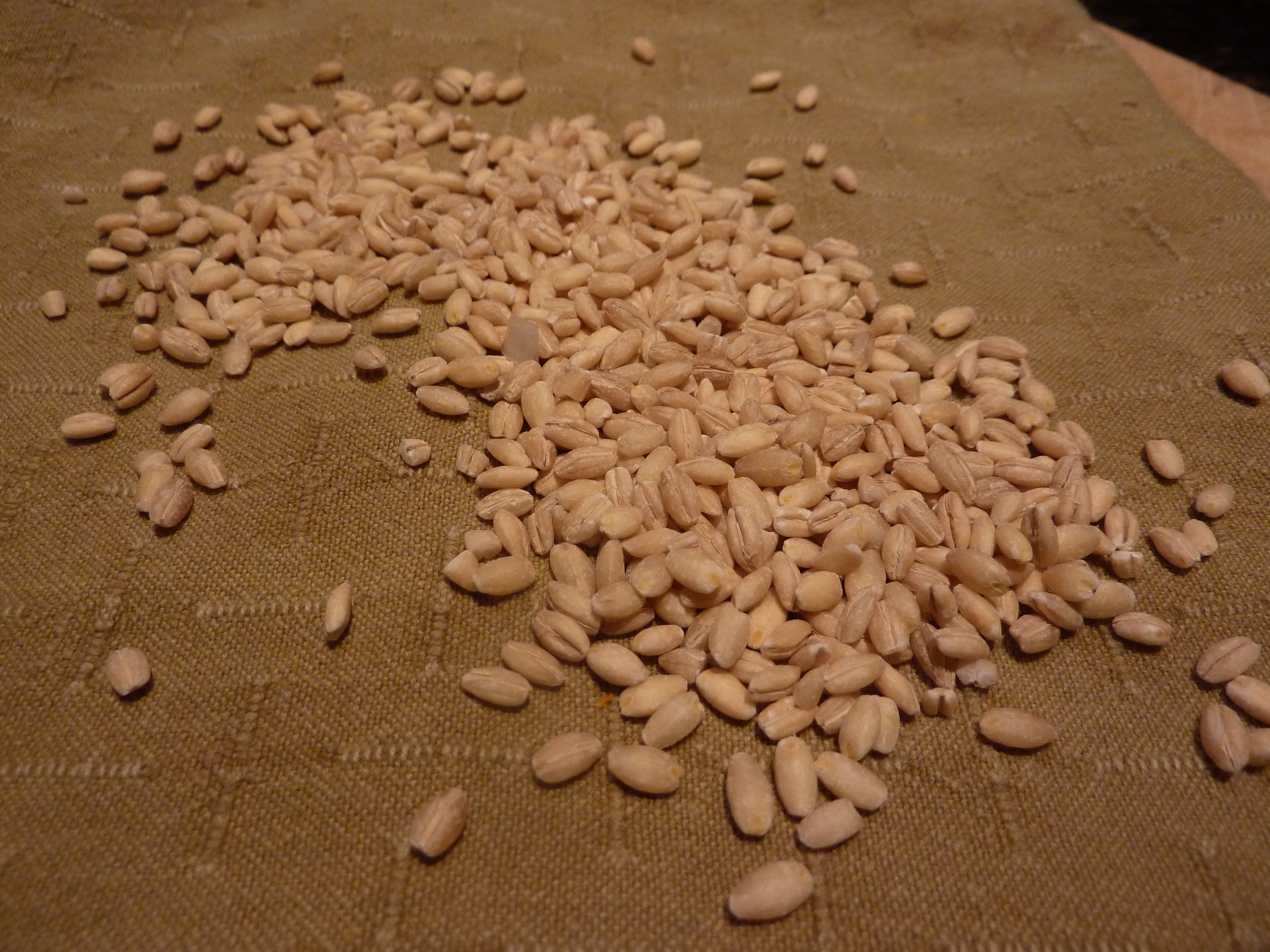
cooking class culinary bike tours italy
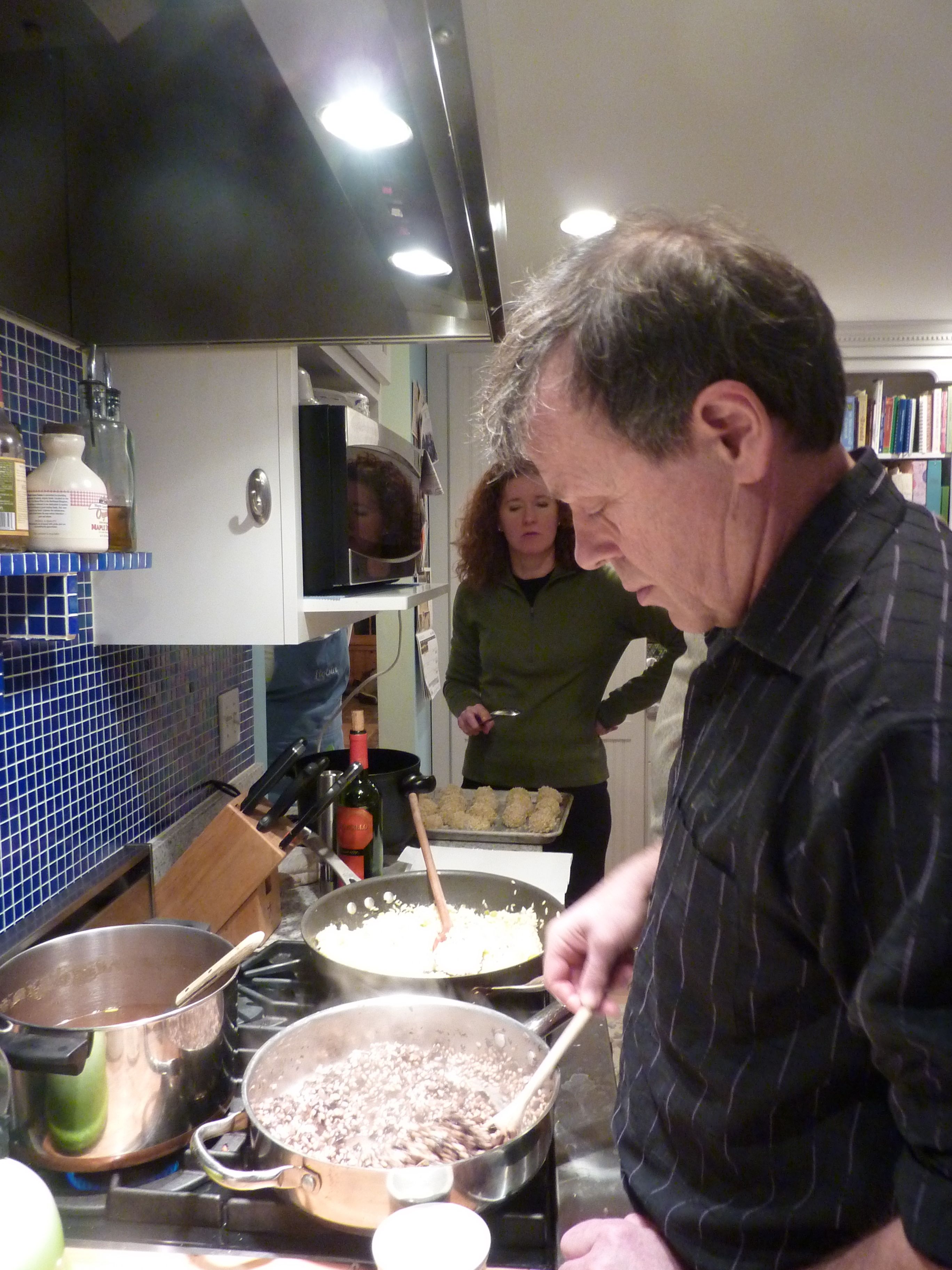
Cooking orzotto in a class

Northern Italy is well-known for its wide variety of risotto dishes made from the wonderful indigenous rices. But we can apply the same techniques to other grains, many of which are nutritionally superior to rice.

In Italian, barley is “orzo”, providing much confusion for us Americans who are familiar with a rice-shaped small pasta by the same name. To make matters more confusing, Americans make a risotto type dish from this orzo pasta. In Friuli Venezia Giulia, a very typical regional dish is a ‘risotto’ made with barley, or orzo, called orzotto. I have seen recipes in the US for an orzotto, but often these are made with orzo pasta, not barley.

barley orzo luxury villa vacation in Italy
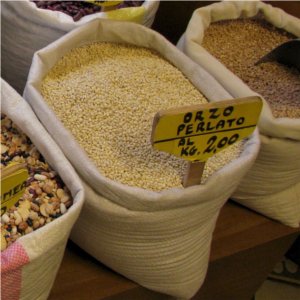
Orzo Perlato

There are two types of barley found in Italy, mondo or hulled barley, which has been minimally processed to remove the hull. It is fiber-rich, and contains several high quality proteins. Perlato, or pearled barley, has been processed further in order to remove the germ and some of the bran. The grains are rounder, and it contains about 30% less nutrients. The mondo barley is used primarily in soups. The perlato barley cooks much faster, and is more often called for in recipes than the mondo type. When cooking with pearled barley, be aware that the amount of ‘pearling’ can vary from type to type, so the cooking time can vary significantly. The more it resembles a elongated grain, the longer it will take to cook.

orzo perlato custom cycling holidays europe
Orzo Perlato at market

Barley has been cultivated in Italy since ancient times, probably one of the first grains consumed in its wild form. Roman legionnaires would march off to battle with a bag of barley, which they would later boil in their helmets, making a hearty porridge. Its’ reputation for sustaining fighting forces was widespread; according to Pliny, barley was the special food of gladiators, who were also known as hordearii, or ‘barley eaters’.

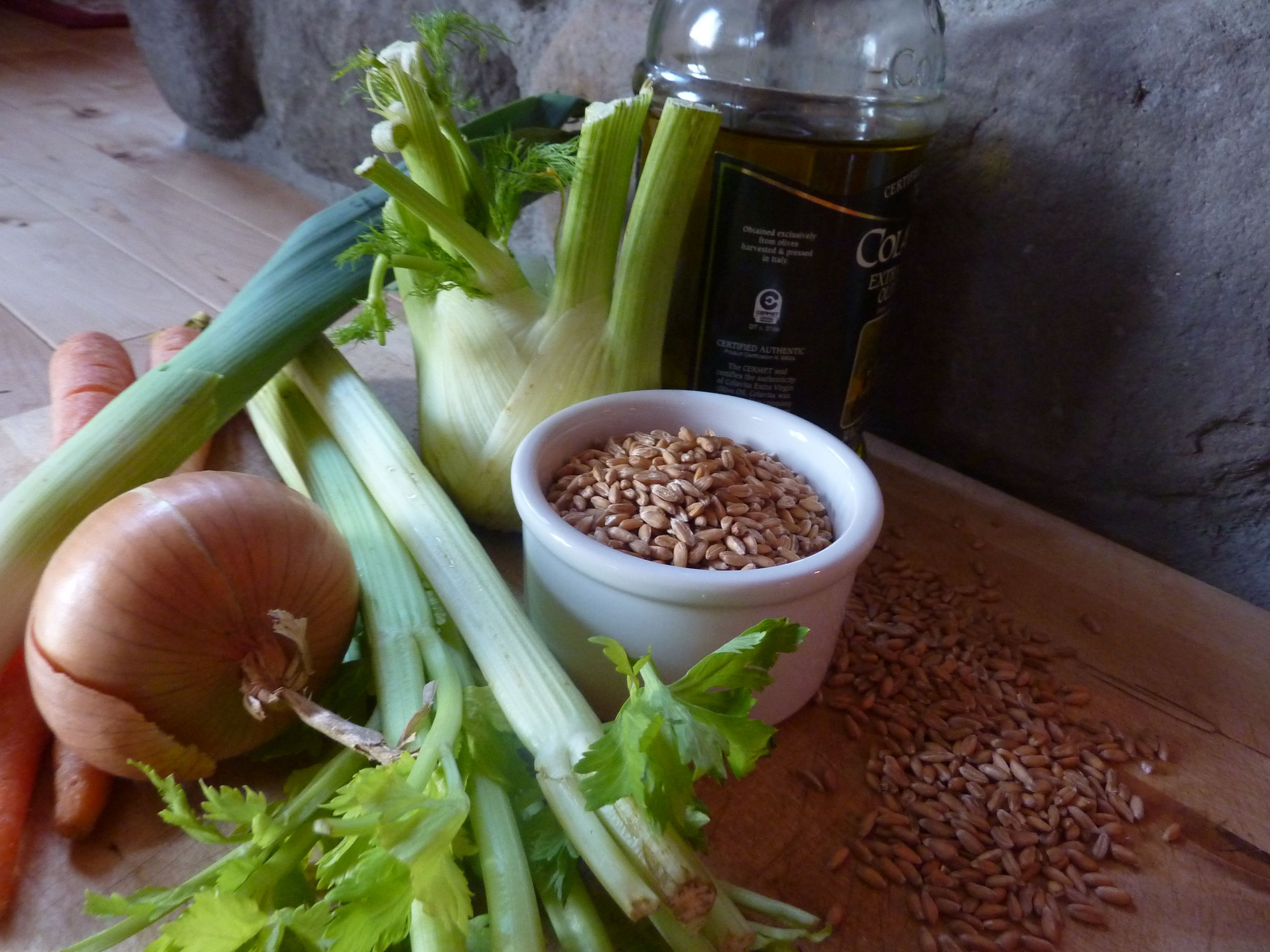
ingredients dolomites cycling tours
Ingredients

Barley is no longer a commonly found grain in the Veneto region, but it appears occasionally, in dishes like Crema d’Orzo al Latte (Barley Crema with Milk), a porridge type dish, similar to oatmeal in which barley replaces the oats. As we move north and east from the Veneto, however, we see more barley being cultivated and consumed today. It is particularly well-suited for cultivation at high altitudes, making it an important grain in the mountainous Trentino and Friuli-Venezia Giulia regions.

In Trentino, it is cultivated in the Adige valley, to the south of Bolzano. In this region, maize or corn is the most important grain, but wheat, oats and barley are grown here has well.

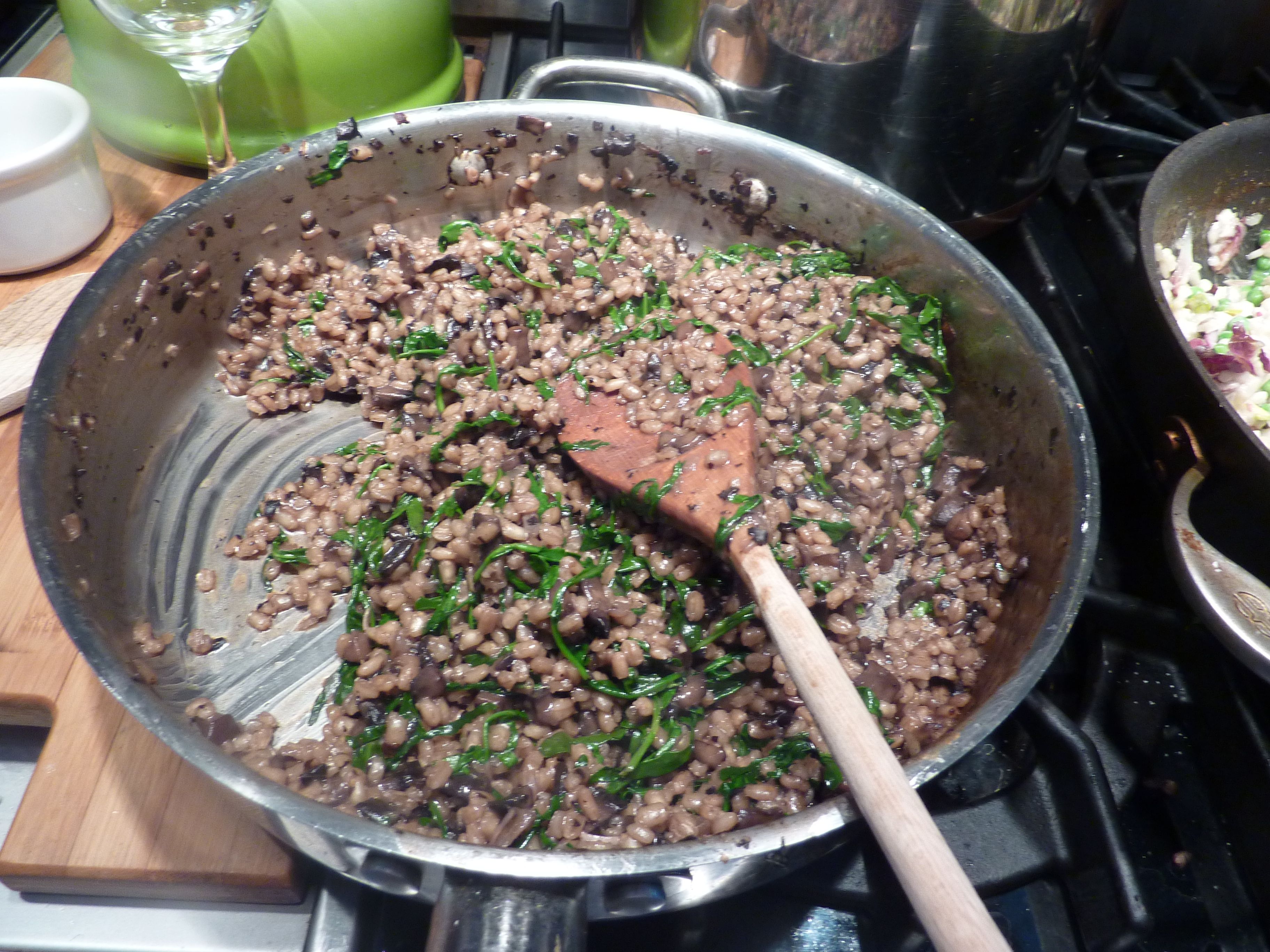
orzotto ski holidays dolomites
Finishing off orzotto

In Friuli Venezia Giulia, barley is one of the most important grains, having been introduced to the area by Jewish peoples who settled in Trieste. Here, the pasta e fagioli (pasta and bean soup) common throughout Italy morphs into orzo e fagoili, barley and bean soup. Also, risottos in this region become ‘orzotto’ when the Vialone Nano rice is replaced with orzo.

Mushroom and Arugula Orzotto

Serves 6

7 1/2 cups vegetable or chicken stock
2 tablespoons extra virgin olive oil
1 onion, minced
1 shallot, minced
2 cloves garlic, minced
3 cups mixed mushrooms, coarsely chopped
kosher salt and freshly ground pepper
1 1/2 cups pearl barley
1 cup red wine
6 cups baby arugula
1/3 cup freshly grated Parmesan cheese

Bring the stock to a boil. Lower heat to maintain a simmer.

Heat the oil in a large pan, add the onion and shallot, and cook over low heat, stirring occasionally, for 5 minutes. Add the garlic and cook until aromatic, about 1 more minute.

Add the mushrooms and cook, stirring, until they start to release their juices. Taste, and season with salt and pepper.

Add the barley. Stir and allow to toast for about 5 minutes, and then add the red wine. Cook until most of the red wine has evaporated. Reduce heat.

Add a ladleful of stock to the barley – about 1/2 cup. Cook, stirring occasionally, until most of the stock has been absorbed. Continue to add the stock, 1/2 cup at a time, and cooking until the liquid has been absorbed before adding more. The barley is finished when creamy and tender, about 35 – 45 minutes; you may not need all of the stock.

Stir in the arugula and cook until slightly wilted, about 1 minute. Stir in the cheese and butter. Season with salt and pepper.

A perfect pairing with this would be a wonderful Tocai Fruiliano, Pinot Grigio, or Pinot Bianco from Friuli Venezia Giulia.

Posted in Arugula, Barley, Manzoni Bianco, Mushrooms, Orzotto, Risotto, Soave, Uncategorized, Vegetarian, Veneto Food | Tagged , , , , , , , , , , , , , , , , , , , , , , , | 1 Comment

Colli Berici DOC Wines – our next stop, with Chef Susan Regis!

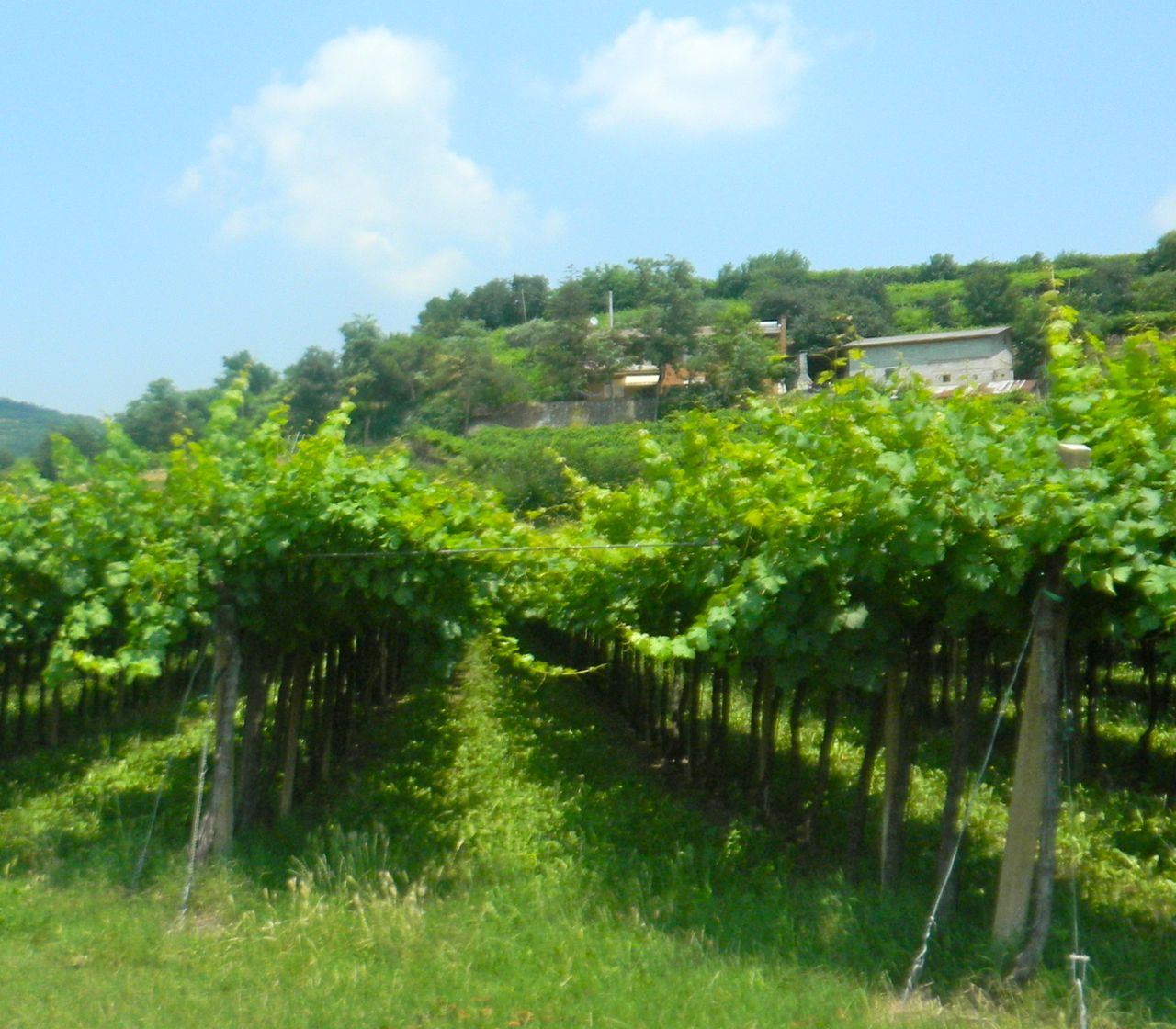
Vineyard in the Berici Hills

Located in the rolling volcanic hills just south of Vicenza, the Colli Berici DOC has been in the business of producing wines for thousands of years, but remains unfamiliar to many outside of the Veneto region. Traces of grape cultivation found in the area date back to over 3000 years BC. The volcanic minerals found in the soil here, in combination with its mild climate continue provide an idea environment for vineyards. Besides soil and climatic conditions, the quality of the wine from the Berici Hills derives from the passion of generations of wine-growers who established the Protection Consortium in 1982.

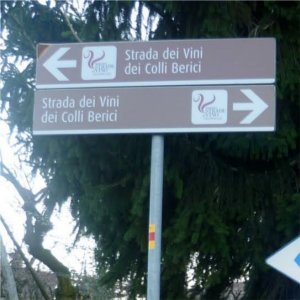
Strada dei Vini

In the Berici Hills, the Strada dei Vini (Wine Road) follows a charming itinerary along vineyards following the line where plain and hills meet. Several villas, villages, retreats and convents stand testimony to the lure the area has had throughout the ages. Còvoli, prehistoric natural caves, and fortified castles dating to tenth and eleventh centuries are treasures bearing witness to mans’ presence in these charming hills during the past ages. We are fortunate enough to have James Beard Award Winning Chef Susan Regis joining us the last week in June for a week of biking, cooking and wine tasting through the Veneto. We will spend a day riding down this very strada!

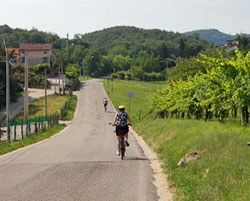
Italiaoutdoors bikes down the Strada

The Strada del Vino (Wine Road) begins in Vicenza, at the old Arch standing at the foot of the “Scalette”, the stairs leading the faithful to the Sanctuary of Monte Berico. It then passes along a section that skirts the most famous villa by Palladio, “La Rotonda”. From here, it follows the contour of the Colli (Hill) linking all the towns built at the bottom of the hills. The itinerary continues on to the outskirts of Verona and the Chiampo valley, finally ending in Vicenza.

Today, there are about 3000 hectares under cultivation, supporting a total of nine DOC wines, six whites and three reds


Whites

Chardonnay DOC: This internationally popular varietal has been cultivated quite successfully here in these volcanic hills. It is typically straw-yellow in color, with a delicate bouquet, and a dry, harmonious, fruity taste. It is typically aged in stainless steel, and can be used pure, or mixed with a slight quantity of Pinot Bianco. It pairs well with fish and rice dishes.

Garganego DOC: This varietal is an indigenous grape that is grown from the Verona Hills to the Berici Hills, and is the grape used in the well-known Soave wine. It also exhibits a straw-yellow color, with a dry, slightly acidic taste. Again, it pairs well with fish, as well as pasta and rice dishes with more robust sauces, and especially with the local baccala vicentina.

Pinot Bianco DOC: The DOC wines from this varietal are produced either from 100% Pinot Bianco grapes, or can include a small quantity of Pinot Grigio. This wine has a lighter straw-yellow color, and a delicate flower and fruit bouquet. It is best served cold, and pairs well with shellfish.

Sauvignon DOC: Another internationally popular variety that has been successfully cultivated here in the volcanic soil of the Berici Hills. Straw yellow in color, with a slightly vegetal aroma, and a dry, full-bodied taste. Pairs well with first courses and fish.

Spumante DOC: A sparkling white wine, and the newest DOC wine in the Berici Hills. It contains at least 50% garganego grapes, with Pinot Grigio, Pinot Bianco and Chardonnay used as blending grapes. It has fine and lingering bubbles, with a fresh dry taste.

Tocai Italico or Tai Bianco DOC: Produced using the indigenous grape of the same name, with occasionally a little garganago blended in, this white wine is again straw yellow in color, with a harmonious, dry, and tangy flavor. It is wonderful as an aperitif, or paired with first course dishes.

Reds


Cabernet DOC: The bordeaux grapes have been quite successful since being introduced to the Berici Hills. The Cabernet Colli Berici DOC uses Cabernet Sauvignon and/or Cabernet Franc grapes. A Cabernet DOC qualifies for the “Reserve” label if it has undergone three or more years of aging, six months of which must be in wooden casks. These wines are deep ruby red, tending toward orange as they age. They are dry, full-bodied, and robust with strong tannins. The pair well with roasted red meat dishes, as well as strong cheeses.

Merlot DOC: Another bordeaux grape makes a strong appearance in this area, producing a slightly less intense red wine. Ruby red, with a velvety, full-bodied, harmonious flavor that pairs well with robust pastas with meat sauce.

Tai Rosso or Barbarano DOC: A DOC produced from the indigenous Tocal Rosso grape, a close relation to the Sardinian cannonau or French grenache varietal. Before 2007, the name was Tocai Rosso, but has been changed to avoid confusion with the Hungarian varietal of the same name. It is produced around Barbarano Vicentino and the surrounding towns, and so is sometimes named after the town itself. It is clear and brilliant, with a bright red color, and a balanced, harmonious taste with a hint of cherries. It pairs well with pasta and rice dishes, braised white meats and grilled meats.

Posted in Colli Berici, Uncategorized | Tagged , , , , , , , , , , , , , , | Leave a comment